You Used to Call Me on Your Space Probe: Drake Equation

Personally, I love the Drake Equation. I think it’s extremely interesting to ponder, and it fascinates me that there are ways to roughly predict life within the Milky Way. However, I feel like the equation should be approached more so as a means to think about life rather than an actual mathematical equation. Rather than using this to accurately predict the exact number of possible life forms out there, it should be used to critically examine methods by which we should be working on expanding that could advance our search for life. From what I’ve read, this is the reason that the equation was created. However, it seems as if some people take it too literally, leading to confusion and extreme criticism.

The thing that never fails to fascinate me about this equation is its ability to determine the optimism (at least space wise) of a person. For a lot of people in our class, their numbers were extremely high; however, others were extremely low. Since the product one receives from the equation is purely based on the estimates he or she makes based on his or her own thoughts on the possibility of life, the number is very telling. My number was pretty high, mostly because I have infinite amounts of hope about the possibility of life.

All in all, my main hope for this post, though, is that the humor of the title is not lost by anyone. In case you didn’t understand it upon first reading, it is a play on Drake’s “Hotline Bling,” which has lyrics that read, “You used to call me on your cellphone.” I thought it was funny.
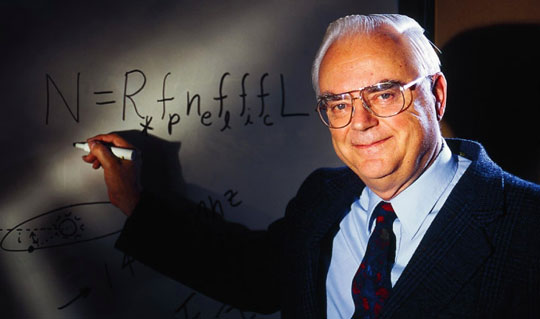
drake-frank-at-board-540px

Here is the man himself, Frank Drake, posing with his equation.

drake-hotline-bling-00

For reference, here is a screenshot from the Hotline Bling music video.


Posted in Class, Space Travel, Universe | Tagged , , | Comments Off on You Used to Call Me on Your Space Probe: Drake Equation

Color in the Universe

The iconic "pale blue dot" image of Earth taken by the Voyager 1 spacecraft, from a distance of 3.7 billion miles in 1990. Earth is the speck halfway down the brownish streak to the right. The streaks are artifacts, caused by the scattering of sunlight in the probe's optics. Credit: NASA

The pale blue dot is Earth, but what if Earth is the only planet that gives off that specific color? While other exoplanets can and have mimicked the pale blue color, a broader portion of Earth’s overall spectrum shows a rather subtle signature that can only be attributed to life. Earth’s blue color comes from the transparent atmosphere. Transparent atmospheres are more likely to scatter blue light as opposed to red light, thus making the sky look blue. The scattering blue light can be seen from space also, so Earth appears blue to external observers as well.

Other planets are capable of duping scientists with their own pale blue colors. Many types of worlds, including gas and ice giants, planets with atmospheres of varying thickness, and words with “hydrogen dominated or thick, water-steam envelopes.” There is even speculation that Mars could have also been a pale blue dot in the past, when it had a thicker atmosphere. However, with Earth’s specific spectral signature in mind, the color has never been duplicated.

Spectroscopy would be able to confirm the atmospheric content of other worlds. If the world has an atmosphere rich in oxygen blended with other abundant molecules that could only be there due to life. Currently, the telescopes at our disposal can only detect and obtain the colors of young, gas giant-sized planets, leaving more work to be done in observing exoplanets and determining habitability based on color.


Posted in Class, Exoplanets | Tagged , , , | Comments Off on Color in the Universe

Contact: The Third Answer to Fermi’s Paradox

contact

The Fermi paradox posits that there are only three possible answers to the question “Where is everybody?” in terms of the search for other intelligent life in the Universe. The three possibilities are as follows:

  1. We are alone
  2. Civilizations are common, but no one has colonized the galaxy
  3. There is a galactic civilization, but it has not yet revealed its existence to us

The 1997 film Contact, based on the book by Carl Sagan, deals with this paradox in a way that I find extremely interesting. In the film, Jodie Foster’s character, who works for SETI, intercepts a signal coming from Vega that is repeating a sequence of prime numbers. She then receives a radio signal that is producing Adolf Hitler’s speech from the 1936 Summer Olympics in Berlin. The signal also includes plans to build a machine to take one person on a voyage to Vega. When Foster goes into the machine, she is taken on a wild ride through the Universe, sees parts of Vega, and is then taken to a beautiful beach where an alien appears to her in the form of her father. The alien does not answer most of Foster’s questions about life in the Universe, but does tell her that this is the first step for humanity to join other spacefaring species.

This film then advocates in a creative way for the third answer to Fermi’s paradox. It took 60 years for the signal to come back to Earth that had been first sent in 1936 because the Vega star system is 26 light years away. But once the signal came back, humans were able to build this advanced machine and make contact with other intelligent life, thus being introduced to the galactic civilization as a whole. This presents the idea that intelligent life is out there, but just has not yet shown itself to us, or made contact. This is by far my favorite answer to Fermi’s paradox, as I simply cannot believe that we are alone, and I would like to imagine that other civilizations have advanced more than we have. Contact is definitely a great film, and if you haven’t seen it, check it out this summer!

Posted in Aliens, Space Travel, Universe | Tagged , , , | Comments Off on Contact: The Third Answer to Fermi’s Paradox

Contact: The Third Answer to Fermi’s Paradox

contact

The Fermi paradox posits that there are only three possible answers to the question “Where is everybody?” in terms of the search for other intelligent life in the Universe. The three possibilities are as follows:

  1. We are alone
  2. Civilizations are common, but no one has colonized the galaxy
  3. There is a galactic civilization, but it has not yet revealed its existence to us

The 1997 film Contact, based on the book by Carl Sagan, deals with this paradox in a way that I find extremely interesting. In the film, Jodie Foster’s character, who works for SETI, intercepts a signal coming from Vega that is repeating a sequence of prime numbers. She then receives a radio signal that is producing Adolf Hitler’s speech from the 1936 Summer Olympics in Berlin. The signal also includes plans to build a machine to take one person on a voyage to Vega. When Foster goes into the machine, she is taken on a wild ride through the Universe, sees parts of Vega, and is then taken to a beautiful beach where an alien appears to her in the form of her father. The alien does not answer most of Foster’s questions about life in the Universe, but does tell her that this is the first step for humanity to join other spacefaring species.

This film then advocates in a creative way for the third answer to Fermi’s paradox. It took 60 years for the signal to come back to Earth that had been first sent in 1936 because the Vega star system is 26 light years away. But once the signal came back, humans were able to build this advanced machine and make contact with other intelligent life, thus being introduced to the galactic civilization as a whole. This presents the idea that intelligent life is out there, but just has not yet shown itself to us, or made contact. This is by far my favorite answer to Fermi’s paradox, as I simply cannot believe that we are alone, and I would like to imagine that other civilizations have advanced more than we have. Contact is definitely a great film, and if you haven’t seen it, check it out this summer!


Posted in Aliens, Space Travel, Universe | Tagged , , , | Comments Off on Contact: The Third Answer to Fermi’s Paradox

(milky) way up, I feel blessed

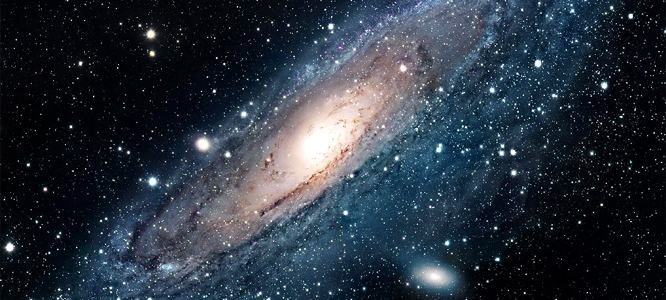
the universe.jpg
The Universe

This semester has been vital to understanding of the universe around me. Coming for Intro to Astronomy last semester, I felt that I had a pretty comprehensive basis upon which to build. What I didn’t realize coming in however was just how much more I was going to learn. The level of detail about not only our Solar System but also the entire universe this course has provided me with has given me a whole new perspective about the universe. I already knew I was small in comparison to the entirety of the universe from last semester, but this course has made me realize just how much is going on in the expanse of the universe. Every planet, moon, and star is unique, and each has its respective place and role in the universe. This course has also cemented m prior belief that we aren’t alone in the universe. I find it hard to believe that in the entire universe we are the only form of life because even if it was chance that created us I think it’s likely that chance did the same thing somewhere else in the vast expanse of the universe. Maybe I’m just optimistic (As I have been told on multiple occasions and in multiple situations), but this course really gave me an appreciation for my existence and the existence of the people I love and care about. In the grand scheme of things, I may just be a random assortment of matter that may not matter in 300 years (I hope not), but for now I’m going to make my blip of an existence matter because who knows what’s coming in the future. This class has given me that outlook, and honestly I am very appreciative of that.


Posted in Class, Universe | Tagged , , | Comments Off on (milky) way up, I feel blessed

A Semester Reflection

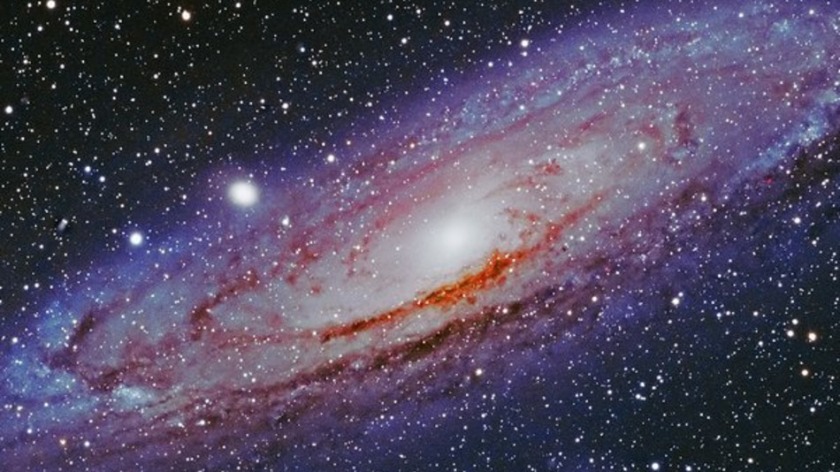
m31-galaxy1
Central Coast Astronomy

Taking astronomy this semester has been awesome. I’ve always loved space but had never previously had the chance to learn about it in a formal setting.

It’s unfeasible for us humans to have a real understanding of the size of the universe – numbers like “billions of light-years” are impossible fully grasp when the only measures we have experience with are the relatively very tiny ones we know on Earth. Classes like this make it a bit closer to being possible, though. While I’ll never really wrap my head around the number of galaxies and stars in our wide cosmos, I now have a much deeper appreciation for that vastness, even if I’ll never truly understand it.

Something that is a core part of my identity is my Catholic faith, and it’s been quite wondrous looking at all of this material through that lens as well. To know that this expansive universe is so much bigger than me is a humbling reminder that my God is so, so huge and great. While I know a lot of scientists have different thoughts on spirituality and religion, for me it only increases my awe at this insanely complex universe in which we dwell.

This class challenged me more than I thought it would, and I’ve learned so much. I recently found myself pointing out the phase of the moon to my friends – a clear indicator that I really enjoyed this semester.

Signing off!


Posted in Class | Tagged , , , | Comments Off on A Semester Reflection

Propulsion Methods

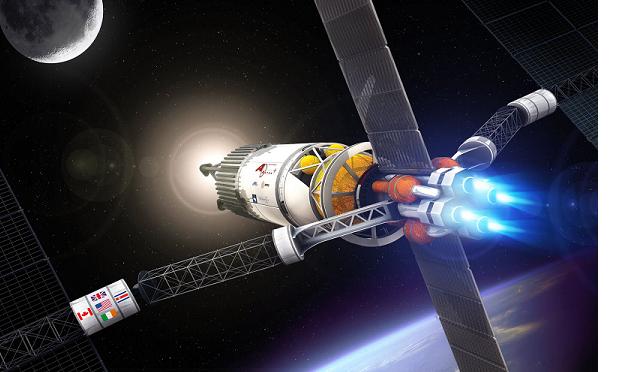
in_space_prop_plasma_rocket

Image Source

In the class, we talk about the measures to accelerate spacecraft and satellites that one day may make interstellar travel possible for humans in their lifetime. And in this blog I would like to introduce some other practical and hypothetical propulsion methods.

The first method is a practical one called ion thruster, a kind of electrical propulsion that produces thrust by hastening ions with electricity. The relatively high charge/mass ratio of the ions indicates that relatively small electric potential difference can lead to very high exhaust velocities. Thus, the required amounts of reaction fuel are greatly reduced and ion thrusters can then attain extremely high specific impulses. The disadvantage of this method is that it must use an external power source and when leaving Earth, a large radioisotope thermoelectric generator must be employed to accelerate the spacecraft.

The second method is a hypothetical one called Alcubierre warp drive. According to this method, humans can create a wave to contract the space before the spacecraft and expand the space behind it. The ship would then be carried along with this so-called “warp bubble” region because of the movements of the drive and may even achieve speed faster than that of light. However, the mechanism of Alcubierre warp drive indicates energy density, which means the feasibility of such method largely depends on the existence of specific kind of exotic matters.


Posted in Class | Tagged , , , | Comments Off on Propulsion Methods

Drake Equation

One of the most interesting things that we have covered this semester is the Drake Equation. This equation uses probability to estimate the number of active, communicative extraterrestrial civilizations in the Milky Way Galaxy. What I like most about this equation is that it might not actually be very practical, but it is a good way to stimulate an interesting, scientific dialogue. I learned that I am fairly optimistic (at least relative to my classmates). When using 15 billion as the number of possible stars in the galaxy, I came up with about 128 possible civilizations. If we increase the number of stars to 200 billion, the number of civilizations would go up greatly. While it is likely that we will never have proof of other civilizations (at least in our lifetime), it is interesting to think about how it is likely (at least according to probability) that hundreds or even thousands of other intelligent life forms exist in our galaxy. Combine that with the fact that there is a hundred billion galaxies in the universe, and it becomes even more obvious that we are not alone.


Posted in Aliens, Class, Universe | Tagged , , | Comments Off on Drake Equation

Where is everyone?

fermi-paradox-cover
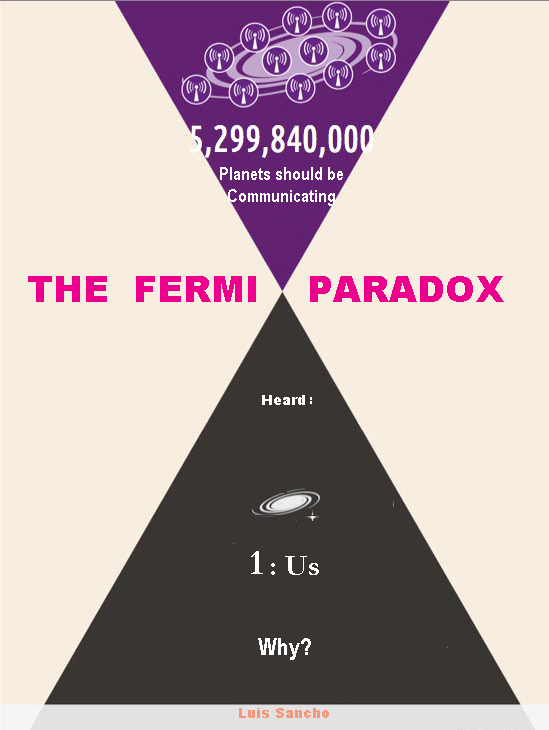
The Fermi Paradox, a.k.a. why are we the only communicating civilization we know of? Source

This past couple weeks, we spent time looking in-depth at the Drake equation, a hypothetical equation that uses estimation to “calculate” how many communicating civilizations there likely should be within any one galaxy. Using accepted values for each variable within the Drake equation, this number is roughly 30 for one galaxy. That number multiplied by the number of galaxies in the universe makes that estimation many orders of magnitude higher.

However, we have yet to actually see or communicate with any of these supposed civilizations, which raises the question: where are they? The Fermi paradox is the observation that despite the 500 quintillion (theorized) Sun-like stars in the universe, we have yet to find any other intelligent life. There a few explanations that I can think of for this.

  1. There just aren’t any. We’re a cosmic coincidence and the only ones of our kind.
  2. The life that exists in the universe isn’t intelligent. It’s bacteria or amoeba, life forms that are unable to do anything beyond exist and reproduce.
  3. The universe is just too big. Any intelligent, communicating civilizations out there just haven’t been able to reach us (or vice versa)
  4. We can’t detect other forms of communication. Radio may be an Earth-specific communication technique; other forms may be harder to detect.
  5. Time isn’t on our side. The Great Filter suggests that after a certain amount of time, civilizations are destined to implode in on themselves. If that’s true for us, it’s true for every other civilization. Perhaps other communicating civilizations have just died out before we were able to communicate with them.

Posted in Aliens, Universe | Tagged , , , | Comments Off on Where is everyone?

Half Empty or Half Full?

I was super excited when I saw the prompt for this blog assignment (not just because it was the last blog assignment)! Sometime last semester I was talking to one of my fellow physics major about Artificial Intelligence and at somehow we ended up talking about the Fermi Paradox (which I had recently read this cool article on).

Basically, Enrico Fermi (read the article though, guy was a physics boss) was like hey guys, something is rotten in the state of Denmark. In the galaxy, there are billions of stars like our Sun that are way older and they should have Earth like planets with intelligent life and even if they move at a snail’s pace, they should be able to cross the entire Milky Way in a million years. So why haven’t we seen them?

There are many offered solutions to this paradox, but one of my favorites is the Zoo Hypothesis, which says that other lifeforms exist and they know of us, but we haven’t reached some milestone they deem necessary before they contact us (for reasons of not wanting to throw our development off kilter). This is very similar to the Prime Directive on Star Trek. I also think it’s one of the lesser frightening alternatives. As it makes other civilizations seem benevolent.

Other possible solutions argue that other lifeforms know that it is unsafe to make contact for all sorts of different reasons. Who knows? Personally, as frustrating as it is, I kind of like the mystery and I’ll feel sorry for those who don’t experience it, as I think it adds to the sense of wonder of the universe. People in olden days would have been amazed by the concept of traveling cross country in a manner of days or even hours yet we don’t even think about any more today. The idea that the same could become of the universe itself is sad.

“But you don’t have to take my word for it.” Read some of the hyperlinked articles or watch these brief summaries!


Posted in Class, Physics, Space Travel | Tagged , , , , , | Comments Off on Half Empty or Half Full?