The Dwarf Planet Sedna

According to Inuit mythology, Sedna was the name of a mortal woman who became a goddess of the ocean and the underworld. One version of the myth holds that Sedna was a young woman who consented to marry a hunter, only to find, once she had left home with him, that he was in fact a seabird who had lied to her. When her father came to visit, she begged that he take her home. He killed the seabird husband and they fled in his boat, but other birds pursued them and created a storm. Sedna’s father threw her overboard to calm the ocean. She sank to the deepest, coldest reaches of the sea to hold sway over all sea creatures and to guard the spirits of the dead. It was her name that was chosen for the dwarf planet Sedna, which, at the time of its discovery, was one of the farthest objects known orbiting the sun.
sedna-orbits-580x580

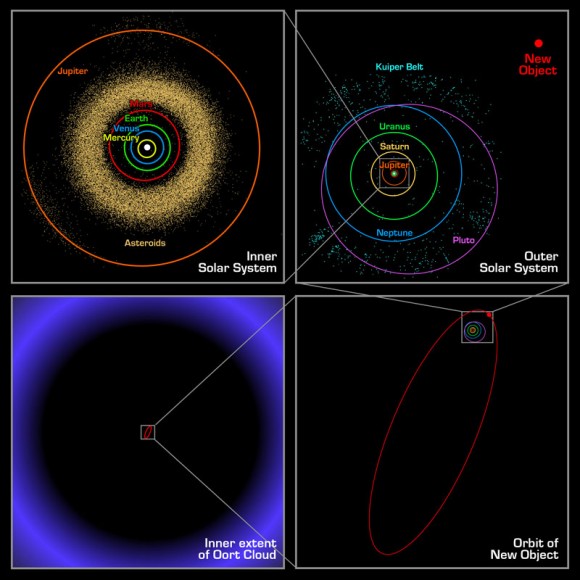
The orbit of Sedna compared to other bodies in the Solar System. Sedna is the “New Object.” 

The dwarf planet Sedna was discovered in 2003 by researchers from Caltech and Yale University using the Samuel Oschin Telescope at the Palomar Observatory. It was observed as moving in a highly eccentric orbit about 100 AU from the Sun. It is believed to be around 1,600 kilometers in diameter, making it the fifth largest trans-Neptunian object at the time, and it is thought to take as long as ten to twelve thousand years to orbit the Sun.


Posted in Class, Dwarf Planets | Tagged , , , , | Comments Off on The Dwarf Planet Sedna

Rocky Planets Shouldn’t Get This Big…

Planetary formation theorists are scratching their heads at the recent discovery of the largest rocky world found to date – BD+20594b. This exoplanet is a rocky world with a diameter half that of Neptune. With a planet that size, one may think that we were talking about a gas giant, but we’re not.

According to our present theory of planetary formation, an exoplanet the size of BD+20594b would attract a large amount of gas and become a cored gas giant, but the planet has not followed this behavior. Kepler 10c, one of the first exoplanets discovered by the Kepler Mission, is another large planet (though not quite as large as BD+20594b) that has not surrounded itself in galactic gas.

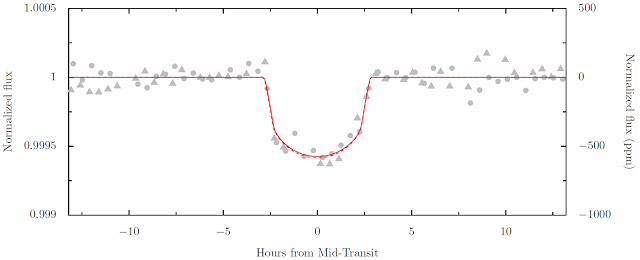
Planetary_luminosity_chart
A graph of how BD+20594b displaces luminosity in its host star. Courtesy of Espinoza (2016).

The Kepler Mission has only observed a very small portion of the observable universe, and already we have found “Super-Earths” half the size of Neptune that are primarily rocky in composition. Studying these planets over time will allow astronomers and astrophysicists to refine planetary formation theories and perhaps understand how other planetary systems are different from our own.

The two major theories that could explain the nature of BD+20594b are:

  1. The planet formed late in the system’s formation when there was little to no gas that could be absorbed.
  2. The planet once had an atmosphere/gas shell that was stripped by a massive impact.

Question Time

What are your thoughts? How does this new planet fit into our current theory of planetary formation? How would you explain the existence of BD+20594b?

*Featured Image courtesy of JPL-Caltech/NASA – acquired from Universe Today


Posted in Exoplanets, Universe | Tagged , , | Comments Off on Rocky Planets Shouldn’t Get This Big…

Pluto’s Heart

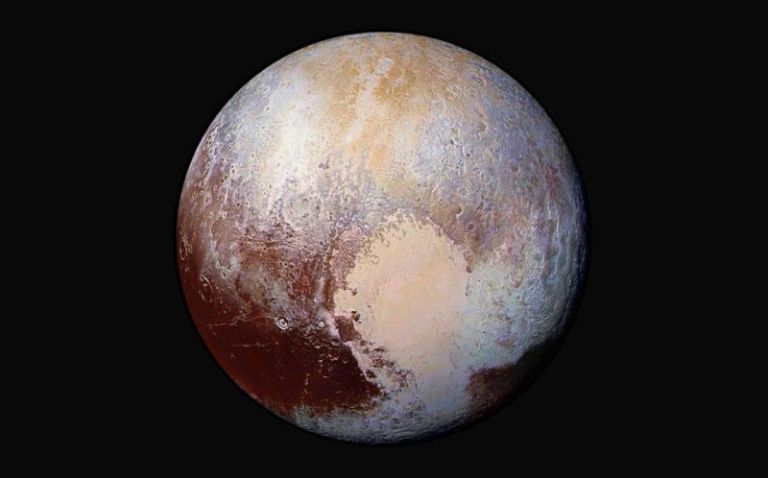
l2z7mwq3ngbnsytdvtwf

The Tombaugh Regio, nicknamed “Pluto’s Heart” (pictured above), is one of the most extensively studied features of the dwarf planet. Thanks to NASA’s New Horizons spacecraft, we can get a closer glimpse into the heart-shaped bright spot on Pluto’s surface.

More recently, New Horizons Principal Investigator Alan Stern has theorized that Tombaugh Regio is the result of a violent impact. Furthermore, the impactor that could’ve caused such a massive crater is likely somewhere in the range of 10 km across.

The New Horizons flyby has given us a look at Pluto that we could’ve never achieved using telescopes near or on Earth. We could certainly stand to learn more about the diverse geological surface of Pluto if we could get a satellite in orbit around the dwarf planet.

Image Source

Source


Posted in Class, Universe | Tagged , , , | Comments Off on Pluto’s Heart

The Mystery of “Hot Jupiters”

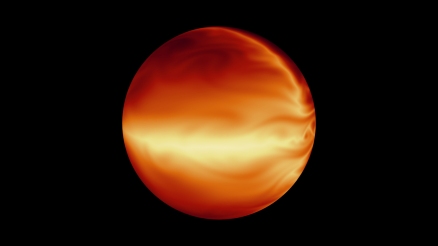
Over the last decade, astronomers have discovered thousands of exoplanets, many of which have gone against our current understanding of planet formation. Most of these exoplanets orbit very close to their star, as these are the easiest to discover since they block out more light from their respective stars than planets orbiting farther out do. However, many of these planets orbiting at around the same distance that Mercury orbits the Sun are around the size of Jupiter. They have been dubbed “Hot Jupiters” due to their proximity to their stars and their massive sizes, yet it makes little sense as to why they formed. How could a gas giant form so close to a star and still have a perfectly circular orbit?pia20066

Recent studies have theorized that these “Hot Jupiters” originally have incredibly eccentric orbits, coming very close to their star and then swinging out far into space only to return hundreds of days later. This could explain how they become so large as they move from very cold to very hot regions of their star systems quite frequently. The main issue is that almost all of these exoplanets we have observed to this date have been in perfectly circular orbits, so something must have changed. It is hypothesized that the gravitational force from nearby planets and stars push these gas giants into a more circular orbit over hundreds of millions of years. While these “Hot Jupiters” are intriguing on their own, it is clear that we are still limited by our technological capabilities and can only find massive exoplanets or exoplanets that are close to their star. It is awe-inspiring to wonder what the future holds as it pertains to the discovery of exoplanets (Source: NASA).


Posted in Exoplanets, Galaxies, Universe | Tagged , , , , | Comments Off on The Mystery of “Hot Jupiters”

The Possibility of Life on Enceladus

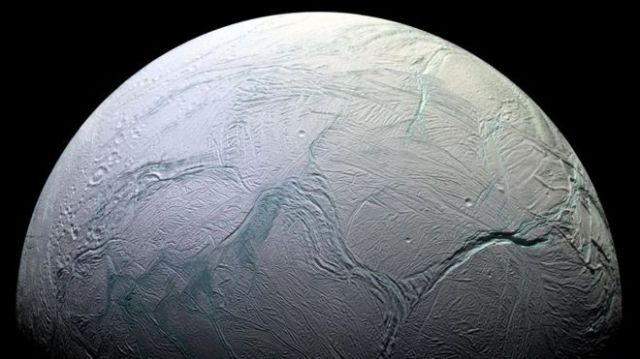
enceladus

One question that still excites both amateur and professional astronomers is the possibility of life on other worlds. Certain important elements, however, must be present in order for organic life to exist. Enceladus, one of Saturn’s icy moons, has an underground ocean that may be a source of life, either sometime in the ancient past or perhaps currently. Moons like Enceladus and Jupiter’s Europa could be sources of life because of the tidal energy they receive from the gas giants they orbit and the fact that they contain liquid water. Scientists are attempting to study the pH of the water on Enceladus in order to test its acidity to determine whether it could support life. Although the pH of the water can’t be tested directly, scientists can measure the pH of the plumes coming off Enceladus in order to make assumptions about the pH of the water itself. Astronomers have found that the pH of Enceladus’s ocean is similar to that of alkaline soapy water.

Scientists believe this alkaline pH comes from the process of serpentinization, in which a magnesium and iron-filled rock converts to clay-like materials at hydrothermal vents such as the ones found on Earth. This process produces hydrogen gas, which can be a source of organic life at these vents. Last October, the Cassini spacecraft did a flyby to specifically study the chemical composition of the plumes of Enceladus. Perhaps we will learn from this study just how likely the possibility of current life on Enceladus really is.

More information on this topic can be found here.

Posted in Aliens, Jovians, Moons, Observables | Tagged , , , | Comments Off on The Possibility of Life on Enceladus

The Possibility of Life on Enceladus

enceladus

One question that still excites both amateur and professional astronomers is the possibility of life on other worlds. Certain important elements, however, must be present in order for organic life to exist. Enceladus, one of Saturn’s icy moons, has an underground ocean that may be a source of life, either sometime in the ancient past or perhaps currently. Moons like Enceladus and Jupiter’s Europa could be sources of life because of the tidal energy they receive from the gas giants they orbit and the fact that they contain liquid water. Scientists are attempting to study the pH of the water on Enceladus in order to test its acidity to determine whether it could support life. Although the pH of the water can’t be tested directly, scientists can measure the pH of the plumes coming off Enceladus in order to make assumptions about the pH of the water itself. Astronomers have found that the pH of Enceladus’s ocean is similar to that of alkaline soapy water.

Scientists believe this alkaline pH comes from the process of serpentinization, in which a magnesium and iron-filled rock converts to clay-like materials at hydrothermal vents such as the ones found on Earth. This process produces hydrogen gas, which can be a source of organic life at these vents. Last October, the Cassini spacecraft did a flyby to specifically study the chemical composition of the plumes of Enceladus. Perhaps we will learn from this study just how likely the possibility of current life on Enceladus really is.

More information on this topic can be found here.


Posted in Aliens, Jovians, Moons, Observables | Tagged , , , | Comments Off on The Possibility of Life on Enceladus

Global Astronomy Month!

Wow! April is quite the month. The sun is shining, finals are approaching, and it is Global Astronomy Month (GAM)! Prior to this class, I didn’t know April was GAM. However, today I was trying to decide what to write my blog about, and I stumbled upon an article about GAM. From my research, I’ve gathered that GAM is run by an organization known as “Astronomers Without Borders” and provides astronomy lovers worldwide a forum to learn and discuss different aspects of astronomy.

One of the coolest things, in my opinion, that happens during GAM is OPTICKS, a project in which images are sent to the Moon and bounced back to Earth as radio signals. The title of the project is rooted in Newton’s work with light spectrum. The project focuses on the connection between image and sound, something I rarely connect in my every day life. OPTICKS will be occurring April 9 and the live performance will be available for viewing on Youtube.

Something else I’m really looking forward to during GAM is the Faces of Astronomy segment. This portion of GAM is going to focus on spotlighting different people from the Astronomers Without Borders community, from those who merely consider astronomy to be a hobby, to those who have dedicated their entire lives to studying the cosmos. I think this is an extremely cool way to connect those in the astronomy community. Sometimes, it can feel intimidating to be part of the worldwide astronomy discussion if you are simply an astronomy student. Faces of Astronomy will give every day star lovers a place to shine (pun intended) in the astronomy world!

GAB

Above is the logo for GAM. I love how there are people in the foreground and stars in the background, all connected in a circle. The symbolism present is out of this world!


Posted in Class, Universe | Tagged , | Comments Off on Global Astronomy Month!

The Solar Shepherds

Rings. It’s what many senior girls are looking for right now, just as graduation approaches. Spring brings the rings, right? The giant planets, however, sport perhaps the most breathtaking rings of all.

What many won’t notice about rings of giant planets, such as Saturn, are its imperfections.

Saturn’s Rings

The darker regions of the rings do not necessarily mean that the rings are made out of darker substances, like the rings of Neptune, which are made out of extremely dark material. The regions in which Saturn’s rings appear dark are actually spaces that have less icy material and particles; that is, less sunlight is reflected in these regions because there is not a comparably large amount of the material present to do so.

Then, where did all that material go? And why does the darkness appear in such uniform, straight patterns?

The answer: shepherds. Yes, objects present in Saturn’s rings (as well as the rings of the other giant planets) actually herd these particles into straight lines around the planet. In order for this event to work, there must be two moons, or satellites, present. One, the outer moon, steals orbital energy from the particles present in the ring around it. This, in essence, “pushes” the particles closer toward the planet – allowing the particles to fall into lower orbits. At the same time, the other, inner moon gives these particles orbital energy. This projects them into the higher orbits, though these orbits are slower than the lower orbits. The push and pull from both moons creates “pressure” on both sides of a section of rings, herding the icy particles into a nice, straight strand.

liU4R89
Saturn’s Shepherd Moons

 The image above shows the effects of the moons’ power in the form of ripples. Yet, we still get nice bands (or flocks, if you will) of icy particles, all thanks to these shepherds.


Posted in Class, Moons | Tagged , , | Comments Off on The Solar Shepherds

Extrasolar = ExtraSPECIAL?

By far, the coolest thing there is about extrasolar planets is the possibility of discovering another Earth. Of course, this is merely an opinion of my own, but I’d like to think that a lot of people agree.

Statistically speaking, it is not only possible but also extremely probably that there is another Earth in our universe and even our own Milky Way. According to Wikipedia, here are the numbers: if there are 200 billion stars in the Milky Way, and each star has at least one planet (presumably 1-5 that are similar to Earth), there are 11 billion possibilities for Earth like planets. And that’s JUST in our galaxy. While not all Earth-like planets will have intelligent life, of course, it is definitely a possibility, purely from a statistical standpoint, that at least one of them does. And to me, that would be enough. The possibilities, in my opinion, are totally endless.

I can’t determine my emotions about this. On one hand, this makes me feel really satisfied; I think it would be absolutely horrifying if we were the sole forms of intelligent life in the entire universe. On the other hand, I’m so creeped out by this prospect. While I don’t want to be alone here, the thought of a planet billions of light years away existing and functioning just like us is spooky to say the very least. Very, very spooky.

At the end of the day, it seems as if only time will tell whether or not we are alone here on Earth. The only issue is, what if we cease to exist before we ever know the real truth?

Planets_everywhere_(artist’s_impression)

This crazy cool image is an artist’s depiction of how many planets there truly are, based on the amount of stars that exist. Wowza!


Posted in Class, Exoplanets | Tagged , | Comments Off on Extrasolar = ExtraSPECIAL?

What is the Fermi Paradox?

calvin_fermi

The Fermi Paradox, first proposed by physicist Enrico Fermi, addresses the question, “where is all the intelligent life in the universe?” It might seem that the answer to this is obvious; life is incredibly rare. But let’s just run a few numbers anyway.

The low-end estimate of how many stars are in just in our own galaxy is 100 billion planets. There is roughly the same number of galaxies in the observable universe. This means that there are roughly 1022 stars in the observable universe. The percentage of Sun like stars is debated and is generally determined to be from 5 – 20%. Assuming again that we go with the low-end estimate, 5%, there are 520 sun like stars. Then lets deal with the number of sun like stars that have an earthlike planet in the habitable zone. According to some studies this can be as high as 50% to as low as 20%. Lets again use the low-end estimate and we arrive with the number of 100 billion billion (1019) Earth-like planets orbiting Sun-like stars. This is roughly equal to the number of grains of sand… in the world… times 100. If we assume that 1% of Earth-like planets orbiting Sun-like stars develops life that’s 1017 planets with life. And if only 1% of those planets evolve into intelligent life we are left with a mere 10 million billion (1015) intelligent civilizations in the observable universe. But other galaxies are sooo far away. Even if we found someone out there we would take a very long time to make contact with them. So lets shrink it down to our neighborhood, the Milky Way. If we divide 1015 by the 400 billion Galaxies in the observable universe we are left over with a “feeble” 100,000 intelligent civilizations in our galaxy. And yet no one has ever made contact with us, ever. Where is everybody and what does this imply about our past and our future. This complex puzzle is the Fermi Paradox.

Source


Posted in Aliens | Tagged , , , | Comments Off on What is the Fermi Paradox?