As climate change heats up, Arctic residents struggle to keep their homes

The Guardian published an intriguing article today regarding climate change and the huge impact it is having on our planet. More specifically, the impact it is having near the North Pole. It describes the rising temperatures and rising sea levels and the impact that this has on people residing in this area. The scariest part? Those impacted aren’t foreigners: they’re Americans. “This winter, both January and February brought record low coverage of arctic sea ice” the article states.

The article tells the story of Mr. Wilson Andrew, a resident of Atmautluak Alaska, who’s house is close to being underwater as a result of rising sea levels. This winter has been particularly warm, in fact the warmest January and February on record.

As we learned in Chapter 10, climate change and global warming are a result of our human actions. We emit billions of tons of greenhouse gases into the atmosphere, and greenhouse gases hold hot air low in our atmosphere rather than letting it be released. Moreover, our actions have caused damage to the ozone layer, allowing more UV radiation to reach us here on earth. While the Ozone layer has been improving, global temperatures have still been rising at a significant rate.

Screen Shot 2016-03-15 at 6.55.22 PM.png
Mr. Andrew’s home in Alaska

Posted in Observables | Tagged , , | Comments Off on As climate change heats up, Arctic residents struggle to keep their homes

Dating the Solar System?

No,  I’m not referring to taking our Solar System out to a romantic dinner and movie. What astronomers and physicists are interested in is the age of our Solar System. And given the vastness and inaccessibility of most of the Solar System, revealing the true age of it has proven to be quite the challenge.

Astronomers have, however, been able to estimate the age of the Solar System via radiometric dating. Usually we think of using radiometric dating to determine the ages of rock layers, but this technique can also be used for extraterrestrial objects (specifically, asteroids).

Asteroids are used for radiometric dating because its rock matter has been largely undisrupted since their creation. This is crucial, because if rock is melted or homogenized, its radiometric dated age will be lower than its true age. This is why we can’t simply use rocks on Earth or on the Moon to estimate the Solar System’s age. Another reason asteroids are dated is that asteroids regularly come into contact with the Earth through meteor showers. Additionally, asteroids were likely formed at about the same time that the Solar System was born, which makes it a great candidate for analysis. Unlike radiometric dating for rocks layers on Earth, elements with longer half lives (700 million to 100 billion years) such as potassium and uranium are used. With this method, double checked against analyzing the age of the Sun, the Solar System has been estimated to be about 4.6 billion years old.

en_image009
Radiometric dating of Meteoroids and Moon rocks

While it’s great that we’re able to determine a fairly accurate age estimate of our immediate neighborhood, aging galaxies or even the universe is a whole different story. Because we don’t have meteors from faraway galaxies hurling towards the Earth, we can’t use radiometric dating. But that’s a topic for another post.


Posted in Observables | Tagged , , , | Comments Off on Dating the Solar System?

A Mission to Smell Mars

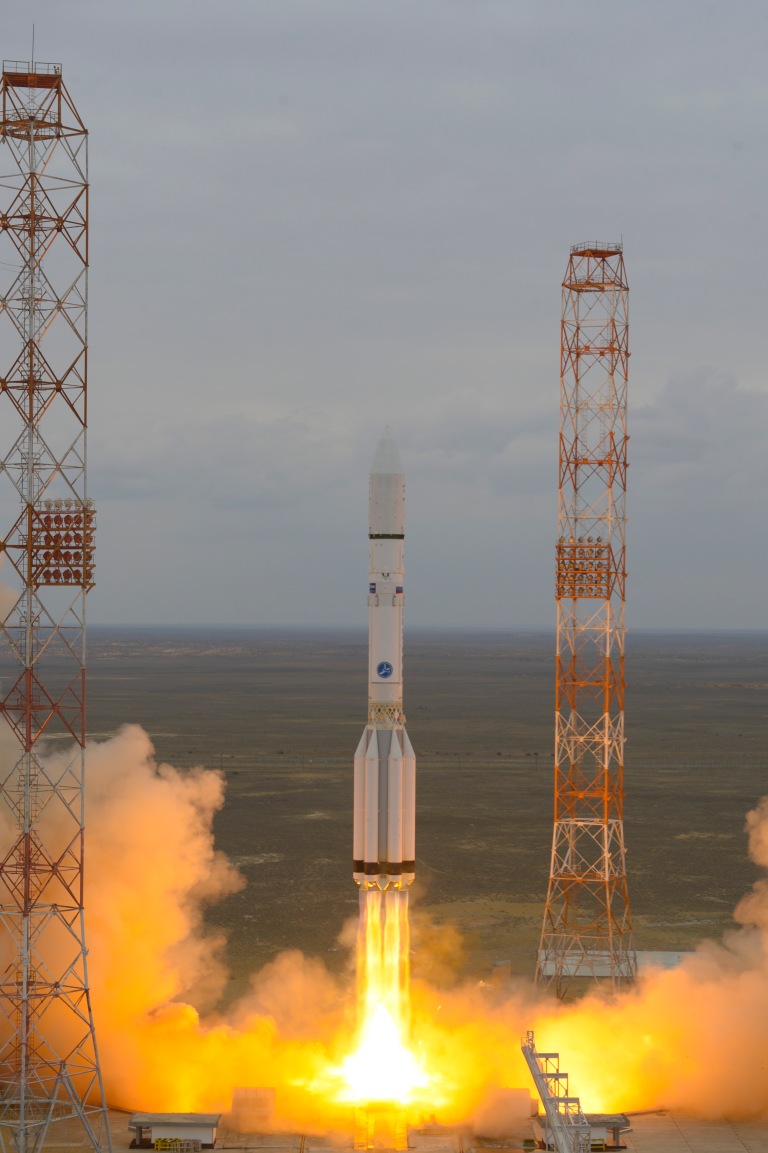
ExoMars 2016 Launch campaign
Launch of the first ExoMars Spacecraft

Exciting news out of the European continent this week, a joint mission to Mars sponsored by Russia and the European Space Agency is successfully underway. Blasting off from its launch pad in Baikonur, Kazakhstan on March 14th, 2016, the first spacecraft in the ExoMars mission began its approximately seven-month trip to Mars’ atmosphere. The main goal of the $1.45 billion project? The detection of methane gas and other trace substances in the martian atmosphere. Methane is a biproduct of microbial life and if unexpectedly high levels are detected in the martian atmosphere the data could be seen as groundbreaking new evidence of life on Mars.

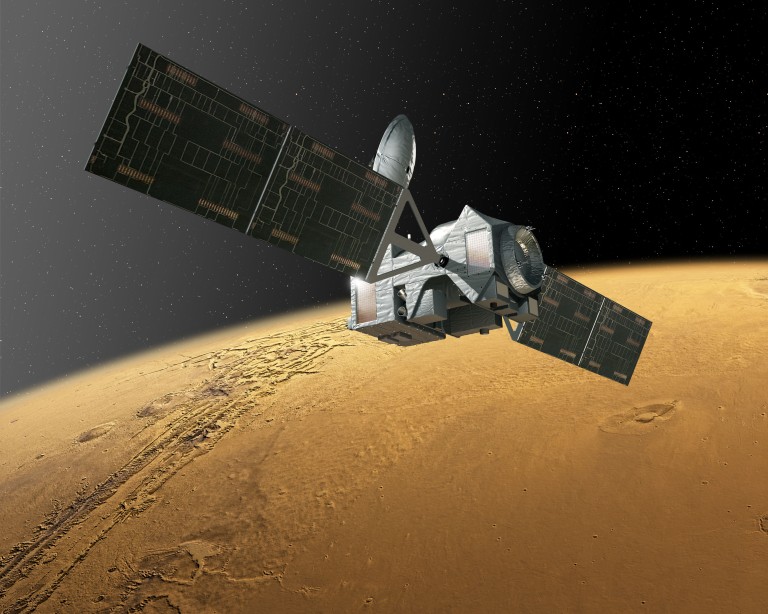
Trace_Gas_Orbiter.jpg
Trace Gas Orbiter

A specially designed probe dubbed the “Trace Gas Orbiter” (TGO) will be responsible for carrying out the important investigation as it circles the red planet over the next six years. Other goals of the mission include mapping future landing destinations for rovers, monitoring martian weather patterns, and a demonstration of the next generation “Schiaparelli Lander” which will deploy to the planet’s surface upon the spacecraft’s October arrival date.

This mission represents an unprecedented level of international cooperation in the midst of increasingly complicated crises such as the Syrian Civil War, the economoc collapses of Spain and Greece, and the Russian annexation of Crimea. Despite such issues, the ESA has emerged better funded and equipped than ever with many missions planned in the near future. Will the ESA and Russia be able to outspend and outpace the US to be the first to detect life on Mars? Only time and the TGO will tell.


Posted in Space Travel | Tagged , , , , | Comments Off on A Mission to Smell Mars

Spaghettification

spaghetti
Spaghettification

The event horizon of a black hole is the point of no return. When an object gets close to this event horizon, extreme tidal forces from the black hole create a gravitational field that is so strong it begins to compress objects into long, thin shapes, like spaghetti. These are the same tidal forces we’ve discussed with the Moon, Earth and Sun. However, the difference in acceleration at the event horizon could be thousands of Earth gravities, so you would literally be pulled apart, or maybe you would just be infinitely stretched into a strand that never broke apart and could never be too thin? Who knows.


Posted in Physics | Tagged , , | Comments Off on Spaghettification

NASA’s Solar Probe Plus

By 2018, NASA will launch the Solar Probe Plus.  This probe will get within 9 solar radii of the surface of the Sun.  That distance is 7 times closer than any probe has ever been.  A portion of the probe will have to remain cool and the rest of it will have to be as heat resistant as possible.  To have a probe survive and operate that close to the Sun is an achievement in itself.

Now, the question is why do we want to get so close to the Sun?  In terms of discovery, we want to better understand how the Sun’s corona is heated.  Currently, we understand that the Corona is heated by magnetic fields, but we only have a vague understanding of this.  We also would like to analyze the radiation environment that the Sun creates for astronauts in space.  Hopefully, by getting this close to the Sun, we’ll finally solve some pressing solar mysteries and make our space travels safer for astronauts.


Solar_Probe_Plus_spacecraft_on_approach_to_the_sun.jpg
The Solar Probe Plus

Sources:


Fact Sheet about the Solar Probe Plus


Posted in Sun | Tagged , , | Comments Off on NASA’s Solar Probe Plus

Atmosphere of Mars

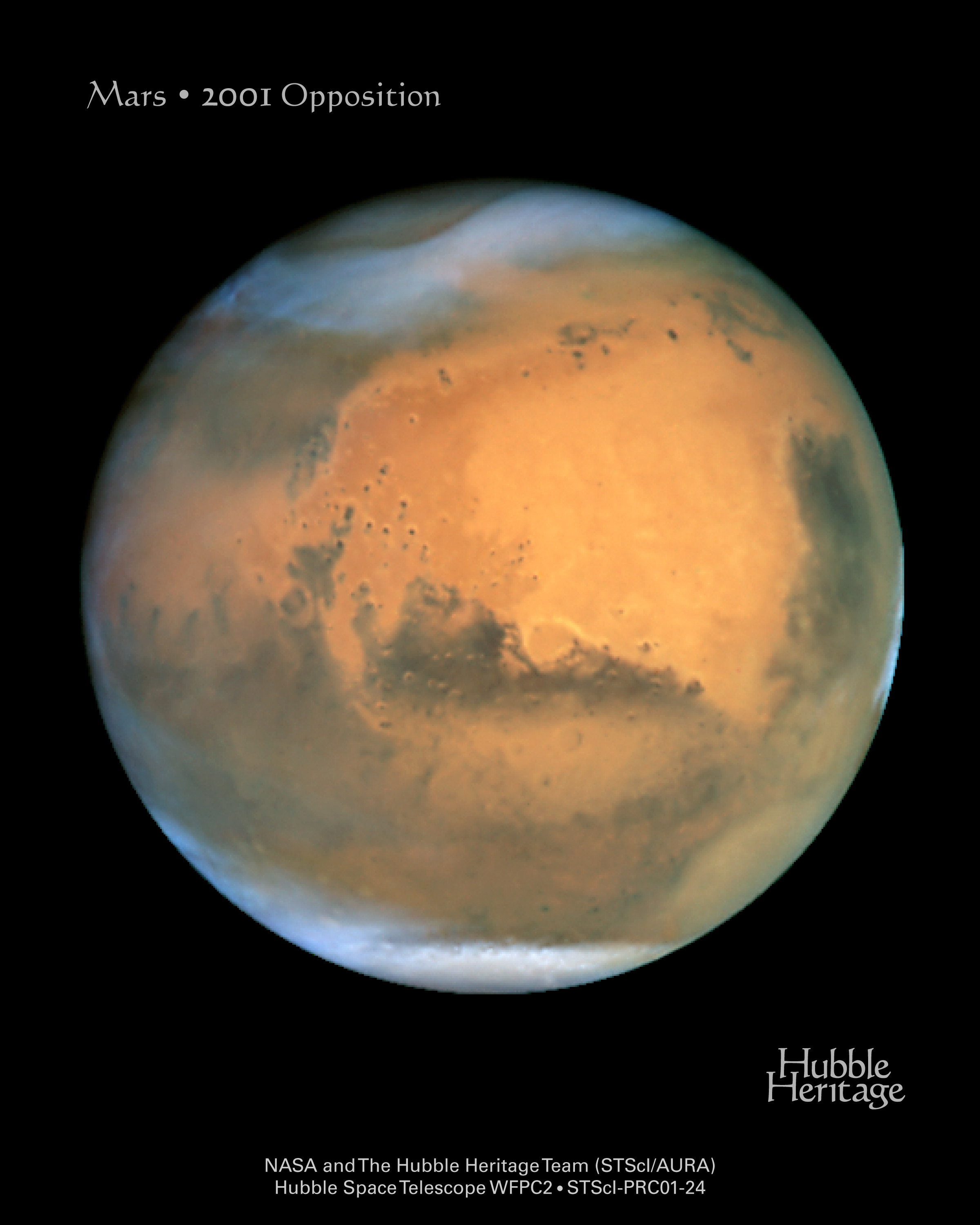
mars_hst_big


For my 5th blog post, I decided to write about what the atmosphere of Mars is like. All the information I write about can be found in this link.

According to Space.com, Mars’ atmosphere is about 100 times thinner than Earth’s atmosphere and is pretty much all carbon dioxide. There are some other elements such as nitrogen, oxygen and argon, however, these elements make up less than 5 percent of the atmosphere. This super thin atmosphere combined with Mars being so far away from the sun makes the planet much colder than Earth. The average temperature for Mars is about negative 80 degrees Fahrenheit. Despite having such a thin atmosphere, Mars is still able to support weather, clouds and wind.

Fun Fact! : “At times, it even snows on Mars. The Martian snowflakes, made of carbon dioxide rather than water, are thought to be about the size of red blood cells. The north and south polar regions of Mars are capped by ice, much of it made from carbon dioxide, not water” (Space.com)

Picture can be found here


Posted in Terrestrials | Tagged , , | Comments Off on Atmosphere of Mars

A Viral Photo Gone Wrong

shutterstock_earthfromhubble.jpg.CROP.original-original
The Bad Astronomer Blog Article

This image was talked about in class today; it has gone viral as a supposed image of Earth from the Hubble Deep Space Telescope. There are a number of reasons why this is absolutely impossible. One clear reason is the size of the atmosphere. From this distance, the atmosphere on Earth could not possibly be seen as this large. On a standard globe, the majority of the atmosphere would be about the thickness of a dollar bill laid across it; in reality, about 6 miles directly up from the Earth’s surface is the majority of the atmosphere. Additionally, the Hubble Deep Space Telescope is built to look into DEEP SPACE. That means that its field of vision is extremely tiny, so as to gather light from only a very small section of the sky and focus on light coming from extremely far away. If pointed towards the Earth, Hubble would only see a tiny part of Earth’s surface, not a full image of the entire planet. Related to that, Hubble is much to close to Earth to be able to see the full image of the entire planet. If Hubble had that large of a field of vision, it would not be able to gather light from extremely far away and give us the beautiful images of deep space galaxies that it does.


Posted in Class, SolarSystem | Tagged , , , , | Comments Off on A Viral Photo Gone Wrong

Nuclear Fusion: the Energy Source of the Future?

Though the power of the Sun is quite amazing, the Sun is simply a giant, burning ball of hydrogen. Due to the immense gravity of the Sun, hydrogen particles at the Sun’s core are under enough pressure that they collide with one another despite the force of the positive charges to repel one another. In this, hydrogen is converted to helium and energy is released, which powers the Sun.

Engineers are coming closer and closer to developing devices that can create sustained nuclear fusion reactions on Earth. The primary difficulty lies in making the hydrogen particles move fast enough in a confined enough space so that fusion can occur, since these conditions do not naturally exist anywhere on Earth. In the last month alone, we have taken huge strides toward making this a possibility. Scientists in China used their Experimental Advanced Superconducting Tokamak (EAST) to heat hydrogen plasma to nearly 50 million degrees celsius for 102 seconds.

east_1024.jpg

(China’s EAST machine)

The benefits of using nuclear fusion as an energy source are profound. Nuclear fusion would provide nearly unlimited energy since it is fueled by hydrogen. Since hydrogen can easily be extracted from sea water, the earth’s oceans would essentially become Earth’s energy source. Furthermore, using nuclear fusion as our energy source would be great for the environment. The only by-product of nuclear fusion (besides energy) is helium, which is not harmful to the atmosphere and mostly escapes into space. Lastly, nuclear fusion is relatively safe and is fairly easy to control. On the other hand nuclear reactors can be radioactive for thousands of years after they are turned off. Nuclear fusion truly has the potential to be the energy source of the future.   


Posted in Stars | Tagged , , , , | Comments Off on Nuclear Fusion: the Energy Source of the Future?

Nuclear Fusion: the Energy Source of the Future?

Though the power of the Sun is quite amazing, the Sun is simply a giant, burning ball of hydrogen. Due to the immense gravity of the Sun, hydrogen particles at the Sun’s core are under enough pressure that they collide with one another despite the force of the positive charges to repel one another. In this, hydrogen is converted to helium and energy is released, which powers the Sun.

Engineers are coming closer and closer to developing devices that can create sustained nuclear fusion reactions on Earth. The primary difficulty lies in making the hydrogen particles move fast enough in a confined enough space so that fusion can occur, since these conditions do not naturally exist anywhere on Earth. In the last month alone, we have taken huge strides toward making this a possibility. Scientists in China used their Experimental Advanced Superconducting Tokamak (EAST) to heat hydrogen plasma to nearly 50 million degrees celsius for 102 seconds.

east_1024.jpg

(China’s EAST machine)

The benefits of using nuclear fusion as an energy source are profound. Nuclear fusion would provide nearly unlimited energy since it is fueled by hydrogen. Since hydrogen can easily be extracted from sea water, the earth’s oceans would essentially become Earth’s energy source. Furthermore, using nuclear fusion as our energy source would be great for the environment. The only by-product of nuclear fusion (besides energy) is helium, which is not harmful to the atmosphere and mostly escapes into space. Lastly, nuclear fusion is relatively safe and is fairly easy to control. On the other hand nuclear reactors can be radioactive for thousands of years after they are turned off. Nuclear fusion truly has the potential to be the energy source of the future.   


Posted in Stars | Tagged , , , , | Comments Off on Nuclear Fusion: the Energy Source of the Future?

The Orion Nebula

162284main_image_feature_693_ys_full
Nasa’s Orion Nebula Image and Article

Nasa’s website overlays two images of the Orion Nebula, utilizing information from both the Spitzer Telescope and the Hubble Space Telescope. This image shows the cosmic cloud, within which astronomers believe more than a thousand young stars are forming. There are four in particular, found near the center of the cloud, that are particularly monstrously massive, and therefore have their own name: Trapezium. After learning about the formation of our solar system and our Sun in Chapter 8, it was interesting to look out at the formation of other stars in the universe, and see incredible clouds surrounding their formation. This image is perhaps the most relevant to astronomers’ learning about star formation, as it is the closest massive star-formation cloud and we therefore have better access to data on it.


Posted in Class, Light, Stars | Tagged , | Comments Off on The Orion Nebula