The Power of a Black Hole Merger


031916_notebook_saywhat

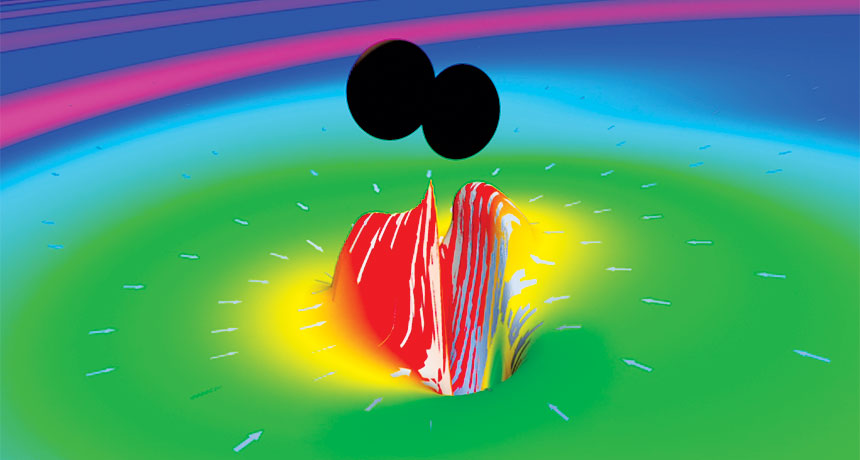
A stimulation of two black holes merging. Source.

An article by Christopher Crockett in ScienceNews came out 5 days ago that stated the amount of power output by the merging of two black holes. This was the same event detected by the Laser Interferometer Gravitational-Wave Observatory, the first detection of observational gravitational waves. The power of merger was apparently 3.6 x 10^49 watts! (Reminder: a watt is measured in joules per second)

That’s a lot of power and energy! I was curious to compare this amount of power to more familiar, human standards. So I looked at the amounts of power for several other events and compared that to the merger.

The merger’s power in time is equivalent to…

  • The bomb dropped on Hiroshima, Little Boy, had a blast yield of 63 x 10^12 Joules. 3.6 x 10^49 J/s / 63 x 10^12 J = ~6 x 10^59 Little Boy bombs per second.
  • Luminosity of the Sun is 3.846×10^26 watts (J/s). That is 3.6 x 10^49 J/s / 3.846×10^26 J/s = ~9 x 10^74 suns.

That’s a frightening amount of power. Such a large energy event was needed to occur in order for us to detect the event from such a great distance.


Posted in Class | Tagged , , , , | Comments Off on The Power of a Black Hole Merger

Radiocarbon Dating

Radiocarbon Dating is a method of determining how old an object is by the amount of carbon in it. The majority of organic matter contains carbon, and while carbon is not usually radioactive one of its isotopes, 14C is radioactive. This means that 14C will have a defined half-life, the amount of time is takes to radioactively decay to half of its original amount. The half-life of 14C is 5,730 years, and knowing this half-life allows scientists to determine the age of substances that contain carbon. The radiocarbon dating method will work on objects up to 60,000 years old.

The method of Radiocarbon dating was created by Willard Libby in 1949. Libby introduced radiocarbon dating to the world by accurately calculating the age of pieces wood from an ancient Egyptian royal barge. The age of this barge was already known from historical documents, and his estimation was very accurate. Libby was awarded the Nobel Prize in Chemistry for this achievement in 1960.


Posted in Class, Historical | Tagged , , | Comments Off on Radiocarbon Dating

IC 1101-The Largest Galaxy

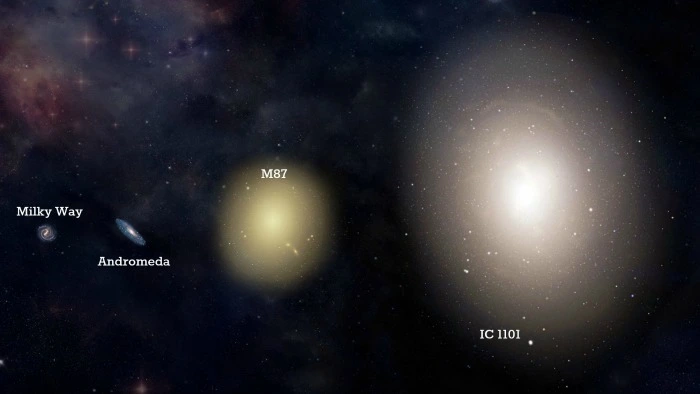
The single largest Galaxy in the Observable Universe is known as IC 1101. There are three types of galaxies: Dwarf galaxies, mid-range spiral galaxies, and gigantic elliptical galaxies. IC 1101 falls under the category known as Elliptical galaxies which is the category of the largest galaxies. IC 1101 is located 1 billion light years away, has a radius of of 2 million light years and contains 100 trillion stars. To put things in perspective, The MilkyWay Galaxy a mid-range spiral galaxy is 100,000 light years in diameter, and contains 100 billion stars. If we were to place IC 1101 where the milky way galaxy currently is the Galaxy would swallow the Magellanic clouds, the Andromeda galaxy, the Triangulum galaxy, and almost all the space in between. This Galaxy is no longer giving birth to any more new stars and unless it swallows any more galaxies it will fade. (Sounds like a movie plot)

Below is a visual to help you comprehend the Sheer size of IC 1101

ic11011

Galaxy Size Comparison (Google Image)

Below is a visual to help you comprehend the difference between million, billion and a  trillion

one trillion

Google Images


Posted in Class | Tagged , | Comments Off on IC 1101-The Largest Galaxy

IC 1101-The Largest Galaxy

The single largest Galaxy in the Observable Universe is known as IC 1101. There are three types of galaxies: Dwarf galaxies, mid-range spiral galaxies, and gigantic elliptical galaxies. IC 1101 falls under the category known as Elliptical galaxies which is the category of the largest galaxies. IC 1101 is located 1 billion light years away, has a radius of of 2 million light years and contains 100 trillion stars. To put things in comparison, The MilkyWay Galaxy a mid-range spiral galaxy is 100,000 light years in diameter, and contains 100 billion stars. If we were to place IC 1101 where the milky way galaxy currently is the Galaxy would swallow the Magellanic clouds, the Andromeda galaxy, the Triangulum galaxy, and almost all the space in between. This Galaxy is no longer giving birth to any more new stars and unless it swallows any more galaxies it will fade. (Sounds like a movie plot)

Below is a visual to help you comprehend the Sheer size of IC 1101

ic11011

Galaxy Size Comparison (Google Image)

Below is a visual to help you comprehend the difference between million, billion and a  trillion

one trillion

Google Images


Posted in Class | Tagged , | Comments Off on IC 1101-The Largest Galaxy

Blog #6 (auroras)

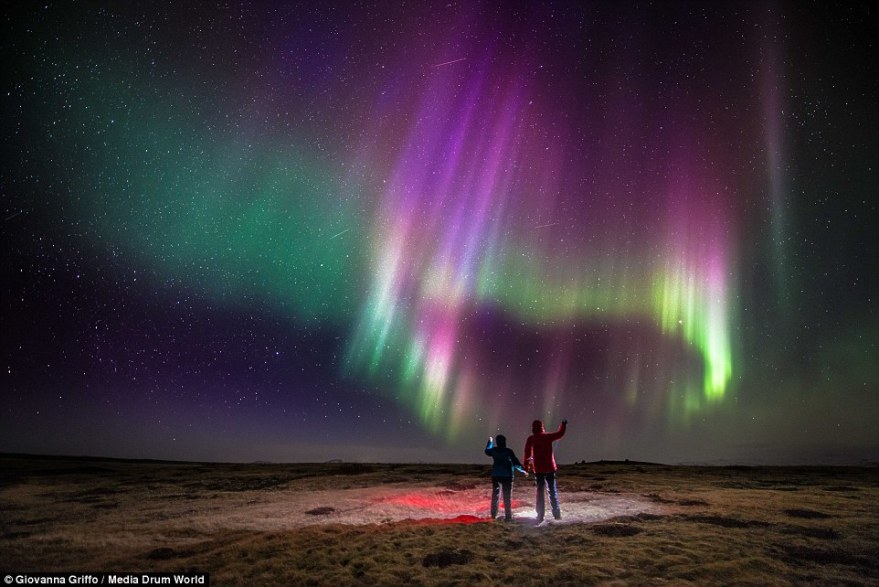
One of the most interesting aspects of astronomy for me is the existence of auroras. As a bit of background, there exist charged particle belts in the magnetosphere that contain high-energy particles. When solar wind gives these particles energy, they leave the magnetosphere and cause radiation in the atmosphere that produces the visual effect of the aurora. Auroras are often seen in places near the Arctic Circle, such as northern Canada or Iceland, because they are near the North (magnetic) Pole. I’ve often wondered whether it is necessary to understand the scientific underpinnings behind a natural phenomenon to appreciate its beauty, or even whether thinking about the scientific aspect of it distracts from that beauty. I think that understanding the intricacies behind these phenomena gives you a sense of satisfaction, and allows you to realize how logical the ways of the universe are. For me, understanding a wide variety of topics in astronomy, biology, chemistry, and physics helps me feel more connected to the universe that I live in and gives me a sense that I at least somewhat understand the ways of the world that have produced life. I also love just taking in the natural world and enjoying it on a more surface level. What understanding science has taught me is that scientific knowledge and appreciation of the natural world go hand in hand and complement each other. It almost makes me feel as if I’ve earned the right to appreciate these phenomena on a more surface level. If I ever visit the northern lights, I’ll give at least brief thought to the reason why it’s there in the first place (Northern lights)2740389500000578-0-image-a-27_1428054804261


Posted in Class | Tagged , , , | Comments Off on Blog #6 (auroras)

Blog #6 The Future of Mining

losttown-300x300
X Class Asteroid (Primarily Metal)

Due to Earth being a terrestrial planet, much of our world’s material falls into the categories of rock and metal. An incredible motivator through humanity’s history has been our love of gold, silver, platinum and now other rare earth metals. We have been willing to blast open mountains and strip open land in the quest for fuel and industrial level diamonds. As we transition into a more developed age of space and technology, our need for precious metals increases along with our skill and experience in spacecraft.

Looking to the future, the company Planetary Resources was founded with the goal of mining near earth objects (asteroids) for their incredible wealth of metals and possibly water. The metals would be either brought back to Earth raw, processed on site and only valuable products brought back, or even located to a new orbit around Earth to be accessed later. Though the asteroid mining may seem impossible, the value of metals found in asteroids will always tempt us as a potential resource. For now, only the incredible cost of space travel limits us.


Posted in Class | Tagged , , | Comments Off on Blog #6 The Future of Mining

The Fermi Paradox

aliens
Aliens

The Fermi Paradox is a fascinating paradox that asks why, in a universe as vast as ours, we have not seen any other signs of life as of now. There are many different possible explanations and they are all very complex but I will attempt to detail some of them below:

One possible explanation is that we have not seen anybody yet because there is no one else out there. This might seem unlikely, given how large the universe is, but we have seen in class exactly how specific the conditions that were needed for life on Earth to form are. It is entirely possible that no other planet has these characteristics, and no other life ever formed.

Another possible explanation is that there are no other forms of life out there, because, while other forms of life have formed, they have all met something called the Great Filter. This is an idea that there is a point that all life forms hit in their evolutionary process, that no life forms can make it past, and results in species going extinct. We could either be the first to pass that filter, or still have yet to hit it.

If, however, there is other life out there, there are many good potential explanations why we have not heard anything from other life. Potentially, life could have visited Earth before humans even existed, or life could have tried to communicate with us while we were here, but we were too primitive to understand. Or we just have not found them or been found by them. There are many more possible explanations for us not having had contact, and they are all very interesting.

I would encourage anyone interested in this to look into it further. You can spend days on the internet reading up on this. I know I have! A good place to start is with this blog post.


Posted in Aliens, Class | Tagged , , , | Comments Off on The Fermi Paradox

Blog #5 (The dangers of climate change)

Simply put, when humans pollute the atmosphere, it leads to an increase in greenhouse gases like carbon dioxide. Then, these greenhouse gases slow the release of infrared radiation reflected off of Earth’s surface, and this leads to an increase in temperature. Historically, this issue has caused a large controversy in American culture. Today, the main disagreement is whether or not humans caused this increase in global temperature that we are seeing. It is clear to scientists that humans did in fact cause climate change because there is a strong correlation between industrialization/pollution and climate change, and because it makes sense that an increase in pollution would increase greenhouse gases and global temperature. Therefore, I think it’s clear that those who oppose acting on climate change in the political sphere are motivated by strong ties to the coal industry, pro-business views in general, or anti-scientific bias. All of these reasons are unacceptable. I don’t believe that all opposition to the scientific aspects of climate change is inauthentic, but I think that most of it is probably motivated by ulterior motives in the face of clear scientific reasoning. Putting the current state of the economy ahead of the future of the planet or ignoring clear science should both be eliminated from our political system. Thankfully, many countries–including the United States–are acting more and more to slow the growth of climate change. In my own life, I value getting out into the natural world a lot, and I would be sad to know that future people couldn’t enjoy the Earth’s natural beauty. We shouldn’t let our planet warm excessively, be polluted, or endure the effects of these things. The picture below represents some of the effects of climate change (Climate change effects).1320_effects-image.jpg


Posted in Class | Tagged , , , | Comments Off on Blog #5 (The dangers of climate change)

Venus’s Atmosphere

Image converted using ifftoany
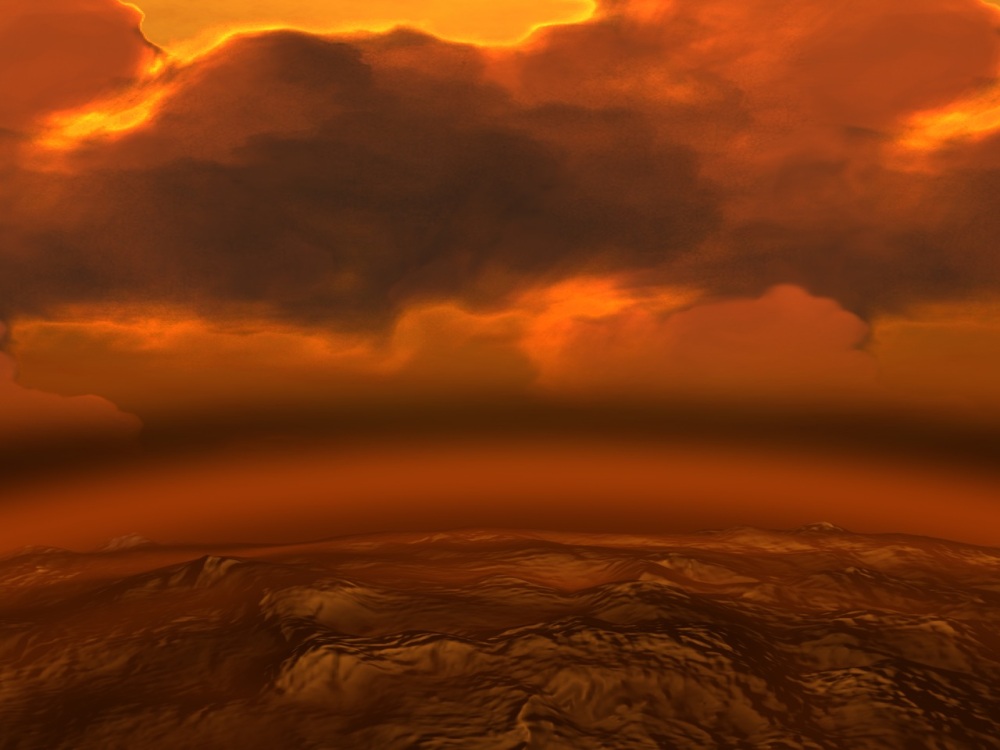
Artist’s rendering of Venus and its atmosphere, from the surface

Venus is of a similar size to Earth, but has an incredibly different climate. The main reason for this is Venus’s atmosphere, which is extremely different from Earth’s. Venus’s atmosphere is made up almost entirely of Carbon Dioxide, and has barely any Oxygen. Because of this, Venus has a much greater greenhouse effect than Earth, and is thus much hotter than Earth. This is why Venus has no liquid water.

The reason Venus’s atmosphere is so different than ours is because it is closer to the Sun. This made it slightly hotter than Earth to begin with, which caused more greenhouse gases to form, which made Venus even hotter, and caused more greenhouse gases, and so on.

Source


Posted in Class, Science | Tagged , , , | Comments Off on Venus’s Atmosphere

Getting really really lucky, or discovering the secret to warp travel

captain’s blog, Stardate 69668.2

This blog post is of the unrestricted variety, so naturally I will take this opportunity to talk about science fiction.

One of my favorite things about sci-fi movies is how frequently (and casually) characters from Earth encounter other intelligent species. Or maybe even other species live with us humans here on Earth. They just hop on a ship and run over to a different planet populated by a different species, like it’s just the same as taking a trip to a different country.

This is why I get so excited about the search for life on other planets, because it brings us one step closer to making science fiction a reality. Who doesn’t want that? But something I didn’t realize until it was pointed out to me: this would require some fairly extraordinary circumstances.

There have recently been some exciting findings regarding life in our own Solar System (s/o to Ganymede), but nothing so far indicating “intelligent” life. But if we take the search for life outside of the Solar System (as we already have), the distances to these worlds are astronomical. (lol get it?) In fact, this article on space.com says one of the farthest discovered planets is 13,000 light years away.

But as we know, this means we’re seeing this planet as it was 13,000 years ago. So if this planet “won the lottery” in the same way Earth did and has intelligent life similar to us, we’d have no way of communicating with them directly. Even if we could travel at the speed of light, or send a message at the speed of light, there’s no telling what would be there to receive us because it would take 13,000 years. Additionally, even if there is intelligent life on the other end, we’ll be long gone before a response from them makes it all the way back to Earth.

This is the most extreme example, but it also applies in general. A planet ten light years away, on the grand scheme of things isn’t that far, but would still take ten years to send our hypothetical “light message”. And even if aliens were really good about responding to emails, it would take another ten years to see their response.

This all being understood, the way I see it, finding intelligent life outside outside our own Solar System seems pretty difficult. It appears our only options are getting really really lucky, or discovering the secret to warp travel.


Posted in Aliens | Tagged , , | Comments Off on Getting really really lucky, or discovering the secret to warp travel