The Atmosphere of Venus

Venus,_Earth_size_comparison
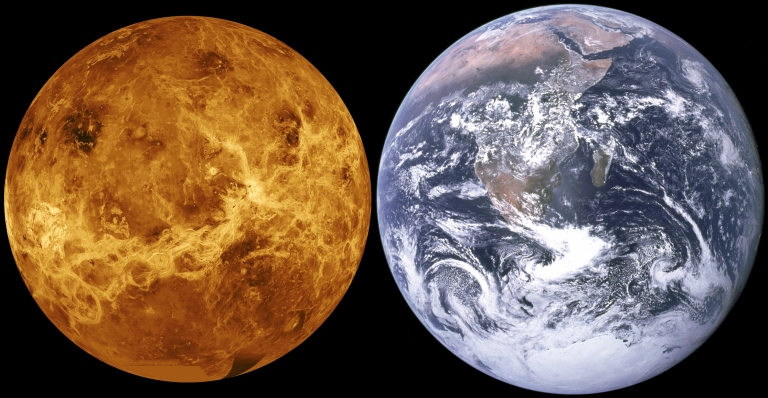
Size and composition comparison of Venus and Earth. Source

I have always been oddly fascinated by Venus. Not only is it the Roman name for arguably the most interesting (and controversial) Greek Goddess, Aphrodite, but it also has a lot of really fascinating characteristics. The surface of Venus is so hot that robotic probes wouldn’t be able to last for very long on it, yet the actual size of Venus is practically the same as Earth’s. I was interested to learn more about what makes Venus so intolerable to life.

First off, the atmosphere of Venus is much denser than that of Earth. This creates the phenomenon of the “runaway greenhouse effect” in which the positive feedback cycle of trapping warm air actually works to heat the planet immensely, leaching out carbon dioxide from rocks and evaporating any form of liquid water. This causes Venus to have a surface hotter than that of Mercury, despite being farther away.

According to an article from Space.com, Venus does not experience the seasonal weather changes that Earth does, partially because its axial tilt is quite small (only about 2 degrees), but also because the greenhouse effect is so efficient at trapping heat that the ground temperature stays fairly consistent (meaning extremely hot).


Posted in Terrestrials | Tagged , , , , , , | Comments Off on The Atmosphere of Venus

Pillars of Creation

Pillars_of_creation_2014_HST_WFC3-UVIS_full-res_denoised
source: Nasa

The above photo is a picture captured by NASA’s Hubble Space Telescope of what is now known as the “Pillars of Creation.” Located in the Eagle Nebula, which is around 6,500 – 7,000 light years away from Earth, the structures are named as such because of their pillar-like shape, as well as because the gas and dust in the picture are in the process of creating new stars. Looking at the photograph, it is easy to see why the pillars have become so iconic for its beauty.

For scientists, the pillars are useful because they provide new insights on the creation of a solar system. Astronomer  Jeff Hester says that the pillars “are actively being ablated away before our very eyes. The ghostly bluish haze around the dense edges of the pillars is material getting heated up and evaporating away into space. We have caught these pillars at a very unique and short-lived moment in their evolution.” The pillars were important because they were the first time that direct observational evidence of the erosionary process of a nebula was being seen.


Posted in Stars | Tagged , | Comments Off on Pillars of Creation

A Natural Lightshow

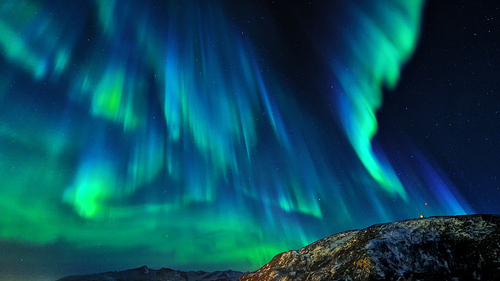
northern-lights-fairies
Fairyest

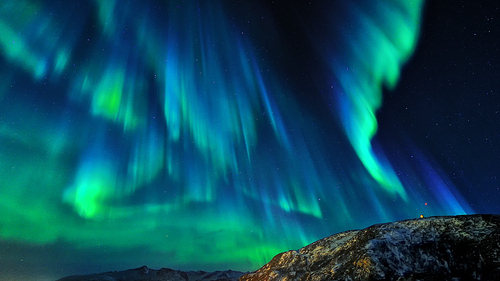
When I think about light shows, I think about Disney World. Every night in the Magic Kingdom that have a “lightshow spectacular” full of elaborate parade floats decked out in incredible light schemes set to music. The show is pretty cool, but there’s one even cooler that our Earth puts on every night all on it’s own: aurora.

Aurora are created by material spewing out of the Sun via coronal mass ejections colliding with gas particles in Earth’s atmosphere. Usually the Earth’s magnetic field is strong enough to deflect the Sun particles, but at the poles of the planet, this magnetic field is weaker, and some of the material ends up entering the atmosphere. When it collides with atmospheric gas particles, a spectacle of colored light is created. The color of the aurora depends on the type of gas particles colliding. The most common color of aurora is a light green created by oxygen collisions.

People all over the world have watched this beautiful light show for centuries. Many native peoples had legends about aurora. For example, Kiwi Maori thought the lights were simply a reflection of their own campfires. Alaskan Inuit believed the lights were a manifestation of the spirits of the animals they had hunted. The contrast between various myths across cultures is very cool to see. Even though we now know the scientific explanation for aurora, letting ourselves believe for a moment that the aurora are some sort of spirits dancing for us is a pretty neat way to connect with Earth-dwellers of years past – and it certainly adds even more theatrics to these beautiful natural light shows.


Posted in Historical, Light, Science | Tagged , , | Comments Off on A Natural Lightshow

New Destinations for New Horizons

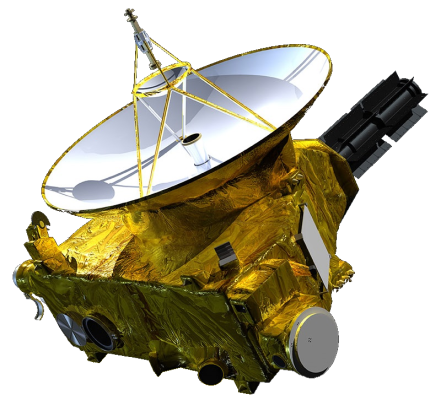
New_Horizons_Transparent
Wikipedia

The New Horizons space probe was launched in 2006 and just last year gave us the coolest Pluto pictures ever taken on a super cool mission. This probe is still kickin’ it out in the solar system today, and has taken up a new mission: a flyby of 2014 MU69, scheduled for January 1, 2019.

2014 MU69 is an asteroid in the Kuiper belt that was discovered in June of 2014 by the Hubble Space Telescope. It is somewhere between 30 and 45 kilometers wide and takes 293 years to orbit the Sun at an average speed of 448 km/s. It is also known that the asteroid has a low inclination and eccentricity. When New Horizons reaches it in 2019, it will be 43.4 AUs from the Sun and will be in the region of Sagittarius in the nighttime sky, though it is too far to be seen with anything less than a very powerful telescope.

Personally I’m very excited by this new mission. The pictures of Pluto taken by New Horizons were absolutely fantastic, and it will be amazing to see similar high quality images of an object as far into the Kuiper belt as 2014 MU69.


Posted in Space Travel | Tagged , , , , , | Comments Off on New Destinations for New Horizons

Forgotten, but not always gone: the various fates of planetary probes


adoptaspacecraftvoyager1
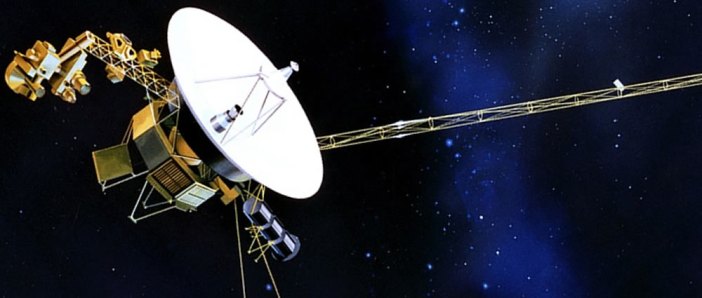
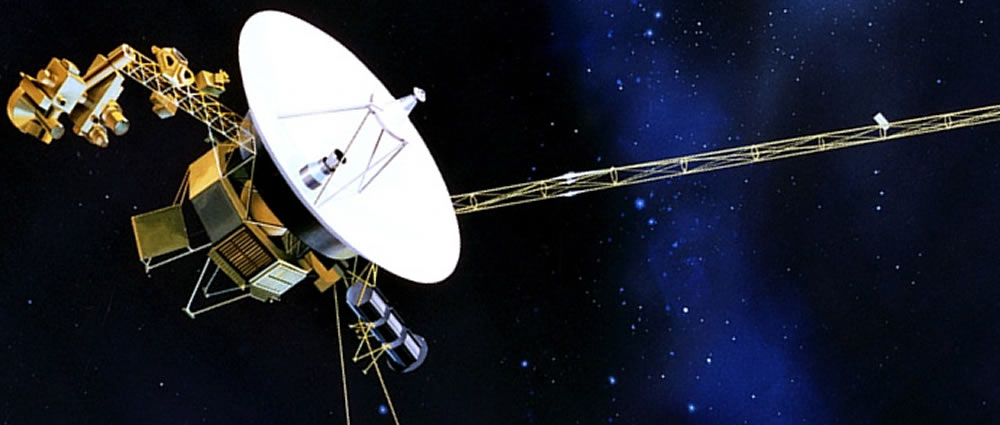
Pictured: an artist’s depiction of Voyager 1, also known as one of the lucky ones. Sometime around 2025, however, it(s power supply) too shall come to pass, and it will die a free probe – more on that later. Source

Bad news: your favorite space probe has been deactivated or worse – its power ran out. What’s the next step? For us as humans, tears for what we’ve lost but ultimately, hope – as long as the government (or Elon Musk) cares, more things will be shot into space. For the space probe, well, that can depend on the mission. There are three main fates for wayward probes: orbit, impact, and jailbreak escape from the solar system.

Orbit

By and large, the primary fate which space probes meet (other than failure to escape the Earth’s gravity – I’m looking at you, early Soviet probes and no-longer-early Russian probes) is that of orbit, be it around the Sun or around other solar system objects. However, probes orbiting other planets or moons will eventually…

Impact

The same civilization which derives viewing pleasure from this also has no qualms about crashing some of its most sophisticated technological achievements into other planets. While all artificial objects in orbit around planets or moons will fall eventually, sometimes we take matters into our own hands by smashing probes into comets or even the moon – for the sake of knowledge, of course! But although impact is certainly more glamorous than a slow death orbiting the Sun, it can’t hold a candle to…

Escape!

Among all the objects mankind has ever constructed, from Lamborghinis to Pintos, from Yeezys to your dad’s flip-flops, only one has escaped (the oppression of) our solar system: the Voyager 1 probe, which was launched on 5 September 1976 and is still somehow transmitting data back to Earth. Also on the way out of the solar system (but not quite out yet) are two derelict Pioneer probes (10 and 11), launched in 1972, Voyager 2 (also launched in 1976), and the New Horizons spacecraft, which was launched in 2006, in addition to four rocket boosters and two counterweights from New Horizons. The Voyager craft and Pioneer craft each carry messages to any extra terrestrial life that may encounter the probes in the future. Below is a video about Voyager 1 crossing into interstellar space.


Read what I read!

Click the links in the text!

Objects escaping the solar system


Posted in Class, Instruments | Tagged , , , , | Comments Off on Forgotten, but not always gone: the various fates of planetary probes

Problems of Nuclear Fusion for Energy

Nuclear Fusion
source: nuclear-energy.net

Scientists have known how to use the process of nuclear fusion as a weapon for over 50 years at this point. However, we have yet to find a way to repurpose it as a safe, nearly unlimited energy source.

One of the main issues that researchers are facing with trying to tackle this issue is that that nuclear fusion requires an extremely high activation energy. As a weapon, this activation energy was provided by first detonating an ordinary fission bomb. It is easy to see how this process would not be ideal for creating clean fusion energy. Instead, scientists are now trying to heat nuclei using magnetic fields and lasers, neither of which has yet been able to provide the necessary temperature.

Another issue scientists face is creating a container out of materials that will be capable of withstanding assaults from the products of fusion reactions. First of all, the temperatures to kick off nuclear fusion are so hard that just finding a method of heating nuclei that could also survive high temperatures itself is already a challenge. Also, nuclear fusion releases some short-lived radioactive byproducts, and so the materials will need to be able to both extract heat effectively and survive battering from these particles at the same time.

There is much dispute over the use of nuclear energy today because of a public conception that nuclear power is a dangerous energy source. Although accidents are rare and nuclear power plants are pretty safe today, it is true that a serious accident could release massive amounts of radiation. However, rather than releasing radiation, the product of nuclear fusion is non-radioactive Helium and thus it does not share the same risk. It is for this reason that scientists are optimistic about using it as a power source in the future.


Posted in Physics | Tagged , , | Comments Off on Problems of Nuclear Fusion for Energy

Blog #5 Venus and Venera 7

Barely a year after we landed a man on the moon, one of our space probes successfully landed on an alien world and transmitted data back to Earth. The Soviet space probe Venera 7 was the first time a lander had survived a surface landing on another planet, even with a damaged parachute. Despite the hard landing and toppled antenna, Venera 7 managed to relay information pertinent to human exploration and survival.

Temperature data of 475 degrees Celsius and pressure data of 90 atmospheres let the whole world know that Venus was an inhospitable planet with no liquid water to be found. After 23 minutes of weak transmission from the surface, Venera 7 succumbed to the incredible heat and pressure at the Venusian surface. To emphasize the vast mass that is the atmosphere of Venus, many of the previous Venera satellites died just traversing the dense atmosphere. And the probes to follow Venera 7 all failed within a couple of hours

800px-venera_1962_diagramm
Diagram of Venera 7

Posted in Class | Tagged , , | Comments Off on Blog #5 Venus and Venera 7

Gravity has waves?

Admittedly, I am late on the whole gravitational waves discovery, however I think that this video above is probably the best explanation as to what gravitational waves are and how scientists actually managed to find evidence for the waves.

The way that scientists actually discovered the waves fascinated me most in all the of news surrounding gravitational waves. Einstein discovered, through the use of math, that these waves do exist and that they stretch and compress any object that they pass through so we are human rubber bands. Well, not really. We will never see this stretching and compressing as it occurs at an atomic level, less than an atomic diameter. Which, is nice to know, because I don’t want to be constantly stretched and compressed like a rubber band. Now even if they are proven in math we have never had evidence of these waves in real life until now. And how they discovered it is fascinating.

They took lasers positioned tangent to each other in two, 2.5-mile-long evacuated pipes and had them combine to create an interference pattern that highly depends on the distance between the two lasers. Now, what allowed them to find the gravitational wave is as the wave passed by the earth it stretched one laser and compressed the other altering the interference pattern they created when combined backed together. When the wave passed the earth, it altered the interference pattern and alas we have evidence of gravitational waves. The device that they developed to discover the waves is truly amazing.

Now I’m just waiting for someone to make a song out of the sound byte that the collision of 2 black holes made leading to the discovery of waves.


Posted in Class, General, SolarSystem | Tagged , , , , , | Comments Off on Gravity has waves?

The Voyager Mission

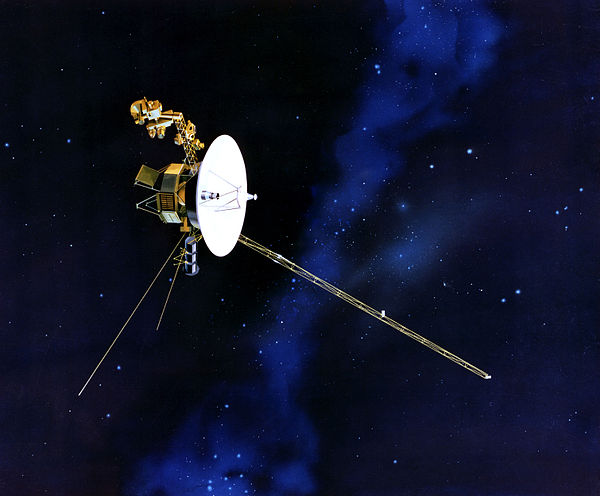
Voyager_spacecraft.jpg

Launched in 1977, the Voyager 1&2 continue to explore deeper into space than any instrument ever before. Using geometries and precise calculations, the space probes were able to perform flybys of Jupiter, Saturn, Titan, Uranus, and Neptune. Upon completion of the primary objectives, they were assigned the new mission of exploring further and further away from the Sun.

These space probes do their job using a system of computers, communication systems, scientific instruments, jet propulsion elements, and power sources. Using some pretty impressive engineering, the mission will continue to have enough power to feed data back to the Earth until 2025.

More recently, the Voyager 1 probe has reached interstellar space and the Voyager 2 is close behind. To give you some sense of scale, the Voyager 1 probe is currently 12.2 billion miles from Earth and the Voyager 2 probe is 10 billion miles from Earth.

Image Source

Source


Posted in Class, Space Travel, Universe | Tagged , , , , , | Comments Off on The Voyager Mission

The Formation of the Solar System

young-sun-like-star

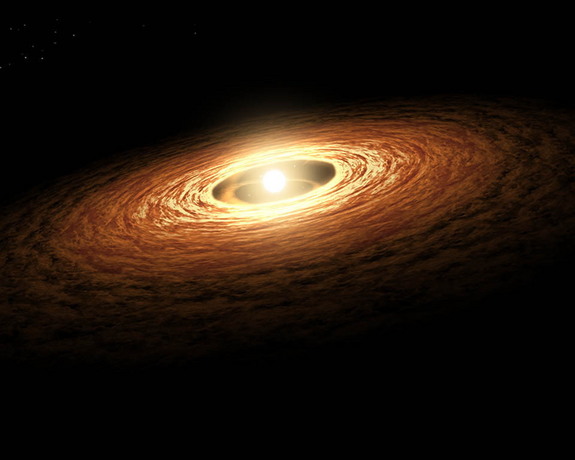
The general consensus amongst astrophysicists is that our solar system was formed through a process of gravitational collapse of a dense cloud. Over time, a large portion of the mass settled at the center, forming the Sun. The formation of the sun produced a swirling disk called a solar nebula. This disk of matter orbiting the central Sun collected over time to form the hot, rocky planets near the center and the ice giants further away.

The formation of our solar system does not stop there. Our system is constantly evolving and changing as our Sun ages. It is important to study and understand the evolution of our solar system so that we can more accurately predict how we will continue to change and what we can do to ensure the survival of our species.

Image Source


Posted in Class, Historical, Universe | Tagged , , , , | Comments Off on The Formation of the Solar System