Solar Storms

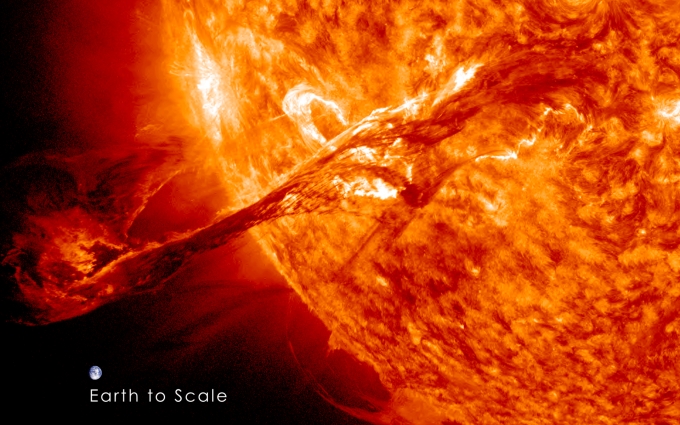
Who knew there were actually storms on the surface of the earth? Well, they aren’t the storms that we are used on earth. Actually, they are quite different. Storms on the sun occur when magnetic fields throughout the sun passing through sun spots and prominences spontaneously shift dramatically. The most known of these storms are solar flares, which are shown above. A solar flare is when X-rays and charged particles are discharged from the inner sun into space and end up reaching most planets including our own. One theory behind these flares is that they occur when the magnetic fields become incredibly tangled up that they cannot bear the tension of magnetism and as a result they break and reshape into a simpler pattern, creating a huge discharge of material from the sun.

So what do these huge solar flares mean for people on earth? We are able to spot them and they actually end up reaching earth a few days later. When they do hit earth, the X-rays are absorbed by our atmosphere and create strong auroras, which are the spectacular light shows that occur in the northern hemisphere. Unfortunately these coronal mass ejections, which is the formal name of the particles these major solar flares give off, can also disrupt earth’s own magnetosphere, which causes problems to our power grid and radio communications. Solar flares, while they are beautiful in pictures and video and create for amazing aurora in the sky, can create many problems for our electrical systems and technology. The amount of technology will only increase in the next century so developing ways to protect technology from these flares is very important to protect our electrical grid.


Posted in Class, General, Science, SolarSystem, Sun, Universe | Tagged , , , | Comments Off on Solar Storms

Are We Alone in the Universe?

And why does that question seem to be so hard to answer?

Our universe is vast. There’s no doubt about that. And statistically, we should be able to find life in some way, shape, or form somewhere in the seemingly endless cosmos. For every grain of sand on Earth, there are ten thousand stars in the universe, and 500 billion billion of those stars (10²² stars total) are sun-like stars. Around those sun-like stars, there are thought to be around 100 billion billion Earth-like planets in orbit.

100 Earth-like planets for each grain of sand on Earth.

tumblr_o1hzbxfh261qi6miqo1_500

So where are the aliens? Where is life? This is the Fermi Paradox – the likelihood of life is very high, so why haven’t we found any yet?

Some explanations of this absence of alien life center around the Great Filter, which is the idea that the evolution of life hits a wall of sorts that very few species manage to pass through. There are three interpretations of the presence of this filter. One: we’re ahead of the Great Filter, which means it’s very rare for a species to achieve a human level of intelligence. Two: conditions in the Universe have only very recently developed conditions that can sustain intelligent life and we are in the midst of an astrobiological phase transition. Third: the Great Filter is ahead of us and it’s only a matter of time before life on Earth is wiped out completely.

There are many other explanations of Fermi’s paradox, and if you are interested I highly suggest you check out this page!

I also recommend watching a few episodes of the X-Files if you really want to start believing in the existence of extraterrestrials.


Posted in Aliens, Class, Universe | Tagged , , , , | Comments Off on Are We Alone in the Universe?

The Pock-Marked Sun God

sunspots

Sunspots are areas on the Sun that appear darker compared to their surroundings because they are cooler than the areas around them. This does not mean that the spots are actually cold, but relative to the 5800K temperature of the rest of the Sun, sunspots are much cooler at 4000K. Magnetic fields prevent the hotter plasma from mixing with the cooler plasma in the sunspots. Sunspots occur in areas with tightly wound magnetic fields that suppress convection, preventing surrounding plasma from entering the sunspot. Since the surrounding plasma cannot enter, the sunspot, the area within becomes cooler and darker. Sunspots usually last up to a few weeks, until their magnetic fields weaken.

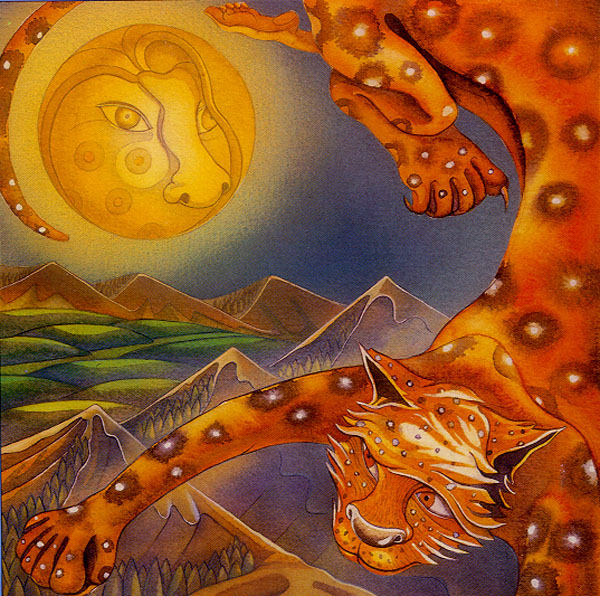
Many ancient cultures worshiped the sun as a god. The ancient Greeks believed the Sun was the chariot for the god Helios, and that it was driven across the sky by four horses! The Incas and Mayans also believed the Sun was a god and tracked its progress regularly to form calendars. Interestingly enough, the Aztec myth of creation includes something that points to the observation of sunspots. The myth includes descriptions of “an obscure but brave god with a scabby pock-marked face [who] sacrificed himself by fire to become the sun” (Regents). Although Galileo would not officially discover sunspots until 1610 with his telescope, it is still interesting that ancient cultures may have noticed these darker areas on the Sun and incorporated them into their mythology.

Posted in Historical, Sun | Tagged , , | Comments Off on The Pock-Marked Sun God

The Pock-Marked Sun God

sunspots

Sunspots are areas on the Sun that appear darker compared to their surroundings because they are cooler than the areas around them. This does not mean that the spots are actually cold, but relative to the 5800K temperature of the rest of the Sun, sunspots are much cooler at 4000K. Magnetic fields prevent the hotter plasma from mixing with the cooler plasma in the sunspots. Sunspots occur in areas with tightly wound magnetic fields that suppress convection, preventing surrounding plasma from entering the sunspot. Since the surrounding plasma cannot enter, the sunspot, the area within becomes cooler and darker. Sunspots usually last up to a few weeks, until their magnetic fields weaken.

Many ancient cultures worshiped the sun as a god. The ancient Greeks believed the Sun was the chariot for the god Helios, and that it was driven across the sky by four horses! The Incas and Mayans also believed the Sun was a god and tracked its progress regularly to form calendars. Interestingly enough, the Aztec myth of creation includes something that points to the observation of sunspots. The myth includes descriptions of “an obscure but brave god with a scabby pock-marked face [who] sacrificed himself by fire to become the sun” (Regents). Although Galileo would not officially discover sunspots until 1610 with his telescope, it is still interesting that ancient cultures may have noticed these darker areas on the Sun and incorporated them into their mythology.


Posted in Historical, Sun | Tagged , , | Comments Off on The Pock-Marked Sun God

Coronal Mass Ejections and You

earth_scale
Sun Splurge

A coronal mass ejection (CME) is a massive outburst of Sun matter interweaved with magnetic field lines. This Sun matter basically consists of superheated particles accelerated at millions of miles per hour. This ejection isn’t self-contained, a lot of this stuff just goes shooting into space. This wouldn’t be so bad in of itself, except the Earth is located in space and sometimes we’re in the path of the ejection. Luckily for us, the CME doesn’t just obliterate everything in its path, rather by the time it gets to us it’s less of a wave of lava-like death and more of a wave of charged particles. Unluckily for us these charged particles are not very friendly towards electronics and can knock out many electronic-based systems for extended periods of time.

The largest CME hit that the Earth has received in recent technological history was in 1859. This is known as the Carrington event. Long story short, the telegraph grid basically shutdown due to a CME hit. Reportedly the telegraph wires began to spark, the operators were shocked, and nearby telegraph papers burst into flames. The northern lights were also seen as far south as the equator and lit up the sky so much that birds thought the sunrise had come and began to wail.

If something like the Carrington event happened today, the consequences would be more severe. Satellites would likely fail and the power grid could collapse for weeks, months, or even years. The damage would likely cost trillions of dollars to repair and society would almost certainly come to a screeching halt.


Posted in Light, Sun | Tagged , , , | Comments Off on Coronal Mass Ejections and You

Nuclear Fusion in the Sun

nuclear fusion pic.png

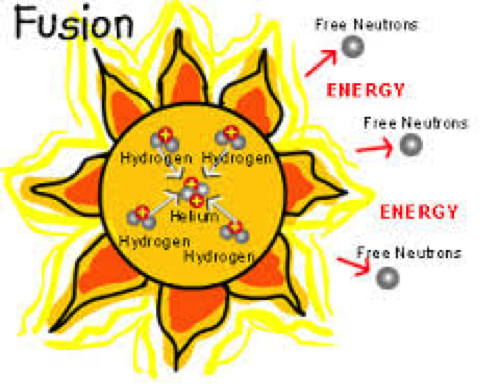
At the core of the Sun, and every other Sun like star, a process called fusion takes place. Fusion describes a process where light elements, such as hydrogen, get fused together to form heavier elements, like helium. Fusion happens due to the intense pressure of gravity acting on the suns mass. A byproduct of this process is energy, which travels 400,000 miles to the sun’s surface over the next 100,000 years. After the energy has completed this journey it reaches the surface of the earth, 93 million miles way, in a mere 8 minutes. Most of the energy that human’s use today originated in the sun. This energy enters our system through photosynthesis, in which plants converts the Sun’s energy, along with water and carbon dioxide, into sugar. The plant then dies and is enveloped in the Earth. After millions of years and lots of pressure, these dead plants become fossil fuels such as coal. Humans then dug up the energy abundant coal and burn it below water. This creates steam, which turns a turbine, which produces electricity, which is distributed by the power grid. It’s pretty astounding to think know that the energy powering your phone was created in the Sun over 300 million years ago.

Source


Posted in Sun | Tagged , , , | Comments Off on Nuclear Fusion in the Sun

Space Bubbles AKA Quantum Foam

Extremely tiny bubbles and irregularities in space-time predicted by certain theories.
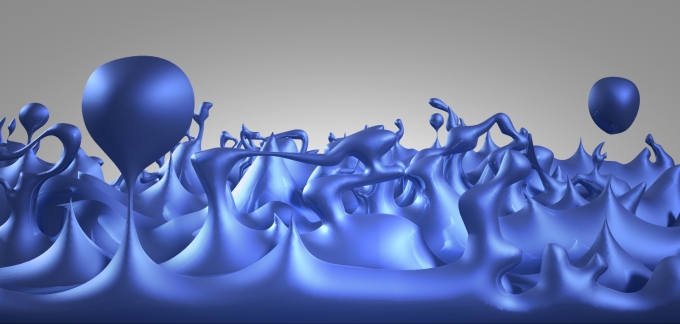
An Artist’s Depiction of Quantum Foam

Spacetime is often described as a “fabric”, but there is one theory that would describe it as more like sea foam- made of a bunch of tiny bubbles. This is the quantum foam theory. The quantum foam theory basically came into existence to try and unite Einstein’s theory of relativity and quantum mechanics, something that hasn’t yet been accomplished successively. Heisenberg’s uncertainty principle allows small particles to have dramatic fluctuations in energy and as the size being discussed decreases, these fluctuations just keep getting larger and larger. General relativity tells us that energy curves spacetime so therefore at an extremely small scale, these fluctuations in energy can become so great as to cause spacetime to take on a foamy rather than smooth characteristic.

These bubbles are thought to be incredibly small. So small in fact, that it has proved very hard to actually observe them. To attempt to observe the effects of quantum foam scientists used gamma and x-ray observatories to observe distant quasars. The thought behind this experiment was this: if quantum foam exists then photons of light would have to maneuver around all the little bubbles while traveling from one place to another. Over a large enough expanse of spacetime these maneuvers would add up and cause different photons from different periods of time to arrive at the same time. For example, this might cause light from 13 billion years ago to arrive at the same time as light from 12.9 billion years ago. This would cause the resulting picture to be out of focus. Gamma and x-ray observatories were used because of their tiny wavelengths, though it turned out that the frequencies weren’t tiny enough because the resulting pictures were all received in focus.

Even though the experiment failed, this didn’t kill the quantum foam theory, it just means that the bubbles are smaller than we had originally thought. In fact, until we test this theory to the planck length, the theory cold still be true. The problem is we don’t really know how to do this.


Posted in Light | Tagged , , | Comments Off on Space Bubbles AKA Quantum Foam

Climate Change

warming

Climate change is unfortunately vastly overlooked as a serious threat to our species today. NASA itself has a detailed list on its website devoted to the current evidence of climate change. The list includes the following phenomena:

  • Sea level rise
  • Global temperature rise
  • Warming oceans
  • Shrinking ice sheets
  • Declining Arctic sea ice
  • Glacial retreat
  • Extreme events
  • Ocean acidification
  • Decreased snow cover

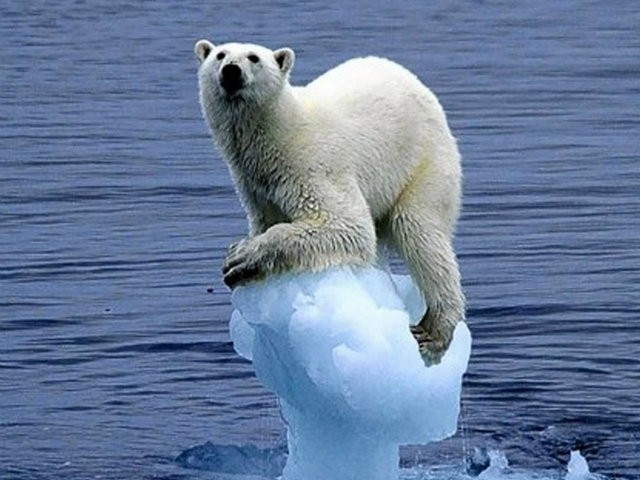
We are contributing more and more greenhouse gases to the atmosphere, which absorb infrared light readily and slow its escape into the atmosphere. The trapping of these gases through the greenhouse effect is gradually, but increasingly rapidly increasing the surface temperature of Earth. According to NASA, the 20 warmest years in recorded history have occurred since 1981, and the 10 warmest were in the last 12 years. Excess CO2 in the oceans has led to increased acidification that is destroying coral reefs around the world. Global warming will cause some regions to become warmer and others to become cooler, with polar regions warming the most. Species local to polar regions such as the polar bear pictured above are becoming threatened as ice sheets shrink. As sea level rises, coastal cities will eventually be flooded. People will be forced to move closer to the poles as temperatures become unbearable near the Equator. Although the temperature has only risen a few degrees, a small change in average temperature can drastically change the climate for the worse, disrupting the delicate balance that has allowed life on Earth to flourish thus far. We need to protect our planet, and take responsibility for our wasteful effect on the atmosphere.

See more detailed descriptions of the current evidence for climate change here.

Posted in Observables, Science | Tagged , , , | Comments Off on Climate Change

Climate Change

warming

Climate change is unfortunately vastly overlooked as a serious threat to our species today. NASA itself has a detailed list on its website devoted to the current evidence of climate change. The list includes the following phenomena:

  • Sea level rise
  • Global temperature rise
  • Warming oceans
  • Shrinking ice sheets
  • Declining Arctic sea ice
  • Glacial retreat
  • Extreme events
  • Ocean acidification
  • Decreased snow cover

We are contributing more and more greenhouse gases to the atmosphere, which absorb infrared light readily and slow its escape into the atmosphere. The trapping of these gases through the greenhouse effect is gradually, but increasingly rapidly increasing the surface temperature of Earth. According to NASA, the 20 warmest years in recorded history have occurred since 1981, and the 10 warmest were in the last 12 years. Excess CO2 in the oceans has led to increased acidification that is destroying coral reefs around the world. Global warming will cause some regions to become warmer and others to become cooler, with polar regions warming the most. Species local to polar regions such as the polar bear pictured above are becoming threatened as ice sheets shrink. As sea level rises, coastal cities will eventually be flooded. People will be forced to move closer to the poles as temperatures become unbearable near the Equator. Although the temperature has only risen a few degrees, a small change in average temperature can drastically change the climate for the worse, disrupting the delicate balance that has allowed life on Earth to flourish thus far. We need to protect our planet, and take responsibility for our wasteful effect on the atmosphere.

See more detailed descriptions of the current evidence for climate change here.


Posted in Observables, Science | Tagged , , , | Comments Off on Climate Change

Pedagogy Seminar- Week 7

Kelsey

 Hey guys! It’s been a while. I’d like to direct this blog towards a more broad perspective –at least more broad than: “Why was that chapter relevant to our course?” With our final project ideas in mind, I think it makes sense to look at the application of different tactics by Dr. G in another classroom setting, or even simply in the real world. First, were there any questions on our second test that made you think, “This can’t be a science course.” Or simply one that made you think completely outside the box—your notes helped you start the logical process, but you ultimately had to take the reins (i.e. the question about another planet orbiting a star with a moon orbiting it, and we were asked to say something about the size of that planet or the sun)? Is this kind of question –Rani, trying to loop back to your blog topics here—truly summative? Or does Dr. G want more from us than just assessing or critiquing our intelligence? Now, to move beyond that question, what kinds of formative and/or summative “questions” do we face in everyday life? Would an atypical mindset be beneficial when taking her exams? Secondly, what is the value of a “real world” perspective in a course setting? You could argue that some of the questions Dr. G uses to assess us are application problems. What is your thought process when answering such questions? Do you think activities, like the colloquium we attended last Thursday, are applicable enough (to the course)? That is, was it relevant to our course, while at the same time a sufficiently unique and thought-provoking lecture in and of itself? I’m wondering how we should value application in a teaching setting. Dr. G uses applications all the time (i.e. practice in LT, speeches, hands on activities, videos, &c.). Some might find them helpful and constructive. Others may find them too wide and shallow. What do you guys think?

Chase

 I would like to focus on the decision to attend the lecture regarding the possibility of life in the universe during class on Thursday. At the start of class on Thursday, many of us were surprised when Dr. G told us that we would be attending the lecture. We received our participation grade by writing down two or more things that we found interesting about the lecture. Do you think that it was the right decision to attend the lecture? I think that an argument can be made for both sides. It was a fortunate coincidence that the lecture occurred during our class and the material was very interesting and somewhat pertained to what we are studying. On the other hand, we have limited class time and we had a test only two classes later. Also, what do you think the primary purpose of the participation grade was? Dr. G could had everybody at the lecture sign our name but instead chose to have us write down things we found interesting/learned from the lecture. This could have been a way to ensure that students got the most out of attending the lecture by making us pay attention and actually think about the information we were given.


Posted in Class | Tagged , , | Comments Off on Pedagogy Seminar- Week 7