Space: The Final Frontier…

Launched on January 19th, 2006 the New Horizons Space Probe was the first mission since Voyager to launch to an unexplored planet!

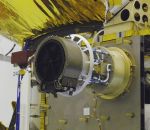
Designed, built and operated by the Johns Hopkins University Applied Physics Laboratory (APL), New Horizons also features instruments from: SwRI (Southwest Research Institute), NASA’s Goddard Space Flight Center, the University of Colorado, Stanford University and Ball Aerospace Corporation.
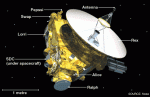
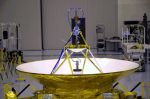
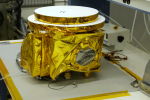
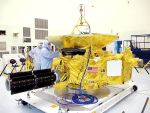
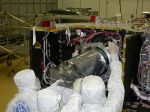
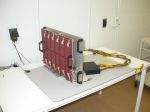
Labeled Instruments Antenna Ralph—telescope and color camera New Horizons at the Kennedy Space Center in 2005 LORRI—long-range camera VBSDC—Venetia Burney Student Dust Counter SWAP—Solar Wind At Pluto

(Images from: WordPress and Wikipedia)

New Horizons is comparable to the size of a piano. It is 27 inches tall,  83 inches long and measures 108 inches at its widest. It weighs about 1,054 pounds.

New Horizons made a brief swing by Jupiter in February 2007 to pick up some data and a bit of a gravity boost (Juno-the second New Frontiers mission- launched on August 5, 2011, is focused on finding more in-depth data about Jupiter) before continuing with its “required” objectives in the Pluto System.

On July 14, 2015, New Horizons made its closest approach to Pluto (7,750 miles away from the surface). It’s primary objectives were to:

  • Characterize the global geology and morphology of Pluto and Charon
  • Map chemical compositions of Pluto and Charon surfaces
  • Characterize the neutral (non-ionized) atmosphere of Pluto and its escape rate

and while we’ve gotten a lot of data, New Horizons could take as long as 16 months to get all of the data back to us (it can only transmit 1 to 2 kb/s)-that means we won’t have it all until November of this year! And then of course there is the time it takes for analysis.

But never fear, in the mean time, New Horizons is continuing onward ( at 9.02 miles/s)  in the direction of the Sagittarius constellation. The hope is that New Horizons will be able to get observations of a Kuiper Belt Object- PT1 (2014 MU-69) in January 2019.
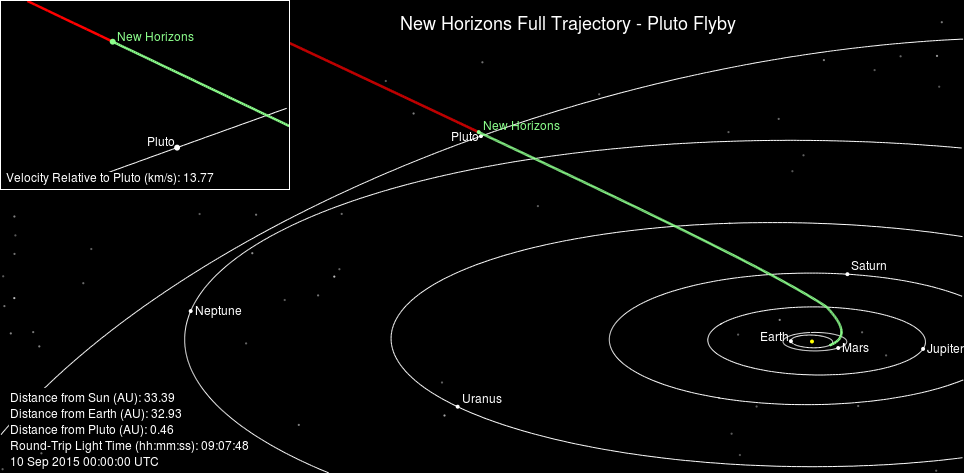
new_horizons_full_trajectory_sideview
New Horizons’ Trajectory (Wikipedia)

More Info:

See Where New Horizons Currently Is

More About New Horizons (from NASA)

NASA Fact Sheet about NH

NASA Press Kit on NH

New Horizons (Wikipedia)

New Frontiers (Wikipedia)


Posted in Class, Dwarf Planets, Jovians, Space Travel | Tagged , , , , , , | Comments Off on Space: The Final Frontier…

Amazing Aurora

aurora_kwon_960
NASA

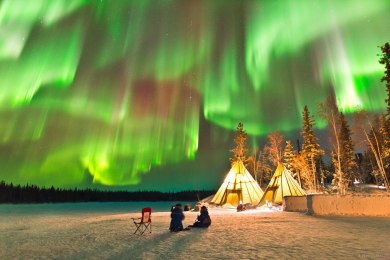
Aurora borealis, the Northern Lights, is one of the most beautiful phenomenon we have on Earth. It is caused by particles from the Sun’s atmosphere that reach Earth’s atmosphere. As the two collide, different colored light is produced, depending on the chemical element and altitude. The lights can shine anywhere from 50-400 miles above the surface of Earth!

Aurora borealis is generally only visible near the North magnetic pole. But wait, there’s more! There are lights near the Southern magnetic pole as well, known as Aurora australis. These names mean “dawn of the north” and “dawn of the south,” named after Aurora, the Roman goddess of the dawn.

Areas with limited light pollution provide the best views for the lights. The photo above shows Aurora borealis in a village in Northern Canada that satisfies this criterion.

Have you ever wanted to create your our Aurora borealis?! Well now you can! This link allows you to generate the Northern Lights display of your choice. Enjoy!


Posted in Science | Tagged , , , , | Comments Off on Amazing Aurora

Tennessee Tectonics

new_madrid_and_wabash_seizmic_zones-usgs3
Wikipedia

Although Tennessee is in the middle of North America, we are still affected by tectonic activity. There are earthquakes in this region from time to time, thanks to the New Madrid Fault.

This Tectonophysics article helps us understand why there are earthquakes in Tennessee. North America began to rift, or break apart, in the Late Precambrian time. One arm of the attempted rift failed and has since been buried by hundreds of meters of sediment. Sometimes, the plates slip along this lingering deep fault and shake Tennessee and the surrounding states.

The New Madrid Fault is named after New Madrid, Missouri. This USGS article details the historic New Madrid Earthquakes of 1811 and 1812, which were famously large, most breaking a magnitude of 7 on the Richter Scale. The Fault hasn’t wreaked such havoc in the past two centuries, but it does cause a notable quake every once in awhile.


Posted in Class, Historical, Science | Tagged , , , | Comments Off on Tennessee Tectonics

Stephen Hawking and the Universe

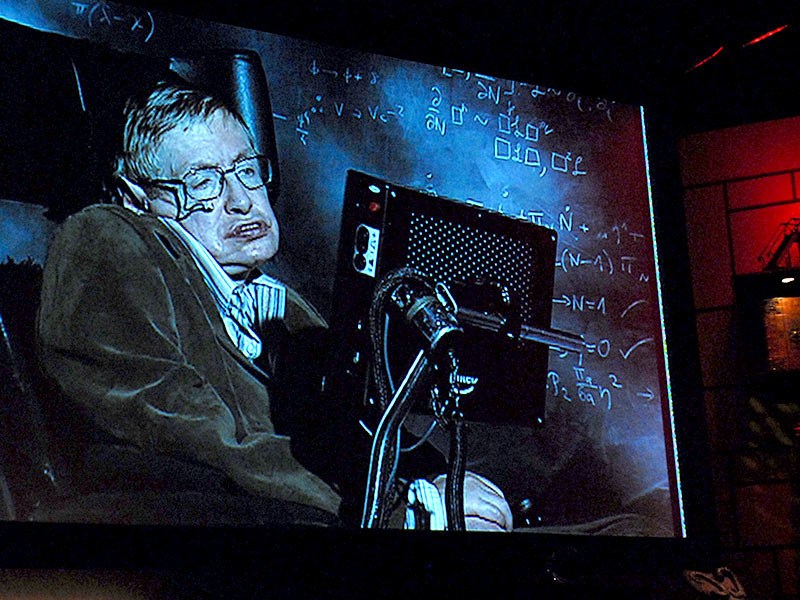
Stephen Hawking has fascinated me since I was a young child. Besides just his scientific discoveries and knowledge, the fact that he has been able to succeed so amazingly with such a potentially hindering disability is extremely remarkable. One of Hawking’s talks that I found extremely interesting was his “Questioning the Universe” TED Talk. In it, he was asked if he believes we are alone in the Milky Way, meaning there is no intelligent life within our close proximity. In response, Dr. Hawking replied, “I think it quite likely that we are the only civilization within several hundred light years;otherwise we would have heard radio waves. The alternative is that civilizations don’t last very long, but destroy themselves” (TED 2008). The alternative answer he provides is what really got me. Either we’re alone, or civilizations destroy themselves. When he mentioned this, I obviously put his idea into the context of our own planet and civilizations. I couldn’t help but ask myself, “Is our civilization going to die with the death of the sun, our life giver, or are we going to destroy ourselves far before that?” It’s a scary thought that humans, a small aspect of the vast, enormous universe have the ability to completely wreck themselves eternally. What’s even scarier to me, though, is that no one will care. As the universe moves on, second by second, it and all of its contents will be completely unaware of the fact that we ever existed or died. Really, really weird stuff.

hawking.jpg

Hawking giving his talk.


Posted in Class, Universe | Tagged , , | Comments Off on Stephen Hawking and the Universe

The Simplicity of Science

When studying science, something that often overwhelms or pushes people away is the apparently complexity of it. In chemistry, a lot of people give up when they reach organic; in physics, some people just can’t get past certain theories. However, when reading about the nature of science in chapter three, something occurred to me: science isn’t meant to be so complex, it is just the inherent nature of it. The chapter discusses a theory known as Occam’s Razor, which basically says that the most simple solution or explanation to an issue should be the one that is used. When thought about practically, this makes complete sense; why would one add unnecessary complication to an explanation. In science, this holds true. The most simple explanations to scientific problems are the ones that are developed, understood and repeatedly used. However, the matter of fact is that science is complex, and therefore even the most simple explanations are oftentimes difficult to understand or work through. This makes science feel a little less intimidating, at least for me, because I now realize even when something is difficult to understand, it is truly as easy as it can get.

occamsrazor

Hilarious comic demonstrating Occam’s Razor in a silly way


Posted in Class | Tagged , , | Comments Off on The Simplicity of Science

The Fermi Paradox

EnricoFermi
Enrico Fermi

Have you ever sat around and wondered, where are all the aliens? Well, you certainly aren’t the only one. In 1950, Enrico Fermi came to the realization that “any civilization with a modest amount of rocket technology and an immodest amount of imperial incentive could rapidly colonize the entire galaxy” according to SETI.  His theory, known as the Fermi Paradox, has four main points. The first is that the Sun is relatively normal, typical star and there are approximately 200-400 billion stars in the Milky Way, along with 70 sextillion stars in the observable universe, many of which are way older than Earth. The second point is that there is a high probability that some of these stars will have Earth-like planets, and some might develop intelligent life, if one thinks Earth to be a typical planet. The third point is that some of these intelligent civilizations, have they been around long enough, might develop interstellar travel, which we are working on now. The fourth and final point is that even at a slow interstellar travel space, the Milky Way Galaxy could be traversed in about a million years, which is a small fraction of the Universe’s 14 billion year old life.

This all leads back to the question of where are they? According to this theory, we should’ve already been contacted by or have some proof of aliens. Hmm.


Posted in Aliens, Class | Tagged , , | Comments Off on The Fermi Paradox

MUSE Telescope

MUSE
Color composite of the unusual polar ring galaxy NGC 4650A created by MUSE

The Multi Unit Spectroscopic Explorer (MUSE) telescope is one of the newest telescopes that allows us to get 3D views of the universe. MUSE is installed on the European Southern Obserbatory’s Very Large Telescope in Chile. It took over a decade to design and develop it but finally went online in March of 2014 and captured a string of incredible images, one of which is pictured above. In the picture above, you can see that there is blue light on the left, and red on the right. This is because MUSE has split the light from each part of this galaxy into component colors to show the chemical and physical properties of each point. In order to accomplish this, the telescope uses 24 spectrographs to split the galaxy’s light into its spectra which then allows it to assemble images and spectra of different regions in the sky. As we talked about in class, the studies of these spectra can tell us about the composition and movements of any object in the sky.


Posted in Class, Instruments | Tagged , , , | Comments Off on MUSE Telescope

The Slowest Speed of Light

Quickly imagine the speed of light. It’s fast right? I’m sure you’ve been taught that the average speed of light falls somewhere around 3 x 10^8 m/s (6.706 x 10^8 mph) and you are partially correct. But what if I told you that you would have been equally right with an answer of just 38 mph?

You may or not have studied the slight deviations in the speed of light through mediums. For example, light travels at 2.25 x 10^8 m/s through water, but in glass light travels at 2.0 x 10^8 m/s. The principle here is that light in a medium travels slower than light in vacuum. So what kind of medium does it take to slow the speed of light to a turtle’s pace of 38 mph?

Scientists from the Rowland Institute and Harvard University collaborated on a research project to find such a medium. The team of researchers discovered that if atoms of sodium were supercooled to essentially absolute zero (the theoretical lower bound for temperature) the atoms acted began to act as a single unit with incredibly unique properties. Using this method, the team was able to take the fastest phenomena known to man and slow it to a comparable craw.

Future applications of this research remain distant, but the team hopes to use the technology to improve the power consumption and size of transmitters, and create new laser systems and camera technologies.


Posted in Class, Light, Physics | Tagged , , | Comments Off on The Slowest Speed of Light

Photo from the Opportunity


Mars Rover Photo.jpg

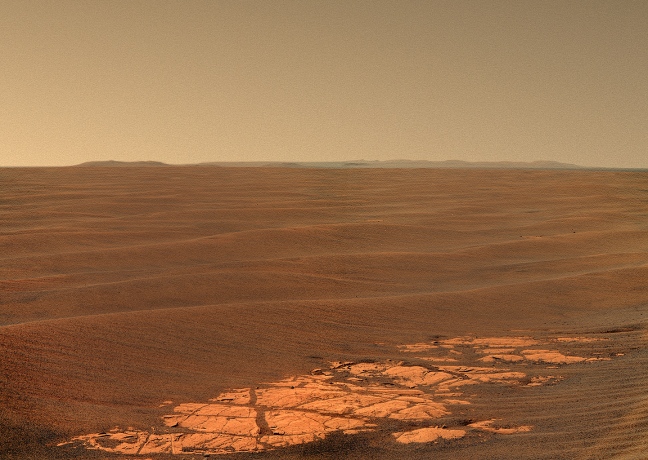
This incredible photo from the rover Opportunity pictures the Endeavor crater rim. It’s truly amazing how that even 12 years after being sent, Opportunity is still sending back photos this amazing.

Opportunity is the longest-running Mars Rover, having been exploring and taking pictures of Mars since 2004. Opportunity has been documenting mineral samples, craters, and even the discoveries of the existence of water since it embarked. Having many difficulties, including being stuck inside of a sand dune for several weeks, the rover is still moving, and sending images similar to the one above.


Posted in Class, Space Travel | Tagged , , | Comments Off on Photo from the Opportunity

Telescope

telescope1

image source

Throughout human history, the invention and improvement of telescope occupied an indispensable place in the advancement of astronomy. And this blog is devoted to introducing  the history of telescope in last four hundred years. The earliest known workingtelescopewas created by Hans Lippersheyin 1608 to “see things far away as if they are nearby”. Restricted by the knowledge and technology in that period, this original telescope had a quite simple structure when comparing with  far-advanced large reflecting telescopes nowadays. It consists only of a convex and a concave lens and has only 3 times magnification. Still such kind of telescope spread rapidly after its appearance and opened the gates to the revolution in observational astronomy in later years. Soon after its introduction to Italy, Galileo, one of the most prominent scientist in modern science, improved and perfected the telescope by grinding his own glasses and change the arrangement of lenses. His masterpiece, “Galileo’s telescope”, became the prototype of modern day refracting telescope, with the difference that the objective lens and eye lens of his telescope was made of different lenses, while modern ones made use of two convex lenses. And when we stepped into the 20th century, scientists began to build large research reflectors , such as the 60-inch Hale telescope in 1908 and 100-inch Hooker telescope in 1917 to fulfill their demand for precision photographic imaging that could not be achieved by refracting telescopes before. And with the fast development of science in post-war periods, active and adaptive optics, together with infrared, X-ray  and Gamma-ray telescopes , were also employed in discovering unknown parts of our universe that haven’t been touched before.


Posted in Class | Tagged , , , | Comments Off on Telescope