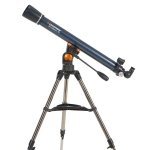
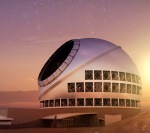
There is such a diverse range of telescopes accessible to consumers around the world. Of course, these telescopes are not of high quality in terms of magnetization and clarity. However, comparing accessible telescopes to high-powered, extremely large telescopes that have entire buildings designed to contain them is not impossible, but seeing as these large telescopes are not accessible to the general public, we shouldn’t necessarily expect the same quality from the telescopes we have at home.
Navigational Compass used in Ming Dynasty image source
Before the invention of artificial satellites and development of data transformation, celestial navigation played an indispensable role in human’s exploration and discovery of newfound lands. And in this blog, I would like to introduce some celestial navigating technologies implemented in Zheng He’s treasury voyage, one of the most significant expeditionary adventures recorded in the 15th century and the navigational compass and constellation map employed during the trip once again show the importance of celestial navigating in ancient times. Firstly, as shown in the figure above, based on their knowledge of magnetic declination, Chinese mariners built their advanced 48-position compass, in which the alignment of the magnetic needle always points to the direction of destination and can be calibrated by artificial measures. During Zheng He’s trip southward to Southeast Asia , one cusp of the needle stay in the direction of North Polaris and when later he switched his destination to the Persian Gulf, the mariner adjust it to point at 22.5 degree SW. Such technology reveals its importance especially in the dates when the sky is clouded over the sea. Another element that is pivotal in the success of his adventure is the constellation map. Unlike maps drawn in previous dynasties, constellation maps employed in his exploration can be separated into seven parts with different sizes and put at arm’s length to determine certain constellation’s height over horizon. And Alpha Lyrae, Pegasi, Canopus and Cassiopeia were frequently used in identifying flotilla’s position during this great adventure.
When one considers that amount of energy that occurs from splitting a single atom, and then multiples that by the 10^80 particles that exist in our universe, one might conclude that the net total of energy in the universe is a astronomically large. Surely beyond anything a human mind could comprehend. The reality however is that the net energy in the universe is Zero.
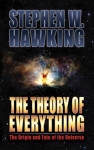
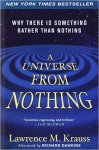
While this may be hard to swallow, Great minds such as Stephens Hawking and Astrophysicists Alexei Filippenko and Jay Pasachoff support such claims. These great astrophysicist hypnotized that for every particle of positive energy (light, matter and antimatter) there is a an equal amount of “negative energy stored in the gravitation attraction that exists between all the positive-energy particles. The positive exactly balances the negative, so, ultimately, there is no energy in the universe at all.” Gravity is deemed “negative energy” because it is the opposing force of the positive amount of energy it takes to pull apart any object. We discuss gravity as a force in class all the time but it’s interesting to see it as a type of energy that counteracts positive energy in the universe. The idea that our vast universe has a net energy of 0 is a unique idea that can be read more in depth in both and “A Universe From Nothing.”
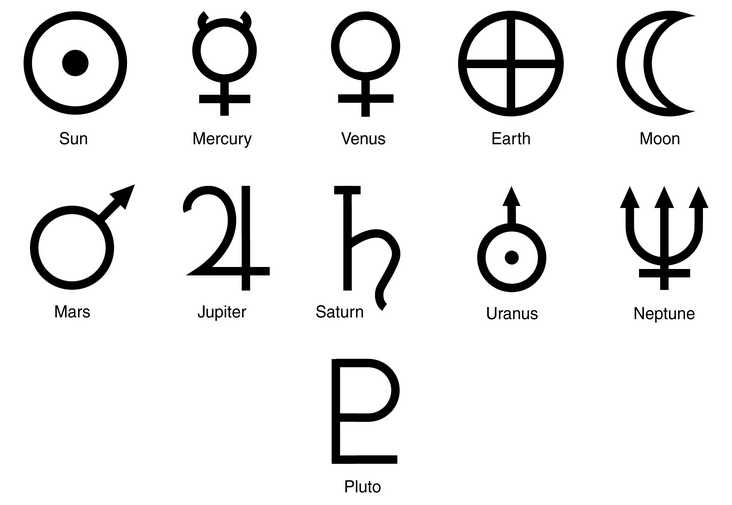
Astronomers, like all scientists, love their symbols. Why spend ages written out full text when shorthand will do? Not only are the symbols for the planets convenient, they also have interesting stories behind them that tie into the planet’s history.
Sun: The symbol for the sun is a circular shield with a dot in the middle, representing the Sun’s central position in our solar system.
Mercury: Mercury is named after the Roman God (Hermes in Greek); therefore this planet’s symbol is Mercury’s winged helmet and staff.
Venus: The symbol represent’s the goddess of love’s hand mirror.
Earth: Our symbol is a globe with a perimeter and meridian.
Mars: The planet named after the god of war and is symbolized by his shield and spear.
Jupiter: Jupiter is named after the king of the gods, known as Zeus in Greek mythology. This symbol is a hieroglyphic of the eagle (who historically represented Zeus).
Saturn: Saturn, also derived from the name of a Roman god, is Saturn’s sickle.
Uranus: Uranus is the combination of the Sun and the spear of Mars to represent all the power of the heavens.
Neptune: Neptune’s trident symbol stems from it’s namesake, the god of the sea.
Pluto: Our dwarf planet Pluto is symbolized by a P and an L after her discoverer, Percival Lowell.
Understanding the history behind these names, like understanding the first astronomers, connects us back to people hundreds of years ago. It reminds us how far we have come in studying space, but also how similar we are to those of ages past who gazed up at the heavens.
While I think that studying space and astronomy is super awesome, I honestly am not sure I can imagine anything worse than living in space for an extended period of time. As we discussed in class, living in space (or at least in orbit) is essentially like being in constant free fall. You know that stomach dropping feeling you get going down a roller coaster? Imagine that all. the. time. Yikes.
But beyond the expected nausea that occurs while in constant free fall, there are numerous other physiological effects that being in space has on the body. According to the National Space Biomedical Research Institute, living in space also affects bones, muscles, the cardiovascular system, the spine, and the inner ear. These effects are listed below.
Bones: Bone growth is facilitated by load-bearing exercise (walking, running, standing, etc). Without the gravitational influence of being on Earth, this load-bearing is significantly reduced, leading to a loss of bone density.
Muscles: Similar to bone, when the muscles are used less, some atrophy may occur.
Cardiovascular System: Without the effects of gravity, the heart actually does not have to work as hard as it does on Earth. This may cause some atrophy of cardiac muscles as well (likely not as significant as somatic muscles).
Spine: The spine actually decompresses slightly, making astronauts slightly taller in space.
Inner Ear: The inner ear is the area responsible for balance on Earth, and is sensitive specifically to gravity. When not used as functioned, this can cause disorientation and additional nausea.
While I think that studying space and astronomy is super awesome, I honestly am not sure I can imagine anything worse than living in space for an extended period of time. As we discussed in class, living in space (or at least in orbit) is essentially like being in constant free fall. You know that stomach dropping feeling you get going down a roller coaster? Imagine that all. the. time. Yikes.
But beyond the expected nausea that occurs while in constant free fall, there are numerous other physiological effects that being in space has on the body. According to the National Space Biomedical Research Institute, living in space also affects bones, muscles, the cardiovascular system, the spine, and the inner ear. These effects are listed below.
Bones: Bone growth is facilitated by load-bearing exercise (walking, running, standing, etc). Without the gravitational influence of being on Earth, this load-bearing is significantly reduced, leading to a loss of bone density.
Muscles: Similar to bone, when the muscles are used less, some atrophy may occur.
Cardiovascular System: Without the effects of gravity, the heart actually does not have to work as hard as it does on Earth. This may cause some atrophy of cardiac muscles as well (likely not as significant as somatic muscles).
Spine: The spine actually decompresses slightly, making astronauts slightly taller in space.
Inner Ear: The inner ear is the area responsible for balance on Earth, and is sensitive specifically to gravity. When not used as functioned, this can cause disorientation and additional nausea.
From the LSD-laden project MK Ultra to the ill-fated foray into psychic warfare that was Stargate Project, the U.S. government has sanctioned some truly strange studies over the past century. But one research endeavor stands out among all the others throught its sheer magnitude, ridiculousness, and surprising potential. I am talking, of course, about Project Orion.
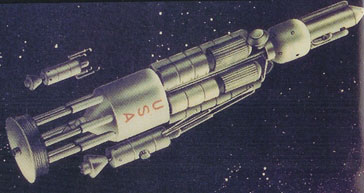
Project Orion began in 1958 in Los Alamos, New Mexico with a team led by physicists Ted Taylor and Freeman Dyson. The idea was simple and, to the average person, sounded completely insane; Dyson and Taylor planned to achieve spaceflight by detonating atomic bombs beneath their ship.
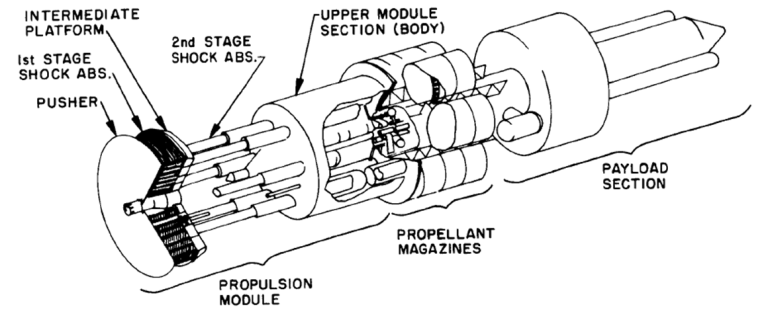
Propulsion would be created through successive atomic detonations a short distance behind the spacecraft. Initial testing of this concept with conventional explosives demonstrated that the force of even a small detonation was enough to destroy any spacecraft so the Orion team came up with the idea of a system of shock absorbers, a pusher-plunger system that would absorb the force of the explosion and safely transfer it to the rest of craft as thrust. Scaled-down Orion crafts were assembled using this concept and explosives testing showed the design to be a great success.
With data in hand, Freeman Dyson went to work on the calculations for a full-size, fully-atomic Orion craft. His results, even by today’s standards, were astonishing. Dyson determined that with the use of 300,000 megatons of deuterium-based thermonuclear explosions a craft weighing 400,000 tons could achieve an incredible speed of 10,000 km/sec! For comparison, the fastest spacecraft ever launched was Helios II had a maximum velocity of only 70.2 km/sec. An Orion spacecraft at top speed would be able to travel to Alpha Centauri, the nearest star, in only 133 years; if implemented, this design would open up an entirely new frontier to manned exploration!
But Project Orion and the its dedicated team would never see there designs come to true fruition. In 1964, 6 years into their endeavor, Project Orion was terminated; the establishment of NASA and the Apollo Program alongside the U.S. signage of the Partial Test Ban Treaty had the final nails into the coffin. 58 years into the future and this incredible project is all but unknown to the average person; however, there is still some hope of mankind one day reaping the benefits of a nuclear-propelled Orion spacecraft. Low to no fallout fission-fusion technology, graphene materials, and advanced electronics have all progressed well beyond the point required to produce such a vehicle, all that remains to be found is a generation dedicated enough to exploring the cosmos to put capital and labor into the project.
Perhaps it will be our generation? Could our generation be the one that takes the technology which once threatened to destroy the world and uses it to seek new ones? Only time will tell.
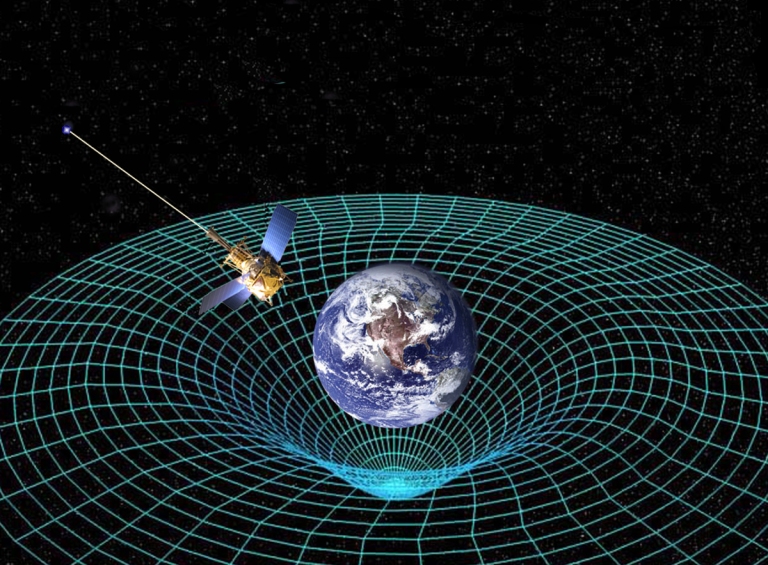
One of the more interesting (and more confusing) concepts we’ve learned thus far in the Solar System is the bending of spacetime. As can be seen in the figure below, massive objects with gravity (such as planets or stars) have the unique property in that they can bend the spacetime “grid” around them.
Spacetime bends, just like sitting on a trampoline. Source
Before you think, “wait now, this sounds like one of those crazy theories in science fiction movies”, this concept is actually based upon the principles of Einstein’s Theory of General Relativity. It essentially describes the way in which objects move around each other in space, and is dependent on the gravitational pull of each object. Similar to our activity in class with the rubber gloves and marble balls, a massive object pulls smaller objects into its gravitational orbit because of this bending.
Another consequence of the bending of spacetime is that massive object can also bend light. This is based upon the principle that light tends to want to travel the shortest possible distance (for example, light bends in media such as glass or water in order to exit in the fastest way). Pretty gravitational stuff.
One of the more interesting (and more confusing) concepts we’ve learned thus far in the Solar System is the bending of spacetime. As can be seen in the figure below, massive objects with gravity (such as planets or stars) have the unique property in that they can bend the spacetime “grid” around them.
Spacetime bends, just like sitting on a trampoline. Source
Before you think, “wait now, this sounds like one of those crazy theories in science fiction movies”, this concept is actually based upon the principles of Einstein’s Theory of General Relativity. It essentially describes the way in which objects move around each other in space, and is dependent on the gravitational pull of each object. Similar to our activity in class with the rubber gloves and marble balls, a massive object pulls smaller objects into its gravitational orbit because of this bending.
Another consequence of the bending of spacetime is that massive object can also bend light. This is based upon the principle that light tends to want to travel the shortest possible distance (for example, light bends in media such as glass or water in order to exit in the fastest way). Pretty gravitational stuff.
Absorption spectra occur when a hot solid or liquid or very dense gas give off a continuous spectrum, with all colors, and then that continuous light moves through a thin gas that is cooler than the source of the continuous light. This thin gas absorbs some of the light being given off by the source of continuous light, creating black lines on its absorption spectrum image. The spectrum of our Sun is an excellent example of this type.
This image shows the full absorption spectrum of our Sun. Each of the black lines gives evidence of various gases that are in the Sun’s atmosphere. The locations of these black lines tell us that the atmosphere of the Sun is made up mostly of hydrogen and helium with traces of eight other gases.











#/media/File:ProjectOrionConfiguration.png)