Limitations of Gravitational Slingshots in our Solar System

The use of gravity assist has been an integral part of space exploration. Gravitational slingshots have been used time and time again to send spacecraft to areas that would be impossible to get to otherwise by providing the spacecraft with increased speed. Accordingly, spacecrafts are able to get places faster and use less fuel.

vtraj.gif

(Voyager aircraft performing gravitational slingshots)

Gravity assist, does, though, have its limitations. First and foremost, relying on the use of a gravitational slingshot means that the mission has to take place in a relatively small window of time. For instance, if we wanted to perform a slingshot around Jupiter in order to get to Pluto, it would make  sense to time the mission so that all three planets were closest to one another. This means that NASA (or whoever else is launching the probe) has to keep to their schedule very tightly or risk having to potentially wait years.

Furthermore, there are limits to how much speed a spacecraft can obtain through performing gravitational slingshots in our Solar System. The most speed a spacecraft can gain through one gravitational assist is the speed at which the planet orbits the Sun. Thus, the most that Jupiter can be used to accelerate a spacecraft with one gravitational assist is about 13 km/s. Though this is extremely fast, it is still not nearly fast enough to make interstellar travel feasible. If we wanted to perform multiple gravitational slingshots to further accelerate a spacecraft , we would need to develop more fuel efficient travel methods since performing multiple gravitational slingshots would take too much fuel.


Posted in Space Travel | Tagged , , , , | Comments Off on Limitations of Gravitational Slingshots in our Solar System

Limitations of Gravitational Slingshots in our Solar System

The use of gravity assist has been an integral part of space exploration. Gravitational slingshots have been used time and time again to send spacecraft to areas that would be impossible to get to otherwise by providing the spacecraft with increased speed. Accordingly, spacecrafts are able to get places faster and use less fuel.

vtraj.gif

(Voyager aircraft performing gravitational slingshots)

Gravity assist, does, though, have its limitations. First and foremost, relying on the use of a gravitational slingshot means that the mission has to take place in a relatively small window of time. For instance, if we wanted to perform a slingshot around Jupiter in order to get to Pluto, it would make  sense to time the mission so that all three planets were closest to one another. This means that NASA (or whoever else is launching the probe) has to keep to their schedule very tightly or risk having to potentially wait years.

Furthermore, there are limits to how much speed a spacecraft can obtain through performing gravitational slingshots in our Solar System. The most speed a spacecraft can gain through one gravitational assist is the speed at which the planet orbits the Sun. Thus, the most that Jupiter can be used to accelerate a spacecraft with one gravitational assist is about 13 km/s. Though this is extremely fast, it is still not nearly fast enough to make interstellar travel feasible. If we wanted to perform multiple gravitational slingshots to further accelerate a spacecraft , we would need to develop more fuel efficient travel methods since performing multiple gravitational slingshots would take too much fuel.

Posted in Space Travel | Tagged , , , , | Comments Off on Limitations of Gravitational Slingshots in our Solar System

We’re all attractive (by gravity!)

dpsrOLYMPUS DIGITAL CAMERA

Images: Gravitational Field Conic Sections

We like to think science has everything figured out—and it has in fact come very far to that end. But there are still many things in the world and the universe that has researchers scratching their heads. One of these phenomena is gravity, the force that attracts all objects.

Sure, we know how to calculate gravitational attraction between two objects (see Newton’s Law of Universal Gravitation).  We can use Kepler and Newton’s findings to determine a planet’s orbital period, predict orbital shapes, and even calculate when a comet will pass us by.

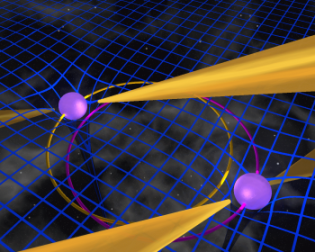
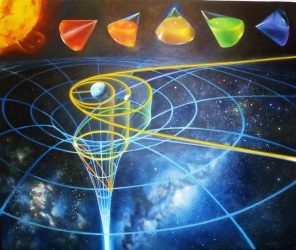
Einstein’s Theory of Relativity offers an alternate take on how gravity functions. He theorized that gravity is actually caused by curves in space-time, otherwise known as the fourth dimension. Rather than viewing gravity as a Newtonian force, Einstein believed that these fourth dimension curves cause objects to orbit other objects and even collide. This can be demonstrated with stretched fabric and metal balls, shown here.

As we can see, scientists have ascertained a lot of information about the patterns of gravity and its general workings. But we still don’t seem to have a grasp on what gravity truly is and how it works on a fundamental level.


Posted in Historical, Physics, Science, Universe | Tagged , , | Comments Off on We’re all attractive (by gravity!)

We’re all attractive (by gravity!)

dpsrOLYMPUS DIGITAL CAMERA

We like to think science has everything figured out—and it has in fact come very far to that end. But there are still many things in the world and the universe that has researchers scratching their heads. One of these phenomena is gravity, the force that attracts all objects.

Sure, we know how to calculate gravitational attraction between two objects (see Newton’s Law of Universal Gravitation).  We can use Kepler and Newton’s findings to determine a planet’s orbital period, predict orbital shapes, and even calculate when a comet will pass us by.

Einstein’s Theory of Relativity offers an alternate take on how gravity functions. He theorized that gravity is actually caused by curves in space-time, otherwise known as the fourth dimension. Rather than viewing gravity as a Newtonian force, Einstein believed that these fourth dimension curves cause objects to orbit other objects and even collide. This can be demonstrated with stretched fabric and metal balls, shown here.

As we can see, scientists have ascertained a lot of information about the patterns of gravity and its general workings. But we still don’t seem to have a grasp on what gravity truly is and how it works on a fundamental level.


Posted in Historical, Physics, Science, Universe | Tagged , , | Comments Off on We’re all attractive (by gravity!)

HW #B3 – A Superpower Redefined

Be it an elementary school sleepover or a university orientation, there’s always a place and time for the infamous question: If you could have any superpower, what would it be? Some people say they’d love to fly or breathe underwater, but one of the most popular answers is X-ray vision.

The entire process behind X-ray “vision” is based on the varying energies different types of light possess. No, this isn’t referring to the brightness of a fluorescent light VS outdoor lighting. Instead, I refer to the Electromagnetic Spectrum, a visual placement of different types of light we can and can’t see.

File:EM Spectrum Properties reflected.svg
The Electromagnetic Spectrum

According to “The Cosmic Perspective” by Jeffrey Bennett, the length of light visible to us is extremely small. “ROY G. BIV,” the collection of visible light we know (red, orange, yellow, green, blue, indigo, violet), is nearly a billion times shorter than all the light that falls between X-ray and radio.

The different types of light that appear on our scale include gamma, x-ray, ultraviolet, visible, infrared, microwave, and radio. Gamma rays are the strongest, meaning that they have shorter wavelengths and higher frequencies than the other types of light. X-rays, then, are pretty intense and can even harm the human body, causing cancer and mutations in some individuals. For this reason, doctors and technicians take precautions when issuing “X-rays” to patients by covering them with lead aprons. However, x-rays are not typically strong enough to penetrate through our bones – which makes sense considering x-ray images show events like fractures in our bones or cavities in our teeth. Yet, the images are produced on a film that records the light that passes through our body.

Sweet. So Superman could bend science at his will to look at things through walls, right? 

Wrong. Without a film behind whatever he’s observing, he wouldn’t be able to see anything special with his vision. The x-ray images we see are merely representations of the process of x-rays passing through a body, being unable to get past bone, and thus leaving an imprint or outline of the bony barriers on the film. The objects Superman would want to see or look through, like walls, don’t give off x-rays. Therefore, Superman’s vision wouldn’t pick anything up, and he’d look straight through the important stuff.

I guess that kills a lot of kids’ dreams (including mine). Now I think I’ll have to answer with a more realistic superpower, like flying.


Posted in Class, Light, Science | Tagged , , , | Comments Off on HW #B3 – A Superpower Redefined

Many Different Milky Ways

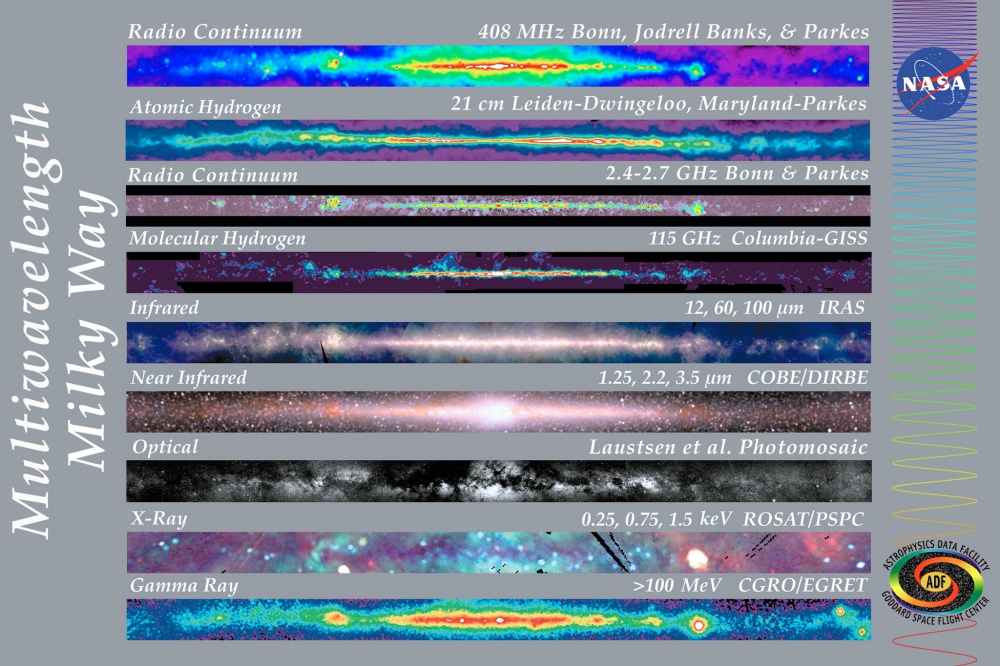
mwmw_all

We know that there are many different types of light in the Universe. Each type gives us unique information about the object we are studying. The above picture from NASA contrasts the same celestial object, the Milky Way, in different wavelengths.

Note that the further we deviate on either side (longer or shorter wavelength), the poorer the quality/resolution of the image. This is because we have yet to improve instrumentation to be on par to the quality of those for optical or infrared. Receiving high energy radiation such as gamma or X-ray light is difficult as it passes directly though a detector unless the incoming x-rays are deflected before they are detected.

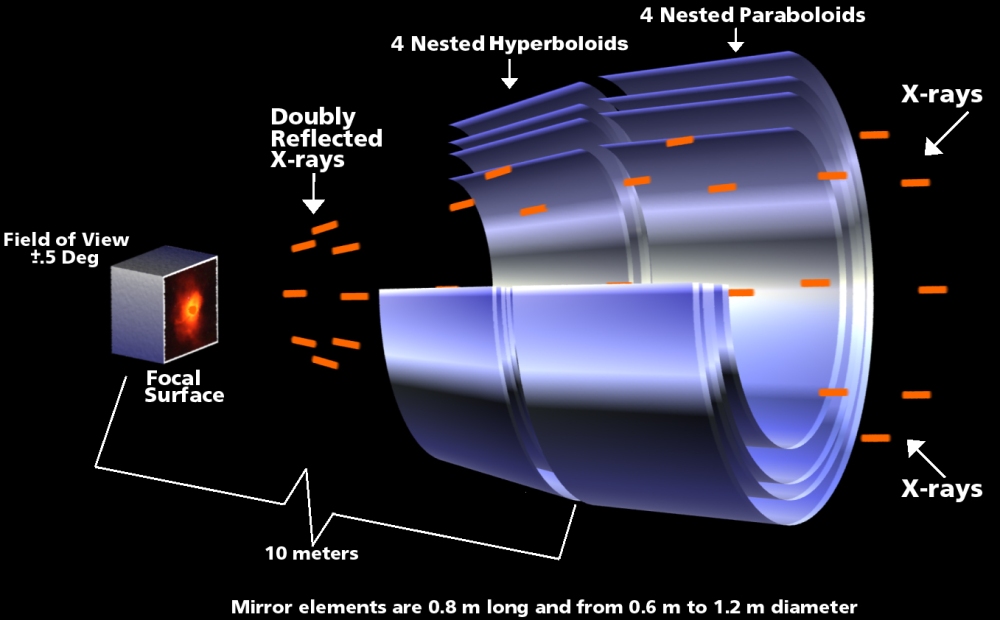
nested-paraboloid

Source: NASA/CXC/D.Berry

This is the internal setup on NASA’s Chandra X-ray Observatory in space. The x-rays are funneled slightly so that they can actually be readable by the detector.

Here’s a quick overview of some functions each type of radiation has for astronomy purposes (most info from here):

-Radio => Radio is good for long range interferometry, a method for getting distances to stars. Also, this is the preferred wavelength for SETI’s (Search for Extraterrestrial Intelligence) research.

-Microwave => Cosmic microwave background (CMB) only visible at this range. We can also detect HI (a transition of neutral hydrogen), which enables us to look past interstellar dust clouds to the celestial objects behind them from our point of view.

-Infrared => Infrared light can translate to the temperature of an object. Commonly used for viewing gas clouds that are stellar nurseries.

-Optical (visible) => It is nice to see the Milky Way in the human’s eye range. NASA’s Kepler Space Telescope uses optical to search for transits, which signify the presence of exoplanets.

-Ultraviolet => UV allows the analysis of young stars and the interstellar medium (Source).

-Gamma/X-ray => Both ranges are used to analyze very high energy events in the universe, such as jet emission from a black hole, gamma-ray bursts, or pulsars.


Posted in Class, Galaxies | Tagged , | Comments Off on Many Different Milky Ways

The Martian – Hollywood exaggeration or accurate?

Yes, I’m super behind on my movie watching but I finally watched “The Martian” over the weekend and wow did it absolutely spark my interest in space travel and the feasibility of living on Mars for months including growing your own food…what? By the way, if you haven’t seen it yet stop reading this immediately and go watch it. It’s completely worth it and this post will spoil it for you.


First off, The Martian does a great job and gets some stuff right, but then again this is science fiction and so there has to be some fictional things but what “The Martian” does is not over exaggerate a ton of things making almost all of it very believable. One blatant thing that they screwed up was the storm at the beginning that stranded the astronaut on Mars after he was hit by the communication tower that the wind knocked over. The dust storm certainly could occur but not to the level it was dramatized because of the incredibly thin atmosphere Mars has. So the storm couldn’t have happened, however, a lot of other things they got right.

For instance, all the orbital dynamics and the time it would take to travel between Mars and Earth was completely dead on and one scientist even acclaimed the movie for doing the computations to determine how long the trips would take. On top of this, the slingshot the Hermes Spacecraft undertook around Earth to head back to Mars was entirely feasible as gravity assisted speed boosts are used to help satellites obtain more speed all the time.

The last two things I wanted to talk about was the ability to grow potatoes on Mars and taking off from mars in a deconstructed rocket. After doing research, I found out that the way Watney grew potatoes was entirely feasible as Martian soil can sustain food growth especially with using feces as fertilizer and obtaining water the way he did, so, in essence, his ability to grow food on Mars is plausible.

Last, what I thought was most ridiculous, was when Watney basically stripped the rocket of its nose cone and other portals so he was essentially flying into space in an open cockpit. I thought there was absolutely no way this could happen. Well, it sort of is and sort of is not feasible. I say this because currently we do not have the technology to take off from Mars because NASA has absolutely no idea how to launch a rocket from Mars at the current point in time so, in that case, it is not possible. However, the fact that the windows are off is potentially possible because the atmosphere is so thin, by the time friction (which would develop heat and thus require the heat shield to protect against the atmosphere) played a factor, it would be negligible. Therefore, it is plausible to launch a spacecraft like that.

All in all, “The Martian” does probably the best job yet of abiding to science when creating a science fiction movie and it was applauded by many scientists as well as checked by NASA to prove it was mostly valid despite a few snafus. If you haven’t seen it yet, I would strongly suggest you go see it immediately.

Sources: Guardian, Time MagazineIFLScience


Posted in Class, General, Science, SolarSystem, Universe | Tagged , , , , , , | Comments Off on The Martian – Hollywood exaggeration or accurate?

10 Seriously Cool Astronomy Facts

diamond-star
Space.com

The prospect of picking my own blog topic this week out of any and all astronomical topics was just TOO daunting for an indecisive person like me. So, I decided to just talk about a bunch of really super incredible amazing things all in the same post. The following are some seriously AWESOME astronomical facts:

  1. Only one two-billionth of the sun’s energy output is actually sent to the Earth.
  2. When an object falls into a black hole, scientists call it “spaghettification” because of the way black holes stretch the objects they absorb.
  3. If you could find a body of water big enough to put Saturn in it, Saturn would float.
  4. Saturn’s moon Titan, Jupiter’s moon Lo, Neptune’s moon Triton are all so massive that they’ve pulled their own moons into orbit.
  5. The core of a star can reach temperatures of 16 million degrees Celsius. If a single grain of sand was this hot, it would be able to kill a human being from 150 kilometers away.
  6. Neutron stars are so incredibly dense that a single tablespoon of their matter would weigh approximately 10 billion tons.
  7. 96% of the universe cannot be seen because it does not emit or reflect light.
  8. Technically, “space” begins at the Karman Line, which is only 100 km above the surface of Earth. Thus, a car driving into the sky could be in space in less than an hour.
  9. Since there is no wind or atmosphere on the Moon, footprints there will last pretty much forever…or until our Sun explodes or s meteor collides with it or something else disastrous like that.
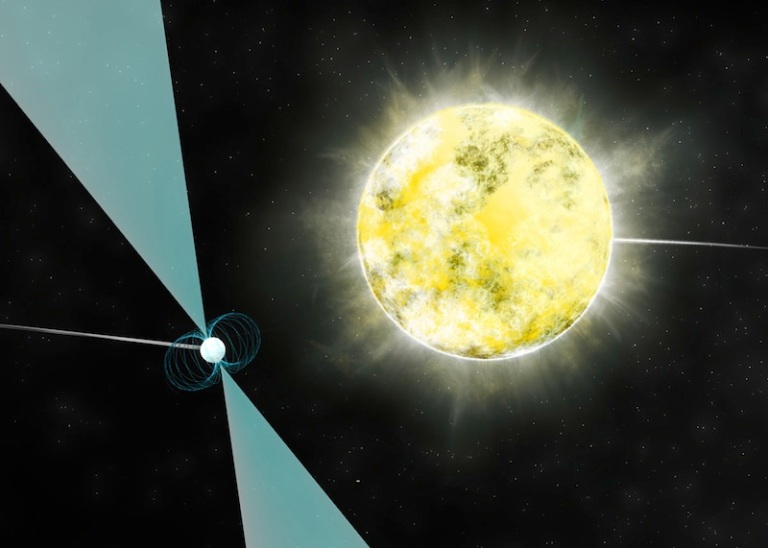
  10. Scientists have discovered a star that is so cold and compact it has crystallized into a solid diamond.

Pretty sweet, right?


Posted in Class, General, SolarSystem | Tagged , | Comments Off on 10 Seriously Cool Astronomy Facts

Spectra Across Spectral Types

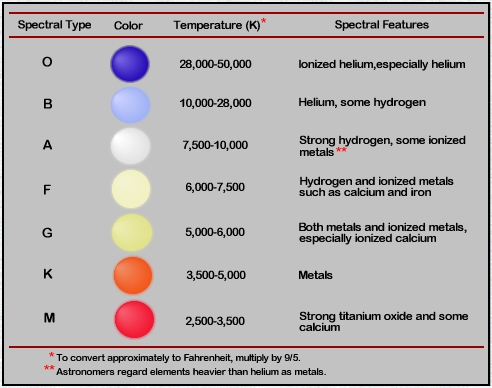
One of the beautiful aspects of the universe is that not every celestial object is exactly the same. The majority of stars spend their lives on the “main sequence” in which they have stable volume and continuously undergo hydrogen fusion. Astronomers use a classification system based solely upon the temperature of a star, assigning each star a “spectral type”.

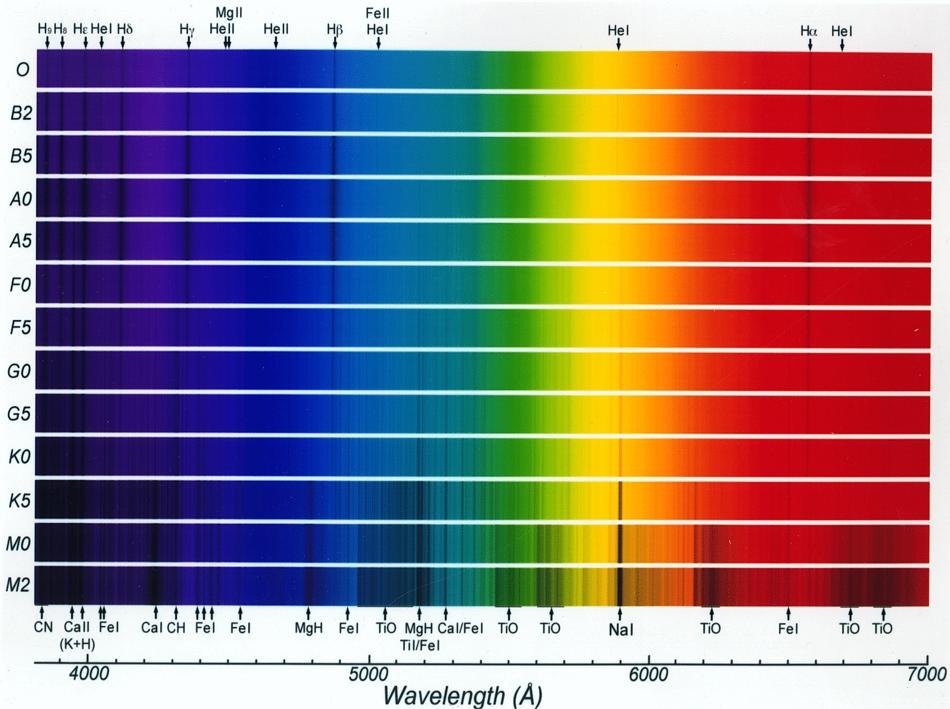
spectral_types

Each spectral types (from O,B,A,F,G,K, and lastly M)  goes from hottest temperature to coolest temperature. Each letter spectral type as a numerical subtype, ranging from 0 to 10 (0 being the hottest and 10 the coolest). For example, an M1 star is hotter than an M5 star, while a K5 star is hotter than an M1 star.

We know that we can split an incoming star’s light through diffraction, and analyze that’s star’s luminosity on a continuous axis of wavelength. By scrutinizing spectra across multiple spectral types, we start to some reasons as to why astronomers decided to classify based upon temperature only.

spectra_briley

The picture above shows graphical spectra across several different spectra types. Though the spectrum for each type is unique, we can see some definite trends.

-Cooler types (such as K5, M0,M2) have very rich spectra (i.e. many dark absorption lines). The cooler temperatures in these stars’ outer layers allow more compounds to form (see NaI or MgH on the bottom). Other stars do not contain these chemicals as the chemicals would otherwise disassociate due to their higher temperatures.

-Likewise, only hotter types contain specific absorption lines. These lines only occur because the high temperature allow for high energy transitions (such as H-beta or H-gamma).

In conclusion it is important to remind ourselves that though we separate stars into distinct types, differently classified stars could be more alike than you would think.


Posted in Class, Historical, Observables, Stars | Tagged , , | Comments Off on Spectra Across Spectral Types

I’ve got this giant telescope and I don’t know where to put it: a guide for all your telescope placement needs.

light pollution
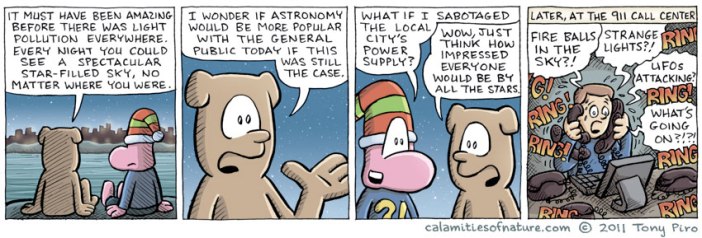
Light pollution, alternatively known as the astronomer’s worst enemy. Source

Hey, where should I put my giant telescope?

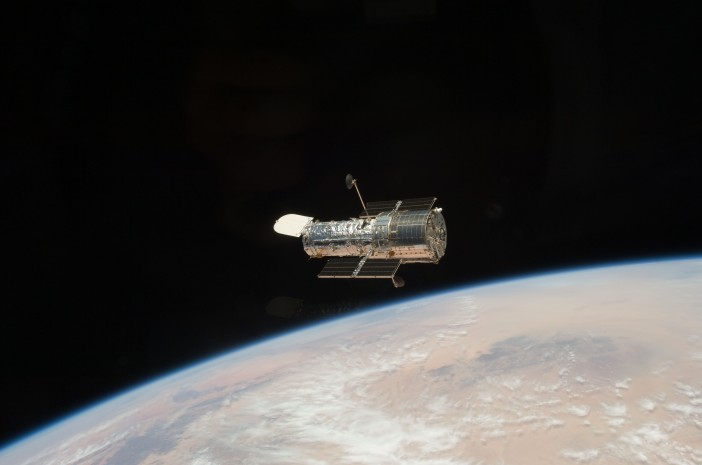
Ideally, you would put your telescope into space! Space is most advantageous for observing the stars because most types of non-visible light are blocked by our atmosphere; this wider spectrum of detectable light allows for more detailed study of some of the universe’s greatest extremes. Some of the most famous telescopes, including the Hubble Space Telescope are actually located in Earth’s orbit instead of here on earth!


Hubble_telescope_2009
Pictured: the best place to put your telescope. Source

Look man, I’m no Elon Musk. I saved for years to get my giant telescope, can’t I just cut costs now by putting it in my backyard?

Do you live in a city? Do you live near a city? Do you live within a few miles of any source of artificial light?

Yeah…

Well then you might want to hold off on setting up your own little observatory in your backyard! If you want your telescope to be a world class stargazing machine, you need to get it away from light pollution. Light pollution is an artificial brightening of the night sky caused by man-made lights. It is extremely destructive to astronomical observations – some telescopes have even been decommissioned because of encroaching light pollution! Most observatories have no form of external lighting on them, so watch your step when you’re headed inside.

light-pollution-us
Pictured: a light pollution map of the United States, alternatively known as where not to put your telescope. Source

Okay, so I can’t put it anywhere convenient to human civilization. Whatever, I can deal – stars are cool! Is there anything else I should worry about?

Well, there’s a couple more things to consider: you don’t want there to be any wind.

No wind?

No wind. Turbulence in the air can lead to some serious distortion of your images. This means that you shouldn’t put your observatory directly on the coast, where there’s lots of wind.

Okay, what about the second thing? You said a “couple more things”.

Oh yeah! Clouds. You should probably make sure it isn’t cloudy all the time wherever you decide to put your telescope. It’s hard to see through clouds.

So, away from the coast, away from cities, and where it’s sunny? How about the middle of the desert?

Great idea! Many of the world’s foremost observatories are located in the middle of the desert, including Cornell University’s planned observatory in the middle of the Chilean desert.

It seems like you’ve got a pretty good handle on this – I’ll leave the rest up to you!

Read what I read!

Caltech: Why do we put telescopes in space?

Cornell: How does light pollution affect astronomers?

Telescope Optics: Turbulence error


Posted in Class, Instruments, Observables | Tagged , , , | Comments Off on I’ve got this giant telescope and I don’t know where to put it: a guide for all your telescope placement needs.