Want to Buy a Telescope?

If you would love to see deeper into space from your own home, you may be interested in buying your very own telescope! Fortunately, Sky & Telescope has some guidelines to help you make this big purchase, as described by Kelly Beatty in her recent article, “How to Choose Your First Telescope.” 

Here are some highlights from the article:

  • You can sometimes find a good telescope form around $250, but most great ones will cost at least $400.
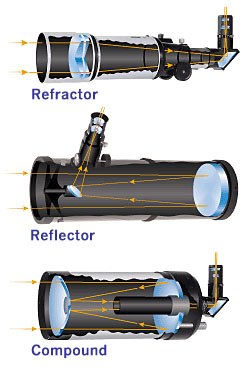
  • There are three types of telescopes that you can purchase for personal use. Refractors are the most common and have a lens at their front end. Reflectors have a mirror in the back and tend to be the cheapest. Compound telescopes are more complex, but they are often smaller and less cumbersome than the other two types. You can see the types of telescopes in the image below.


telescope-types-m
Sky & Telescope
  • It is important to consider the type of tripod or mount that comes with your telescope, so you can use it easily.
  • Above all else, make sure to think about the aperture you desire for your telescope. This is the diameter of the telescope’s lens or mirror and determines the detail in which you can see objects at a given distance. 

For more inspiration, Deep-Sky Watch has a great article called “What Can You See With Different Telescopes” that shows you what you may expect to be looking at with a telescope of your own.

Whether or not you choose to purchase a telescope, hopefully you have learned more about these amazing devices!


Posted in Class, Instruments, Science | Tagged , , | Comments Off on Want to Buy a Telescope?

Historical Astronomers in Context

johannes-kepler
Famous Scientists

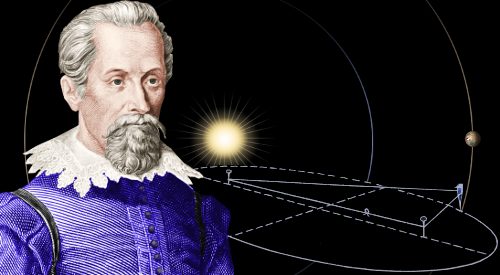
My chosen astronomer is Johannes Kepler, who lived from 12/27/1571 – 11/15/1630. Kepler helped us understand orbits. He developed three rules, the first of which tells us that things orbit in elliptical shapes. His second rule tells us that when something is in orbit, it sweeps equal areas in equal time. His third rule shows us a formula to understand the relationship between distance and the time it takes for an object to orbit. These rules have been extraordinarily helpful in physics and astronomy, especially as used to understand the relationship between the sun and the Earth.

During Kepler’s lifetime, the following interesting events occurred:

1605: The first part of the Spanish novel Don Quixote was published by author Miguel de Cervantes.

1607: English settlers establish the Jamestown colony in Virginia.

Additionally, William Shakespeare lived from 1564 – 1616. He is a still a world famous playwright, likely the most famous of all time.

When I first saw the dates during which Kepler was alive, they seemed so long ago that little of modern relevance could have possibly been going on. However, I have learned not only how many other major astronomers were alive during Kepler’s time, but also that important literary and historical events with modern relevance were happening.


Posted in Historical | Tagged , , | Comments Off on Historical Astronomers in Context

SCED: The Science of Perspectivism

Hey guys! Rani and I have been talking a lot about perspective for this week’s blog. First, I wanted to think about the place historical context holds in a STEM course similar to this one.

Dr. G mentioned last Tuesday that our lecture about historic science (Copernicus, Tycho, Gallileo, etc.) would likely be the last we’d see. We already touched on this in seminar, but does anyone want to expand on the benefits of looking at science through the lenses of history? I think it’s a great way to establish a broad mindset—one with which you can question new material as you learn it. Can a science major or scientist survive without paying attention to historical advances in their field? Will their work really be affected if they just memorized famous names as an undergraduate and now focus their active attention on the future (on progress in their field)?

With more regard to the context of our course, I’ve been thinking about the value of teaching this kind of historical science to a very diverse group of kids. Some students are hard science majors. Others might just be taking the class because they’re interested in the material or they think it’ll be an easy 2000-level class. Either way, is it worth bothering communication majors with a historical perspective on astronomy? Do science majors really need it? – K

In keeping with this theme, we wanted to explore a little more fully the different approaches to assessment that Dr. G demonstrates. Professor Johnson talked a little bit about different assessment styles and their efficacy and place in a STEM course in general, and a more broad introductory course like this in particular. From https://www.cmu.edu/teaching/assessment/basics/formative-summative.html we see that the goals of formative and summative assessments are varied in scope, with the former being “monitoring student performance to provide ongoing feedback” and the latter “evaluating student learning at the end of an instructional unit.” Clearly the multitude of assignments and assessment opportunities that Dr. G peppers along our learning experience has differing learning and assessment outcomes, but Kelsey and I wondered why specific things are set up the way they are – why, for example, are the lecture tutorials, which centrally influence student learning and constitute a model for test-taking, optional, whereas the more freeform blogging assignments are mandatory? What is the import given to each type of learning experience – be it direct question-and-answer problem solving and concept intake and retaining (as in the L-T) or a more creative, less confining arena like blogging? And more importantly I guess for the scope of this blog post, what is the import given to the assessments associated to each learning experience? Do you want more assignments with summative assessment? More formative assessment? How do these questions fit into the broader question of centralizing learning? What are y’all’s thoughts? – R


Posted in Science | Tagged , , , , , , , , | Comments Off on SCED: The Science of Perspectivism

The Egyptian Senmut Star Map

egpytians

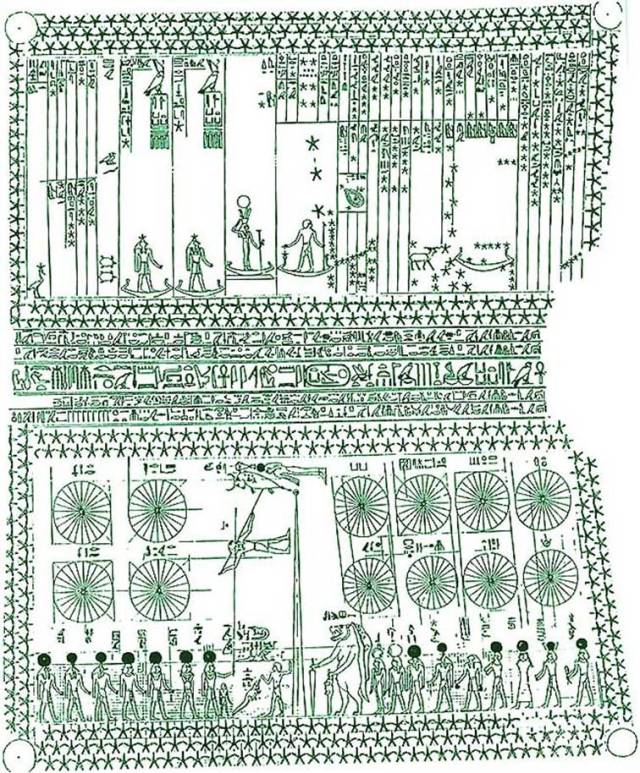
The Ancient Egyptians made significant contributions to the field of astronomy. These ancient anstonomers were able to predict solar eclipses based on the passage of the moon between the Sun and Earth during the daytime. The Egyptians developed calendars and star clocks that kept time based on celestial movement. Senmut, the grand vizier of Egypt in 1500 B.C., developed the world’s oldest known star map. The Senmut star map (pictured above) shows precise planetary positions as well as an understanding of retrograde planet motion.

Ancient Egyptian religion included aspects of cosmology, incorporating a special knowledge of the stars. Ancient cultures often interpreted celestial events such as eclipses as signs from a deity of things taking place on Earth. The hieroglyphic sign for a star was often written the same way as the sign for a god. Despite the conflation of scientific observation with religious interpretation, the Egyptians certainly made major progress in their study of the firmament.

I find it fascinating that the Senmut map includes humans in its depictions of celestial positions. There are also strange lizard looking creatures among the people. The Senmut map appears like a code not only to the celestial sphere, but also to the culture of these fascinating ancient people.

Check out more information on the Ancient Egyptian Astronomers here.

In modern science fiction, Egyptian culture’s link to astronomy is often explored. I’m sure some of us remember the movie Stargate and can appreciate it’s idea of a star portal to ancient Egypt?!


stargate


stargate_movie_jackdaniel

Posted in Historical, Science | Tagged , , , , , , | Comments Off on The Egyptian Senmut Star Map

The Egyptian Senmut Star Map

egpytians

The Ancient Egyptians made significant contributions to the field of astronomy. These ancient anstonomers were able to predict solar eclipses based on the passage of the moon between the Sun and Earth during the daytime. The Egyptians developed calendars and star clocks that kept time based on celestial movement. Senmut, the grand vizier of Egypt in 1500 B.C., developed the world’s oldest known star map. The Senmut star map (pictured above) shows precise planetary positions as well as an understanding of retrograde planet motion.

Ancient Egyptian religion included aspects of cosmology, incorporating a special knowledge of the stars. Ancient cultures often interpreted celestial events such as eclipses as signs from a deity of things taking place on Earth. The hieroglyphic sign for a star was often written the same way as the sign for a god. Despite the conflation of scientific observation with religious interpretation, the Egyptians certainly made major progress in their study of the firmament.

I find it fascinating that the Senmut map includes humans in its depictions of celestial positions. There are also strange lizard looking creatures among the people. The Senmut map appears like a code not only to the celestial sphere, but also to the culture of these fascinating ancient people.

Check out more information on the Ancient Egyptian Astronomers here.

In modern science fiction, Egyptian culture’s link to astronomy is often explored. I’m sure some of us remember the movie Stargate and can appreciate it’s idea of a star portal to ancient Egypt?!


stargate


stargate_movie_jackdaniel


Posted in Historical, Science | Tagged , , , , , , | Comments Off on The Egyptian Senmut Star Map

Tycho Brahe in a Historical Context


51242337

Tycho Brahe, a historically famous and important astronomer, was born on December 14, 1546 and died on October 24, 1601. During his lifetime, two important events occurred:

  1. The Counter Reformation (1562): This was a period of Catholic resurgence that occurred as a response to the Protestant Reformation. It was an attempt to return Catholicism to its spiritual foundations in a time of uncertainty.
  2. Shakespeare began his career as a playwright in 1585. He is regarded today as one of the greatest writers in the English language.

In addition, another very important historical figure lived at the same time as Brahe: John Calvin. Calvin was a major figure in the Protestant Reformation and he established a system of Christian theology that is now referred to as Calvinism. One of this famous acts was nailing “The Ninety-Five Theses” to the door of a Catholic church.

I believe too often today we see science as existing in some sort of empirical vacuum, immune to influence from outside sources like society and culture. Reading about the context that these astronomers lived in reminds me that the idea of this vacuum simply isn’t true. I believe that society and culture dramatically shape both the way science is done and the way it propagates throughout society. Knowing this allows us to look at science in a different light and understand how some scientists came to the conclusions that they did within their time periods.


Posted in Historical | Tagged , , | Comments Off on Tycho Brahe in a Historical Context

Isaac Newton in Context

Newton was important because he formulated the laws of gravity, which are crucial for understanding planetary motion. These explained orbits, the tides, and many other things about Astronomy. He also came up with his three laws of motion, which are extremely important in Physics. Source

New Amsterdam was taken over by the British and renamed New York in 1664. This was a major event, and paved the way for Britain taking over the Thirteen Colonies and New York becoming a major city. Source

The English Civil War lasted from 1642-1651. These wars determined who was to rule England, between Parliament and the monarchy. Oliver Cromwell also took over at some point and ruled kind of as a dictator. And The Parliament ended up winning and required the monarchy to get Parliamentary approval before ruling. Source

Benjamin Franklin lived from 1706-1790. He was an important figure in the American Revolution, and was also an inventor who came up with inventions like the bifocals. Source

I think this was relevant to show me just how recent of a development the heliocentric model (and physics and the other things Newton discovered) has been. Important events in American history were occurring during Newton’s life, and America is a relatively young country.


Posted in Historical | Tagged , , | Comments Off on Isaac Newton in Context

Historical Astronomers in Context

Isaac Newton (December 25, 1642 to March 20, 1727) discovered the laws of motion and universal gravity which are still taught in introductory physics classes today. These principles allowed him to demonstrate that the physical laws that operate on Earth also operate across the rest of the universe. Newton discredited any remaining doubts about the validity of the heliocentric model of the Solar System. Additionally, among many other things such as helping develop calculus, he predicted that Earth was shaped as an oblate spheroid and built the first reflecting telescope.

Historical Events

The Great Plague of London was the last outbreak of the epidemic that occurred in London from 1664 to 1666. It killed almost 100,000 people, or approximately one quarter of London’s total population at the time.

The Glorious Revolution was the overthrow of King James II of England that occurred in 1688. This led to the passage of the Bill of Rights, and since 1689, England (and now the United Kingdom) has functioned as a constitutional monarchy.

Historical Person

Thomas Hobbes (April 5, 1588 to December 4, 1679) was an English philosopher who established social contract theory and developed the fundamental principles for classical liberalism.

Reflection 

The amount of great philosophers who were alive at this time is amazing. While Isaac Newton is now considered a scientist or mathematician, in his day he was described as a natural philosopher (the philosophical study of nature and the physical universe). He describes himself as such in the title of his book, “Philosophiae Naturalis Principia Mathematica.” Additionally, there were great philosophers whose ideas are still relevant today. Rene Descartes, John Locke, and Thomas Hobbes are some of the more notable philosophers who lived during this time period and whose theories are still studied in philosophy classrooms today. The late 1600s and early 1700s where a great time for both philosophical and scientific discovery.


Posted in Historical | Tagged , , | Comments Off on Historical Astronomers in Context

Hypatia – Historical Astronomers in Context (repost)

<note to students: I went farther than you need to because no one can use Hypatia as their historical figure>

Hypatia – 350?? to 415 C.E. pic source Mathematician, astronomer, philosopher, teacher

Hypatia was the first woman KNOWN to contribute to mathematics and science.  Her father, Theon of Alexandria, was a well-known academic and taught his daughter to follow in his footsteps.  Remarkably, she was the head of the Platonist school of philosophy in Alexandria, Egypt.  She was advisor to rulers and sought out by scholars and those who wanted to learn for she was famed for her oratory skills, her sharp mind, and her virtue.  She worked on astronomical bodies and tools (astrolabes especially), on density, and abstract mathematics of the day.  Her greatest contribution to mathematics turned out not to be an original work but one that described the mathematics of conic sections (ellipses, parabolas, hyperbolas) in a manner more easily understood than the original author.  Unfortunately, she is perhaps most well-known for her manner of death: a mob of Christian fanatics kidnapped her, took her to a church, stripped her of clothing and then of her skin using roofing tiles, then burned her mutilated body.  Many historians say this event was really the end of rigorous scholarship in the once great city of Alexandria.

Other sources of interest about Hypatia:

  • Hypatia biography (from University of St. Andrews)
  • Biographies of Women Mathematicians: Hypatia (from Agnes Scott College)
  • Women in History: Hypatia (Humanist Network News Ezine)

Contemporary person:

Contemporary events:

  • Stained glass starts getting used in Roman churches
  • The Sack of Rome by the Visigoths (410 CE) – basically ended the Western Roman Empire (though the Byzantine (Eastern Roman) Empire lasted another 1000 years).  Generally said to be the end of “classical history” and the start of the “Middle Ages”
  • Hadrian’s Wall (separating “barbarian” Scotland and “civilized” (a.k.a. Romanized) Britain) is overrun for pretty much the final time and allowed to fall into ruin (406 CE)
  • In China – Jin Dynasty
  • In IndiaGupta Empire (“The Golden Age of India”)
  • In Africa – People start settling the area of the Great Zimbabwe (but don’t build stone structures yet)
  • In Mesoamerica – the Maya and Zapotec were the most well-developed cultures but were mostly city-states with Teotihuacan as the most powerful (too early for Aztec)
  • In America – Southwest: Late Basketmaker II Era ; In Midwest/East: Hopewell Culture
  • In South America – most significant cultures are Moche and Nazca (the ones with the lines) (too early for Inca)

Reflection:

I really enjoyed seeing what was going on in the world of Hypatia’s – the things that affected her spheres and what was going on throughout the globe.  Hypatia’s specific world was one where scholarship was valued but it could really be affected by the politics of the era, especially with fanatic Christians.  It seems once Christians of the day got a bit of power or really just stopped being murdered, they adopted some of the same intolerant tactics.  She just happened to be in the wrong city in the wrong time period but she did get to live a scholarly life and be appreciated by MANY in her rather long (for that period) lifetime.  However, she lived when the mighty Roman Empire was finally defeated – what a strange time!  The Western Empire (i.e., not Byzantine) was floundering anyway but that Visigoth sack of Rome was so disheartening to the people of the day.

Elsewhere in the world, I found that what was going on in the Americas particularly interesting – I always have trouble with putting the ancient American civilizations into context.  We hadn’t gotten anywhere near Incans or Aztecs or Iroquois, but the civilizations that were there were mighty themselves.  I always wonder at what we’ve lost over the years from American cultures (from idiotic conquerers), from Mediterranean cultures (from the fires that happened at the Library of Alexandria and from religious zealotry), from just the passage of time…


Posted in Historical | Tagged , , , | Comments Off on Hypatia – Historical Astronomers in Context (repost)

The Best Astronomy Apps

Top Five List of The Best Apps In the Apple Store Now

SkySafari (4.99) Allows you to view the the position of celestial bodies as far back as 1 million years back and as far forward as 1 million years in advance. Purchase  comes with subscription of Skyweek.

StarMap (4.99)- A point and locate app that Suggests the best celestial bodies to view each night. Also locates possible locations of shooting stars.

Distant Sun (3.99)- Another point and locate app that has detailed information on 300,000  stars. The app also updates its users  with the latest news from Astronomy Magazine.

Pocket Universe (2.99)- A great app for beginners that keeps track of the the celestial bodies you have viewed and quizzes you on the celestial bodies you have seen.

Solar Walk (2.99)- An interactive map of our solar system that allows you to see the exact location of each planet in its orbit. Can click on any planet in our solar system and get comprehensive history of the exploration of a given planet

Click to view slideshow.


Posted in Class | Tagged , , | Comments Off on The Best Astronomy Apps