Armageddon: The End or a New Beginning?

Artist depiction of an asteroid impacting Earth

Armageddon is a word that generally refers to an end-of-the-world scenario. One of the more common ideas, in regards to Armageddon, is that our end shall come at the hands of an impact from a near-Earth object (comets, asteroids, meteorites) that will create such a disturbance from not only the energy released from the initial impact, but also the after effects caused by it . After effect examples are as such: dust in the air from impact could potentially drop the average temperature of Earth by several degrees due to sunlight being blocked; If a carbonate rock rich area is hit, a large amount of CO2 would be released into the atmosphere which would lead to an increase of the average temperature of earth due to the greenhouse effect.

As of now we don’t have any 100% valid methods of defending against any nEo’s that wouldn’t naturally burn up completely in our atmosphere. And, although, such an impact by a large nEo has quite a low probability of occurring there is still a chance, however slight, that one day we may face eminent impact from a large nEo.

The last time we were hit by an extremely large nEo (6 mile diameter) was about 65 million years ago by what is now called the Chicxulub asteroid. The dinosaurs, who were the dominate species at the time,  were completely wiped out which paved the way for the smaller mammalian species to flourish and become the new dominate species on Earth. This gave humans the chance to evolve into the species that we are now, for without the extinction of the dinosaurs there would have been no way for us to become as we are since we would have become very easy prey for the carnivorous dinosaurs as we grew bigger. It is hypothesized that due to the mammalian small size at the time (approximately the size of a rat) we were able to hide underground for most of the destruction that the Earth saw and resurfaced once conditions were better to find that we were some of the biggest animals still around. I posit that another such catastrophic event will simply lead to another species rising to power and having a shot at reigning supreme on Earth; maybe this species would evolve to be smarter, stronger, and more empathetic than humans have been.

An impact event, or some other apocalyptic event, could eventually happen to Earth and we as humans need to have safety nets in place as soon as possible lest we be wiped out of existence completely and become fossils for some other species to study in the distant (or not so distant) future.


Posted in Class, Universe | Tagged , , | Comments Off on Armageddon: The End or a New Beginning?

What is the true mission of NASA?

Ted Cruz has drawn both criticism and support in recent weeks for his declaration that NASA should be focused on the tangible goals of space exploration rather than their recent endeavors into earth science and climate change. Some see his arguments as longing for the inspirational spirit of NASA’s classic Apollo missions, but others see them as petty partisan tactics. If he were simply a vocal senator, it would not matter all that much, but given that he leads the Senate subcommittee on Space, Science, and Competitiveness, his opinion is crucial. Subcommittees have the ability to dictate policy in congress by killing bills before they reach the floor. If NASA is to continue to provide key research on climate change, it will have to do so in spite of Cruz.


Posted in Public Policy | Tagged , , | Comments Off on What is the true mission of NASA?

Io being squeezed

We all know that Jupiter exerts tremendous tidal squeezing on Io, but we need images to truly grasp the magnitude of this force. This image shows Io spewing a 200 mile high volcanic plume! For reference, that is greater than the distance from Nashville to Knoxville! It is baffling to think that tidal squeezing alone can cause such massive ejections of debris.


Posted in Moons | Tagged , , | Comments Off on Io being squeezed

Green Galaxies?

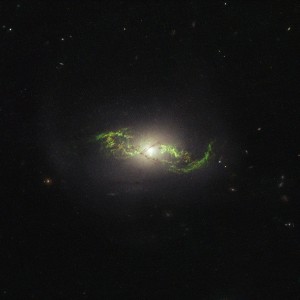
Back in 2007, using the popular website Galaxy Zoo, Hanny van Arkel discovered galaxies with emitting a green color. Though stars emit the color green, it is thought that it isn’t possible for their color to appear green. Now equipped with new data from the Hubble Space Telescope, astronomers believe these green galaxies to actually be two galaxies merging, each with their own super massive black hole. The super massive black holes orbit each other upon merging galaxies and feed off large amounts of material in the other galaxy leaving large amounts of ionized oxygen in the farthest outreaches of the galaxy with the green hue coming from “the echo” of these.

hs-2015-13-c-large_web-300x300


Posted in Galaxies | Tagged , , | Comments Off on Green Galaxies?

Why I did not like the movie “Interstellar”

When Cristopher Nolan’s Interstellar hit the theaters in November 2014, I decided to wait for reviews from my friends. My friends, most of whom were pursuing Electrical Engineering and Physics majors, had this to say about the movie after they watched it: “Meh, too many logic holes”. So I skipped the movie; but over the year my curiosity and anticipation grew as I kept hearing positive recommendations from many others. So I picked up the movie when the DVD was released last month.

My verdict: I was disappointed. Why? Because I did not understand the movie. Don’t get me wrong; the performance by Matthew McConaughey and Michael Caine was polished, the cinematography was spectacular, and the CGI was fully convincing. But it was my incomprehension at the science presented in the movie that marred the experience. I was fully aware that the movie was a fiction, not a science documentary. But when you have experts like Kip Thorne, a theoretical physicist at Caltech, as a consultant for the movie, you are bound to expect better or easier to understand justification for the “fictitious science.”

Here are a few of the things in the movie that I could not understand

The worm hole shown as a 3D tunnel

For a brief amount of time, the movie showed the Ranger’s passage through the wormhole as going through a tunnel. Suppose we collapsed space to a 2D plane. Even if we assumed the worm hole to be a 3D tunnel between two points of the folded 2D space, the “tunnel” would become a 4D space in reality, at least according to the movie’s explanation. An instantaneous warp to the other point in the universe, and not 3D tunnel, perhaps would have been more plausible for visualizing purposes.

Visualization of the wormhole concept

blackholes_wormhole


Ranger requires booster rockets on Earth but not Mann’s and Miller’s planets

The spacecraft Ranger required propulsion from booster rockets to reach escape velocity when launched from Earth. However, it seems that Ranger did not require any booster rockets to leave Miller’s and Mann’s planets. The fact that the astronauts’ walk composure looked the same as they did on Earth indicated that the planets’ surface gravity is similar to that of Earth. One way to address this discrepancy is to assume that the planets were significantly smaller than Earth. Escape velocity rises with sqrt(m/r) while surface gravity rises with m/r^2, where m = mass of planet and r = radius of planet. Hence, decreasing the radius of a planet for a given mass increases surface gravity much faster than it increases the escape velocity. But then again, does planetary formation allow for such dense planets?

The Ranger spacecraft

Interstellar-Ranger


Frozen Clouds on Mann’s planet stay afloat despite 80% Earth Gravity

Let us just ignore the first discrepancy: Dr Mann (Matt Damon) reveals to Cooper (McConaughey) that the planet does not have surface. So it is like a Jovian planet? Yet its outer atmospheric conditions are similar to a terrestrial planet? What cannot be ignored is that the solid frozen clouds on the planet are defying gravity. What is holding them up in the skies?

The frozen clouds on Mann’s planet

Mann's_planet


Time dilation within the black hole Gargantua was only a few decades

We shall simply ignore that as soon as Cooper in his ship came near to the event horizon of Gargantua, differential gravity would have elongated him into a spaghetti. What is also incomprehensible is that even after spending a few minutes inside singularity itself, less than a 100 Earth years have passed: Cooper’s daughter is still alive, probably in her 100s. Bear in mind that on Miller’s planet 1 hour equated 7 Earth years just by being close to Gargantua. Due to the inverse square law, gravitational field strength increases exponentially as one approaches the source. Not even considering singularity, just by being near the event horizon for a few seconds should have caused thousands of Earth years to have passed.

The black hole Gargantua

interstellar-top_0


If you think I am mistaken in explaining the scientific holes in the movie, please feel free to correct me in the comments.

References

http://www.motherjones.com/media/2014/11/interstellar-movie-science-david-grinspoon-inquiring-minds

http://www.quora.com/Interstellar-2014-movie/Why-did-it-take-two-rocket-stages-to-lift-off-the-Earth-and-get-to-the-Endurance-orbit-but-just-Ranger-rocket-engines-to-lift-off-Millers-planet


Posted in Physics, Science | Tagged , , , | Comments Off on Why I did not like the movie “Interstellar”

Lunar Eclipse Creates an Apocalyptic View

bloodmoon-09-670x440-150406

Last weekend, one of the first two lunar eclipses of 2015 occurred and left a great view. The moon dimmed and turned red giving it an eerie and dark feeling, leading some people to dub it as a blood moon. As we have learned already, eclipses consist of two parts. The penumbra is when the moon is partially in the Earth’s shadow and the umbra is when the moon achieves totality. Though totality wasn’t seen by most onlookers, most people were able to view a partial eclipse. In myths and legends, blood moons were seen as bad omens or a sign that the apocalypse is approaching. However, now we know that the red color is caused by the color of the eclipse during totality where light refracts through the Earth’s atmosphere tainting the moon. However, the moon isn’t always viewed by red by everyone. Some people may see a faint shade or a very obvious red depending on viewing conditions and atmospheric effects.


Posted in Class, Science | Tagged , , , , | Comments Off on Lunar Eclipse Creates an Apocalyptic View

Space has a lot of….space

Most people, including myself before ASTR201, have only seen seen the scaled models of the solar systems where planets are to scale but right next to each other.

However, space is called space for a reason. You may have heard of the real life scaled down model, but you would never understand the true emptiness until you either walked it or scrolled it by using this website. Experience the time it takes to scroll from the Sun to Earth. Look at the distance between the Earth and the Moon and compared it to the distance to Mars. It makes sending a rover look more impressive.

Source
Source

Posted in Class, General | Tagged , , | Comments Off on Space has a lot of….space

An End to the Discovery of Bright Kuiper Belt Objects?

Check out this image from Universe Today:

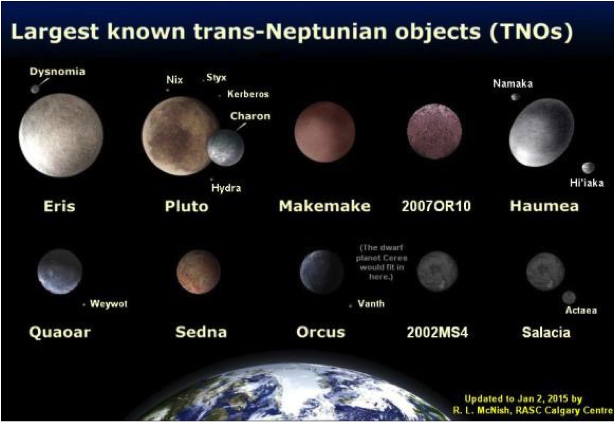
The presently known largest small bodies in the Kuiper Belt. (Illustration Credit: Larry McNish, Data: M.Brown)

The presently known largest small bodies in the Kuiper Belt. (Illustration Credit: Larry McNish, Data: M.Brown)

This shows the largest known objects in the Kuiper Belt. Pretty interesting to see how many things out there are similar in size and appearance to the former planetary member of our solar system – Pluto. I’ve always been a fan of the little guy, so it’s fascinating to see Eris and Makemake and these other dwarf planets way out there. The guy who is responsible for relegating Pluto, Dr. Michael Brown, has come forward saying that the objects represented in the picture above represent the largest objects that will be discovered in the Kuiper Belt, confidently saying there is nothing else to see and that surveyors of the sky should look elsewhere. Interesting stuff coming from the guy who killed everyone’s favorite ‘planet’!

From Universe Today


Posted in Class, Dwarf Planets, Universe | Tagged , , | Comments Off on An End to the Discovery of Bright Kuiper Belt Objects?

Merging Green Galaxies

Green, glowing whorls of ionized oxygen around the galaxy NGC 5972. Credit: NASA, ESA, and W. Keel (University of Alabama, Tuscaloosa)

Green, glowing whorls of ionized oxygen around the galaxy NGC 5972. Credit: NASA, ESA, and W. Keel (University of Alabama, Tuscaloosa)

This picture is a pretty cool visual representation of what’s going on way out there in outer space. This picture represents a supermassive black hole pulling two galaxies together and merging them. Apparently, as amateur astronomer Hanny Van Arkel discovered a few years ago, the gravitational forces of the black hole combined with the chemical reactions occurring result in the two galaxies emitting a green luminescence. It’s for me to really give a good description of exactly what’s happening, but Scientific American does a good job explaining everything in the link below. I think its really fascinating to visualize some of these massive galactic forces at work.

From Scientific American

http://blogs.scientificamerican.com/observations/2015/04/03/supermassive-black-holes-make-merging-galaxies-green/


Posted in Class, Galaxies | Tagged , , | Comments Off on Merging Green Galaxies

The Search for Extrasolar Planets

Extrasolar planets, or exoplanets, lie outside our solar system. We have so far discovered nearly 2000 exoplanets, most of which are Jovian planets like Jupiter.

However in 2009, a possibly Earth like planet was discovered: Gliese 581d had the potential to support liquid water on its possibly rocky surface. It has a mass of around 7 times that of Earth, would be twice as big and has a surface gravity around twice that of Earth. In 2014, however, astronomers at The Penn State University pointed that the signal for Gliese 581d was just noise. The supposed Gliese 581d’s star is a Red dwarf 20 light-years away from us. Red dwarves are covered with sunspots, and it was believed that the data for Gliese 581d was just an interference signal caused by a solar flare. The planet didn’t exist! But now astronomers at Queen Mary University have stated that the dismissing conclusion was premature.

Artist’s Impression of Gliese 581d

dnews-files-2015-03-exoplanet-670x440-150309-jpg

Whether or not Gliese 581d exists is still a debate. Nonetheless, this gives us non experts the impetus to learn about the tools that astronomers use to detect exoplanets.

Doppler spectroscopy is the most common method, which was also used to detect Gliese 581d. It uses radial velocity measurements by examining Doppler shifts in the spectrum of a star. Tiny changes in a star’s radial velocity indicate the existence of nearby massive orbiting body. By tracking these changes over time, astronomers can estimate a planet’s minimum mass.

Another method is to look out for the dimming of the brightness of a parent star. Such dimming indicates a planet passing between the observer and the star. This is the second most useful method, though it does lead to false positives.

Lastly, astronomers also use astrometry — position of a star in the sky is pinpointed and the tiny changes is its position are used to determine the existence of a planet nearby.


References

http://news.discovery.com/space/alien-life-exoplanets/habitable-super-earth-gliese-581d-might-exist-after-all-150309.htm
http://www.space.com/17738-exoplanets.html


Posted in Exoplanets, Instruments | Tagged , , , | Comments Off on The Search for Extrasolar Planets