Martian Aurora?

Illustration showing Maven and the aurora over Mars

Source: National Geographic

NASA’s MAVEN spacecraft has recently detected a strange aurora in the lower atmosphere of Mars. Dubbed “Christmas lights” by scientists, the mysterious phenomenon occurred for five days in December, following a solar electron storm. On Earth, auroras are formed when these particles slam into atmospheric atoms, but on Mars, the lack of a global protective magnetic field allows the particles to penetrate deeper into the atmosphere to about 30 to 60 miles off the surface. The result is an aurora that occurs in the ultraviolet wavelengths, making it visible only to our equipment. As University of Iowa professor Jasper Halekas states, “it’s not your grandfather’s magnetosphere.” Phenomena like this one remind us that Mars is not as sterile and unchanging as we might think; it is still a hub of fascinating activities and processes.


Posted in Physics | Tagged , , , | Comments Off on Martian Aurora?

Studying the Effects of Space Travel on the Human Body

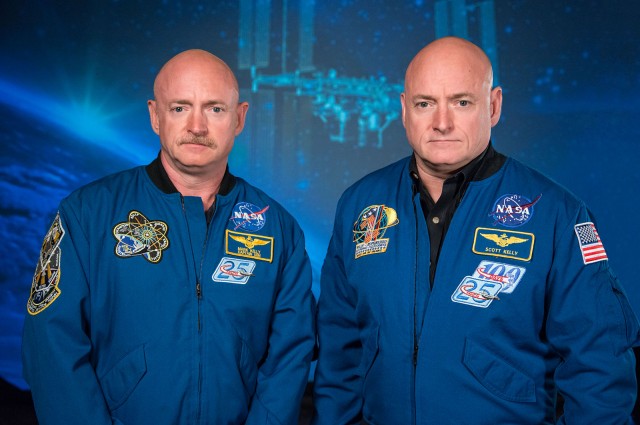
Mark and Scott Kelly

Mark and Scott Kelly

NASA is conducting an experiment to determine the effects of living in space on the human body. Such studies have been done before, but this one is unprecedented in the length of time the subject will spend in space (a full 365 days) and in that the participants are identical twins.

One astronaut named Scott Kelly has agreed to live in the International Space Station for a full year while his identical twin brother, Mark Kelly, has agreed to take part from  the ground. Both brothers will undergo physical and psychological testing before and after Scott’s trip, and both will follow similar diets. Because the brothers share the same DNA, any changes that occur between them will likely have been caused by their environment.

This study is ground breaking as it will allow scientists to find ways to mitigate any problems that come with living in space for any future space trips, and may pave the way to one day travel to Mars, Venus, or even other systems entirely.


Posted in Space Travel | Tagged , , , | Comments Off on Studying the Effects of Space Travel on the Human Body

Exoplanet in Four Star System

Source: Discovery News

Astronomers recently discovered the second exoplanet known to be part of a four star system. To find a planet in such a system is rare because the gravitational interaction between the stars are likely to remove planets from any sort of stable orbit. Four star systems are fairly rare themselves, making up about 4% of all systems. In this case, a gaseous exoplanet (which is about 10 times the mass of Jupiter) safely orbits its parent star, which has a binary partner. This binary system interacts with another binary system to form a larger 4-star binary orbit, with each pair of stars serving as a partner. Due to the complexity of this system, the night sky on the exoplanet would be very bizarre by our standards. According to NASA, the planet’s parent star would appear as a small sun in the sky, and the binary partner and other 2 star system would appear as bright stars, even during the day.


Posted in Exoplanets | Tagged , | Comments Off on Exoplanet in Four Star System

Planet Discovered with Four Parent Stars

4starplanet

An Artist’s Depiction of the System

Binary star systems, like the one featured in the Tatooine system of Star Wars are common in the universe with half of all systems being comprised that way. Ternary system, or systems with three stars, are more rare, and even more rare are quaternion systems.

Planets within these four star systems are also rare, so much so that we have only just now found the second such a planet in the last few weeks. The planet, dubbed 30 Ari, is a “hot Jupiter” that lies exceptionally close to its primary star, orbiting once every three days. However, the planet’s primary star is thought to have had little to do with its creation; it is much more likely that it was thrown into its current orbit from gravitational interactions with the other three much larger, more distant stars.

The article does not go into the composition of the planet, but though they describe it as a “hot Jupiter,” I doubt that it has a composition close to that of Jupiter. Jupiter is full of ices that wouldn’t be able to form. Perhaps it was once a gas giant, but unless it’s magnetic field protects it, my guess is that the gases have been stripped off of it.


Posted in Stars | Tagged , , , | Comments Off on Planet Discovered with Four Parent Stars

The Toughest Creature in the World

In the early 1700s, several different scientists examining the components of water and water habitats came across a miniscule creature that seemed to float around in many different areas abundant with water. These scientists found that these creatures were really present in many dry places too, but only began to move when hydrated by rainfall or submersion in some body of water.

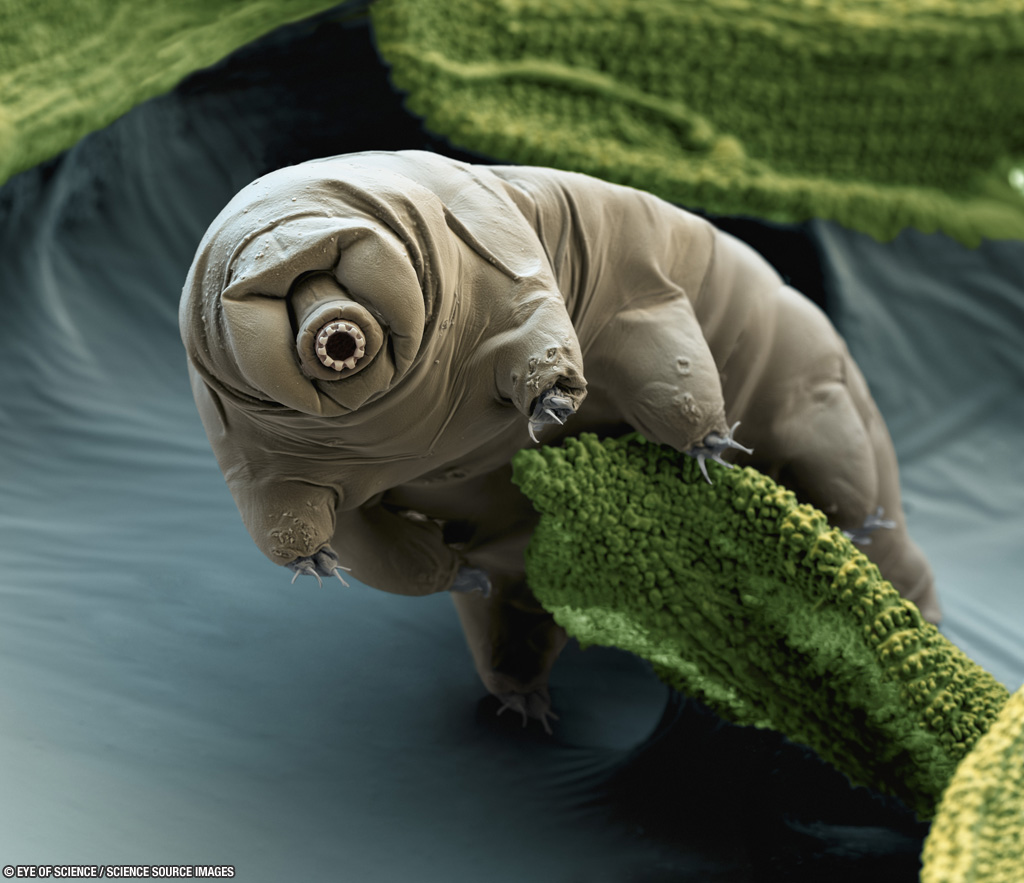
These creatures were later named tardigrades, and they would become some of the most mysterious and fascinating subjects in modern biology and, though perhaps this may seem unlikely, astronomy. Tardigrades are also called “water bears” because they resemble small, squishy bears with claws and sharp, pointy teeth. In general, most tardigrades survive by sucking up juices from moss, lichens, and algae.
Water Bear

The tardigrade, also called a water bear (NASA Astronomy Picture of the Day).

Though found in some common areas, tardigrades have also been found at elevations of more than 18,000 feet in the Himalayan Mountains, in Japanese hot springs, on the floor of the ocean, and within layers of ice in Antarctica. Tardigrades are an example of “extremophiles,” organism that can survive in extreme environments like these. Our current understanding of tardigrades supports the theory that in order to survive in areas of such extreme pressure and temperature, tardigrades enter a death-like state in these conditions, lowering their metabolism hundreds of times and shedding all water from their bodies. When they are returned to a stable environment, they become rehydrated and continue to live, eat, and reproduce (BBC).

It seemed that these small organisms could survive nearly any climate change in any environment. So, naturally, scientists pushed them further to see if they could survive in the most formidable environment known to mankind – outer space. In 2007, Swedish astronomers launched a satellite into space covered in tardigrades that would, upon leaving Earth’s atmosphere, be freely exposed to the vacuum of space and intense UV radiation from the Sun. The satellite stayed in space for ten days and then returned to Earth. Though many of the tardigrades had gone into a dried-out state, the vast majority of them were revived upon entering water on Earth. A few of them even laid healthy eggs even after being exposed to such a harsh environment.

This experiment could completely change the way that we think about life in space. In fact, many astronomers are exploring the Panspermia Hypothesis, which theorizes whether organisms like tardigrades would be able to survive if a giant impactor – an asteroid, for instance – hit Earth. If tardigrades were able to survive on pieces of Earth that were ejected into space, the existence of life could be spread throughout the Solar System and, potentially, throughout the universe (Smithsonian).

Many aspects of tardigrades are still a mystery to humans. Why did they evolve to be able to withstand several times the amount of temperature and pressure found anywhere on Earth? Where did they evolve, and have they really endured on Earth since the Cambrian period? What can they tell us about the existence of life in space?

Watch this goofy video for more about tardigrades!

More info at New Scientist.


Posted in Science, Space Travel | Tagged , , , , , | Comments Off on The Toughest Creature in the World

0.58% vs 24%

The new NASA 2016 budget proposal of $18.53 billion was a $519 million increase from the $18.01 billion of 2015. However, despite NASA’s countless achievements and positive reputation, many people believe NASA’s budget is too high. Disregarding the significant influence that politics exerts on NASA, the main reason for public dissatisfaction towards NASA is due to an over-inflated public perception of how much space exploration truly costs. In a study done by The Space Review, it is found that “NASA’s allocation, on average, was estimated to be approximately 24% of the national budget (the NASA allocation in 2007 was approximately 0.58%.)”

American Public on NASA Budget

Looking at the chart above, we could see that Americans are increasingly supportive of a NASA budget increase, yet the percentage of respondents who think the NASA budget is too high outnumbers ones who think its too low. In my opinion their concerns are irrational, especially comparing NASA’s budget to the size of other government expenditures. For example, the The military budget of the United States during FY 2014 was around $770 billion, compare that to NASA’s $18.01 billion in 2015 it is clear that the US government could double NASA’s budget with ease.

The website PENNY4NASA does a good job showing us why bringing NASA’s expenditure to 1% of the federal budget is a good idea.

Posted in Public Policy | Tagged , , , | Comments Off on 0.58% vs 24%

0.58% vs 24%

The new NASA 2016 budget proposal of $18.53 billion was a $519 million increase from the $18.01 billion of 2015. However, despite NASA’s countless achievements and positive reputation, many people believe NASA’s budget is too high. Disregarding the significant influence that politics exerts on NASA, the main reason for public dissatisfaction towards NASA is due to an over-inflated public perception of how much space exploration truly costs. In a study done by The Space Review, it is found that “NASA’s allocation, on average, was estimated to be approximately 24% of the national budget (the NASA allocation in 2007 was approximately 0.58%.)”

American Public on NASA Budget

Looking at the chart above, we could see that Americans are increasingly supportive of a NASA budget increase, yet the percentage of respondents who think the NASA budget is too high outnumbers ones who think its too low. In my opinion their concerns are irrational, especially comparing NASA’s budget to the size of other government expenditures. For example, the The military budget of the United States during FY 2014 was around $770 billion, compare that to NASA’s $18.01 billion in 2015 it is clear that the US government could double NASA’s budget with ease.

The website PENNY4NASA does a good job showing us why bringing NASA’s expenditure to 1% of the federal budget is a good idea.


Posted in Public Policy | Tagged , , , | Comments Off on 0.58% vs 24%

Blog Post #8: Mike Brown and Eris

We did blog posts on historical astronomers, so why not take a look at recent history, too? Mike Brown was briefly mentioned in class as being the author of “How I Killed Pluto and Why It Had It Coming”, and aside from thinking the title was clever, I wanted to know the answer, so I did a little research:

Michael Brown is the man who led the team of astronomers and researchers who discovered Eris which is, if you forgot, the dwarf planet that is the only known trans-Newtonian object that is bigger than Pluto. He discovered Eris in 2005, which directly lead to the questioning of Pluto’s planetary status as well as the re-defining of a planet. He published the book in 2010 as a memoir of discovering Eris and the process of coming up with a definition of a planet that lead to Pluto’s “death”.

51NDGU6MclL._SY344_BO1,204,203,200_

Amazon

What I found interesting was that this discovery was so recent: only 10 years ago! Just goes to show that even within our own solar system, we continue to discover and re-discover truth and will continue to do so into the future!


Posted in Historical | Tagged , , , , | Comments Off on Blog Post #8: Mike Brown and Eris

Blog Post #7: Comets Can Be Artists Too

_82031003_82031002

bbc.com

new study shows that Mercury may have been “painted” black by passing comets. In class, we have learned to compare Mercury to the Moon, but in fact, another difference between the two is that Mercury absorbs more light than the moon and reflects less. The matter that absorbs light and gives Mercury its dark color was originally thought to be iron, but the surface has since been proven to be low in iron content. Recent studies have shown that carbon deposits onto Mercury’s surface are to blame, but how did it get there?

_82016266_image3

bbc.com

When comets get close to the Sun, they begin to break down into smaller particles until they are basically dust. This dust can contain up to 25% carbon, and can cause a black “paint” effect, which is what scientists believe must have covered Mercury’s surface billions of years ago. This happens when carbon is trapped upon impact and takes on a black color.


Posted in Small SS Objects | Tagged , , , , | Comments Off on Blog Post #7: Comets Can Be Artists Too

Kepler Search for Exoplanets

kepler_hall_of_fame_jan2015_profile-full_0 (1)
Kepler Hall of Fame, Image Credit: NASA

The Kepler spacecraft entered its 4th observing campaign in February. There are nearly 16,000 target stars, which are being searched for exoplanets and other astrophysical phenomena. Included in the target are two open star clusters in the Taurus constellation. Onboard fuel is projected to last until December 2017.

In its previous campaigns, the Kepler team has identified more than 4,000 candidates and 1,023 verified exoplanets. Included in this number are 8 Earth-like planets as seen in the above image. Within the next 2 years, many more exoplanets will surely be added to this extensive list!

Source


Posted in Exoplanets, Instruments | Tagged , , | Comments Off on Kepler Search for Exoplanets