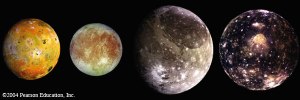
When I went out observing on the 24th Avenue Parking Garage the other night, every astronomical object that I saw through the telescope amazed me, but Jupiter especially captured my attention. I had never viewed Jupiter through a telescope before, and on this beautiful and mostly clear night, I was able to clearly see not only Jupiter itself, but also its four largest moons (like Galileo had!). These moons–Io, Europa, Ganymede, and Callisto– are known as the Galilean moons because they were discovered by Galileo. All four of these moons are so large that they would be considered planets or dwarf planets if they orbited the Sun, and each has special characteristics that make it especially unique and remarkable.
Volcanic Io is the most volcanically active world in the solar system. In fact, no impact crater has survived Io because its surface is so young as a result of frequent eruptions from large volcanoes always repaving the surface. Although debris has covered most of the tectonic features, it can be assumed that Io has tectonic activity. Io’s volcanoes share many similarities with those on Earth and outgas mostly sulfur dioxide, sufur, and some sodium. Tidal heating from Jupiter’s tides accounts for the fact that Io is hot on the inside, while orbital resonance accounts for the fact that Io’s orbit is slightly elliptical.
Icy Europa has a surface of water ice over an interior that is heated by tidal heating. Scientists hypothesize that there exists an ocean just beneath the icy surface. It may even be possible that this concealed ocean holds more than double the amount of liquid water in all of Earth’s oceans. In addition, the same kinds of volcanic vents that host life in Earth’s oceans may also appear in Europa’s ocean, pointing to the possibility that there may even be life on Europa.
Groovy Ganymede serves as the largest moon in the entire Solar System. Ganymede’s icy surface appears dark with many craters in some areas and then light-colored with few craters in other areas. Liquid water swelling up to the surface and then refreezing along a crack in the surface explains all of the grooves on Ganymede. Ganymede’s magnetic field might suggest that the moon has a salty ocean under the surface; however, tidal heating is not great enough on Ganymede to melt the ice.
Fulfilling expectation for an outer system satellite the most accurately, cratered Callisto proves to be the least surprising to scientists. However, the moon also has some surprising features, such as a dark powder in low-lying areas and a lack of volcanism and tectonics (because of inadequate internal heating). It could still be possible that Callisto has a subsurface ocean as well, as it has a magnetic field.
(Source: Laboratory for Atmospheric and Space Physics)