Put a Ring on It

An interesting characteristic that all the jovian planets possess is their rings. The most remarkable and noticeable of these are Saturn’s, which extend hundreds of thousands of kilometers wide. However, Jupiter, Uranus, and Neptune all have rings as well, on a much smaller scale. Although the rings are rather wide, they are only 1-1000 m thick at most, proving to be extremely thin.
The rings are not physically part of the planets themselves, but are really a disk-shaped group of moonlets, dust, or other small planetary objects orbiting the planet. It is believed that this material came together in one of three ways: from material that was within the Roche limit and therefore could not condense into a moon, from debris of a moon that was hit by a large impactor, or from debris of a moon interrupted by tidal stresses when passing within the Roche limit. A small amount of material could have been ejected from the planets themselves as well. The rings are generally composed of ice, dust, and various rocky materials. The particles have a wide range of sizes, from very small rocks to large boulders.
The rings are not just one piece – there are several gaps between each “ring” where there are no materials orbiting. Specifically within Saturn, some of these gaps are due to the presence of tiny moons orbiting around within it; they have cleared a path for which to orbit and that prevents any material to occupy that space. Ring spacing is also maintained by the gravitational effects of small shepherd moons such as Saturn’s Prometheus and Pandora. The orbits of these moons regulate the orbit of certain rings, drawing them away from the planet and pulling it back in so it maintains its relative position.
Although rings are currently a jovian quality, it is believed that Mars’s moon, Phobos, will soon break up due to its low orbit and create a ring around the planet. It is unclear, but perhaps rings will become a more common planetary characteristic as many years go by.


Posted in Jovians, Planet Rings | Tagged , , , | Comments Off on Put a Ring on It

Io’s crazy volcanoes!

gemini-io-dates

photo from space.com

So, we all know that Io is notoriously the volcanic moon of Jupiter, but apparently a couple of years ago it randomly got…MORE volcanic? According to this article, in August of 2013 three large eruptions occurred on Io.  To put it in perspective, this is the number of large eruptions that we would normally see over a span of six to seven years, but for some reason they all happened in a short span of only two weeks, with one of the three being the brightest ever observed on the moon.  While astronomers aren’t exactly sure what caused this sudden bursts, they took advantage of this opportunity to obtain really awesome images like the one seen above.  Those are a series of images taken over a series of twelve days during the eruption.  Not only was the event useful for obtaining cool pictures, but it was also a learning experience for astronomers.  They got watch an amazingly volcanically active moon and use this to formulate better ideas as to what the terrestrial planets like Earth and Venus were like during their early, volcanically active days.  So, who knows why this happened, but I guess if it’s gonna happen, we’ve got to take advantage of it and learn as much as possible!


Posted in Moons | Tagged , , , | Comments Off on Io’s crazy volcanoes!

White dwarf supernovae

White dwarf supernovae only occur in a binary system, in which one of them is a white dwarf while the other can be a giant star or just a main sequence star. As far as we know, a white dwarf is the remnant of a star after the nuclear fusion inside its core has ceased, and it is composed mostly of carbon. If the mass of the white dwarf exceeds the Chandrasekhar limit, which is 1.38 solar masses, a supernova will occur, and this kind of supernova is called a white dwarf supernova.

The white dwarf supernovae take place because the electron degeneracy pressure in the white dwarf cannot prevent the catastrophic collapse. In a binary system, the white dwarf can accrete mass from its companion star, resulting in a continuous increase in mass. As soon as its mass exceeds the limit, it begins to collapse, and the collapse therefore raises the temperature to the carbon fusion ignition point. Within a few seconds, a substantial fraction of the matter in the white dwarf undergoes a runaway reaction, releasing enormous amount of energy in a supernova explosion.

These supernovae have nearly the same luminosity because of the uniform mass of white dwarfs so that they can be used as standard candles to measure distance to their host galaxy, since apparent brightness depends only on distance.

Here’s a configuration of the SN2006X system before and after the explosion.

Image from Google Images


Posted in Class | Tagged , , , , | Comments Off on White dwarf supernovae

Halley’s Comet

Halley’s comet is a short-period comet, which can be seen from Earth every 75-76 years so that a person could see it at most twice during his or her lifetime. It is undoubtedly the most famous comet. The last time it returned was in 1986, and it will be back in 2061 as predicted.

Halley’s comet has been known since a recorded observation around 240 B.C. The most famous appearance was in 1066 right before the Battle of Hastings, which marks the beginning of the Norman conquest of English.

It is named after an English astronomer-Edmond Halley, who figured out the periodical return of a comet to Earth from reports of it approaching Earth in 1531, 1607 and 1682. He also predicted that this comet would be back again in 1758. His successful prediction led to the comet being named after him, though he didn’t live to actually see it.

When it returns in 2061, it will be on the same side of Sun as Earth but will be much brighter than in 1986. Don’t forget to see it when it comes!

halleys-comet-1986

Image from Google Images


Posted in Class | Tagged , , , , | Comments Off on Halley’s Comet

Predicting Impact Events

In 1994, Comet Shoemaker-Levy 9 created a large impact event on Jupiter, giving the scientific community a greater sense of urgency in detecting possible impact objects before they reached Earth. These efforts to detect near-Earth objects, known collectively as “Spaceguard”, have enjoyed both successes and failures.

For example, in 2008, the Catalina Sky Survey discovered 2008 TC3, a four-meter wide, 80,000 kg asteroid, 19 hours before it impacted Earth. Observers were able to determine that the object would “not survive passage through the atmosphere”, but unsure of where the object would make contact on Earth. This was the first instance of a near-Earth object being detecting before entry into the atmosphere.

However, Spaceguard efforts were unable to detect the Chelyabinsk meteor, the “largest known natural object to have entered Earth’s atmosphere since the 1908 Tunguska event.” The asteroid went undetected because it was relatively small in size and because it came toward Earth from the direction of the sun, which blinded telescopes.

Spaceguard has made great strides in effectiveness, but still has work to go in forecasting large impact events. How might observers better detect objects coming from the direction of the sun? Should the scientific community put more effort into detecting near-Earth objects?

APTOPIX Russia Meteorite

The Chelyabisnk Meteor

Posted in Class | Tagged , , | Comments Off on Predicting Impact Events

Predicting Impact Events

In 1994, Comet Shoemaker-Levy 9 created a large impact event on Jupiter, giving the scientific community a greater sense of urgency in detecting possible impact objects before they reached Earth. These efforts to detect near-Earth objects, known collectively as “Spaceguard”, have enjoyed both successes and failures.

For example, in 2008, the Catalina Sky Survey discovered 2008 TC3, a four-meter wide, 80,000 kg asteroid, 19 hours before it impacted Earth. Observers were able to determine that the object would “not survive passage through the atmosphere”, but unsure of where the object would make contact on Earth. This was the first instance of a near-Earth object being detecting before entry into the atmosphere.

However, Spaceguard efforts were unable to detect the Chelyabinsk meteor, the “largest known natural object to have entered Earth’s atmosphere since the 1908 Tunguska event.” The asteroid went undetected because it was relatively small in size and because it came toward Earth from the direction of the sun, which blinded telescopes.

Spaceguard has made great strides in effectiveness, but still has work to go in forecasting large impact events. How might observers better detect objects coming from the direction of the sun? Should the scientific community put more effort into detecting near-Earth objects?

APTOPIX Russia Meteorite

The Chelyabisnk Meteor


Posted in Class | Tagged , , | Comments Off on Predicting Impact Events

New Horizons

Exploring Pluto

Pluto, the small icy body at the edge of our planetary system, has been under scrutiny in scientific and public communities for the last decade after the International Astronomical Union (IAU) demoted it from a true planet to a dwarf planet. Though Pluto’s planetary status is important, the real issue raised by this demotion was that of the IAU’s lack of a true classification system for planets and dwarf planets. One of the best ways to refine this definition is it to explore the composition, features, and satellites of Pluto in order to determine the differences between it and terrestrial and Jovian worlds.

newhorizons

A graphic of New Horizons from BetaWired.

NASA’s Response to the Need for Exploration

Following the discovery of two faraway satellites of Pluto in 2005, NASA collaborated with the Southwest Research Institute (SwRI) to launch the space probe New Horizons. This probe was built to fly by the terrestrial planets, approach Jupiter for a gravitational assist that would slingshot it to the outer reaches of our Solar System, and get closer to Pluto and its moon Charon that any space probe has gone thus far. The first close flyby of Pluto is planned for July 2015. New Horizons may then fly past Pluto and into the rest of the Kuiper Belt, sending back images of the compositions of various Kuiper Belt objects. (Johns Hopkins University)

The Spacecraft

New Horizons is equipped with seven different probes to measure various aspects of Pluto and its moons. The first is an ultraviolet imaging spectrometer that will measure the composition of Pluto’s atmosphere. Other sensors will measure the geography and surface features of Pluto and other worlds; measure the density, pressure, and temperature of atmospheres; read evidence of geological features like volcanoes and geysers on planets and moons; study solar wind and flow of electrons around planets; analyze the movement of particles leaving Pluto’s atmosphere; and examine dust particles in the space around planets. (See NASA for more info.)

All in all, New Horizons aims to give astronomers a better understanding of the composition and current layout of large bodies in the outer reaches of our Solar System. This will help us understand the differences between terrestrial planets, Jovian planets, dwarf planets, and Kuiper Belt objects, and may help us understand more about the formation of the outer Solar System.

See here for info about naming the features of Pluto!


Posted in Dwarf Planets, Instruments | Tagged , , , , , , , | Comments Off on New Horizons

Orbital Resonances: They Space Out the Solar System

In class we learned that the divisions in Saturn’s rings are caused by orbital resonance. Orbital resonance is a phenomenon in which “two orbiting bodies exert a regular, periodic gravitational influence on each other,” usually because their orbital periods “match up”. For instance, if particles were in Saturn’s Cassini division, they would orbit twice for every one time the moon Mimas orbits Saturn. Because of this 1:2 orbital resonance, any particles that enter this region are pulled by Mimas’ gravitational influence, giving them elliptical orbits that push them out of the region

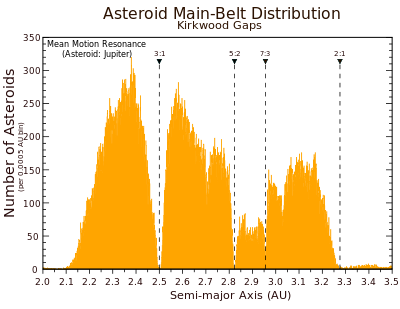
While the Cassini division is a great example of orbital resonance within a planetary system, similar resonances exist on the scale of the entire solar system. For example, within the asteroid belt between Mars and Jupiter, there are prominent blank spaces known as the Kirkwood gaps which align with the 1:3, 2:5, 3:7 and 1:2 resonances with Jupiter (2.5, 2.83, 2.95, and 3.27 AU, respectively). There are also narrower gaps found at other resonances from Jupiter (9:2, 10:3, etc.).

I find the phenomenon of gaps caused by orbital residences to be especially interesting, and potentially useful for predicting how matter is distributed in solar systems. Why might some orbital resonances have stronger effects than others? Could the phenomenon of orbital resonances have an effect on how stars move within the galaxy?

400px-Kirkwood_Gaps.svg

Photo source

Posted in Class | Tagged , , | Comments Off on Orbital Resonances: They Space Out the Solar System

Orbital Resonances: They Space Out the Solar System

In class we learned that the divisions in Saturn’s rings are caused by orbital resonance. Orbital resonance is a phenomenon in which “two orbiting bodies exert a regular, periodic gravitational influence on each other,” usually because their orbital periods “match up”. For instance, if particles were in Saturn’s Cassini division, they would orbit twice for every one time the moon Mimas orbits Saturn. Because of this 1:2 orbital resonance, any particles that enter this region are pulled by Mimas’ gravitational influence, giving them elliptical orbits that push them out of the region

While the Cassini division is a great example of orbital resonance within a planetary system, similar resonances exist on the scale of the entire solar system. For example, within the asteroid belt between Mars and Jupiter, there are prominent blank spaces known as the Kirkwood gaps which align with the 1:3, 2:5, 3:7 and 1:2 resonances with Jupiter (2.5, 2.83, 2.95, and 3.27 AU, respectively). There are also narrower gaps found at other resonances from Jupiter (9:2, 10:3, etc.).

I find the phenomenon of gaps caused by orbital residences to be especially interesting, and potentially useful for predicting how matter is distributed in solar systems. Why might some orbital resonances have stronger effects than others? Could the phenomenon of orbital resonances have an effect on how stars move within the galaxy?

400px-Kirkwood_Gaps.svg

Photo source


Posted in Class | Tagged , , | Comments Off on Orbital Resonances: They Space Out the Solar System

Exoplanets: Planets Not Orbiting the Sun

Hey there!

Today I’m going to be discussing the topic. The definition of an Exoplanet is a planet which orbits a star (or stellar remnant or brown dwarf) which is not the Sun. Thus far, over 1900 exoplanets have been discovered. 480 of these exoplanets are confirmed to exist in multi-planet systems. These planets are of special interest to those who search for the possibility of extraterrestrial life. These scientists look for exoplanets which orbit suns in their habitable zones–that is distances (based off the power output of the sun) where liquid water can exist. Another interesting brand of planets which are sometimes grouped into the category of exoplanets (although this is not the standard practice)  are the so called “rogue planets”. These are planets, often gas giants, are more often classified as brown dwarf class The closest exoplanet, if its existence is confirmed, is Alpha Centauri Bb.

From Wikipedia

Source


Posted in Class, Exoplanets | Tagged , | Comments Off on Exoplanets: Planets Not Orbiting the Sun