Solar Eclipse

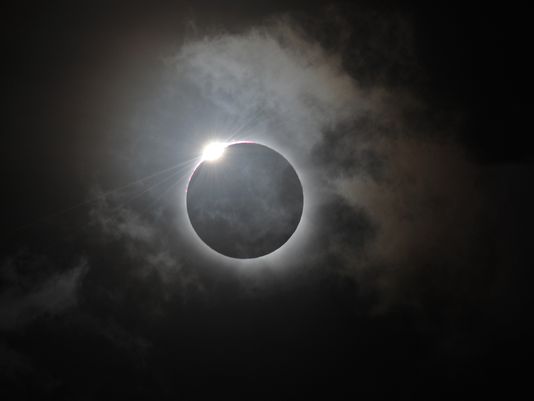
Today, residents of Europe got to see something truly spectacular. In the early morning hours, a solar eclipse occurred (a total solar eclipse was viewed by residents of islands in the far North of Europe). This eclipse coincided with the Spring equinox (which occurs on the first day of Spring) as well as a Supermoon, which is when the moon is at its closest position to Earth. The next solar eclipse that will be visible on Earth will occur in 2017, so this was a treat for those who were lucky enough to witness it. Solar Eclipse’s occur when the moon passes in between the Sun and Earth, and the Moon can either partially or fully block the Sun. To read more about the Solar Eclipse that occurred, click here. 

Posted in Class, Science | Tagged , , | Comments Off on Solar Eclipse

Climate Change

Today, one of the most pressing issues in society is climate change. The Earth, due to pollution and the ensuing increase in greenhouse gases in the atmosphere, is experiencing global warming. Average temperatures around the globe have increased a few degrees Celsius in the past few decades. While that may not seem like a lot, this increase in temperature has severe consequences on the Earth. If the pollution rate continues to grow at this rate, the Earth will become progressively warmer, which will lead to the sea levels rising due to the polar ice caps melting, as well as more severe weather. In fact, the devastating effects of a recent Cyclone in Vanuatu was blamed on climate change. You can read more about that here. 

Climate Change- Gloabl Warming

Climate Change– Global Warming


Posted in Class | Tagged , , , | Comments Off on Climate Change

The deep blue under the crust

NASA’s Cassini mission scientists announced recently that Saturn’s sixth-largest moon, Enceladus, has a warm ocean at its southern pole. The ocean is 9.7 km deep and resides under the moon’s icy crust of about 40 km. Tiny grains of rock were detected by NASA’s Cassini spacecraft near Saturn. This indicates that there may be hydrothermal activity occurring underneath Enceladus’s icy surface, and hence the ocean may be habitable.

The tiny Enceladus, of 500 km diameter, joins the ranks of Europa in the category of icy moons with an underground ocean speculated to harbor life. Europa of course, contains more water in its salty icy ocean than all the water on Earth.

Enceladus’s Internal Structure

Cassini_Nugget_Enceladus_crop

The Icy Surface of Europa

europa_tstryk-2


References

http://www.11alive.com/story/news/2015/03/14/saturns-moon-enceladus-may-have-a-warm-ocean/24761383/

http://www.wikiwand.com/en/Enceladus


Posted in Aliens | Tagged , , , , | Comments Off on The deep blue under the crust

Other Life in our Solar System?

ganymede

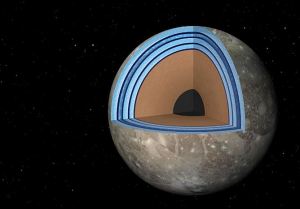
Through the use of computer modeling, a team of NASA scientists have confirmed that Jupiter’s largest moon, Ganymede, contains water under its icy top layers. New modeling that takes into account salinity of the planet’s water suggests that below the surface there are pancaked layers of ice and liquid water. Since we know that life on Earth formed through liquid water we know that there is a possibility of life existing in the oceans beneath the surface of Ganymede. The water content on Ganymede is 25 times larger than Earth and its entire surface is covered in ice. The ESA has a mission planned to launch to Ganymede, Europa, and Callisto, in 2022 so there can be research done on the ground level.


Posted in Aliens | Tagged , , , , , | Comments Off on Other Life in our Solar System?

Nuclear Fission or Fusion?

fissionfusion

Fusion involves the combination of nuclei between two atoms and fission is the process of splitting the nuclei of atoms. When looking at the release of energy from nuclear fission versus nuclear fusion there is a clear winner: Nuclear Fusion. Through the use of the interactive tool, you can compare the power of fission versus fusion.


Posted in Physics, Science | Tagged , , , , , | Comments Off on Nuclear Fission or Fusion?

40 Year Odyssey of The Voyager 1

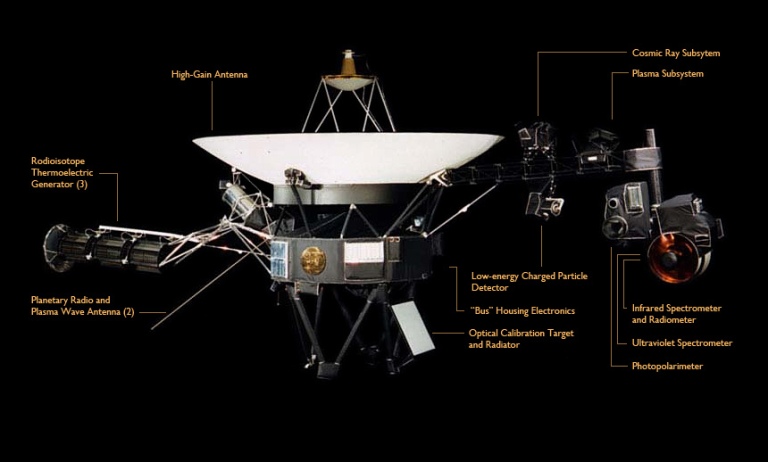
The Voyager 1, launched on 5th September in 1977, is the farthest spacecraft and hence the farthest man made object from Earth. At a distance of 12 billion miles from Earth, the spacecraft is escaping the Solar system at a speed of 1 million miles a day. At that distance, it takes mission control’s communications, travelling at the speed of light, 17 hours to reach the Voyager.

The Voyager mission was originally meant to last four years, till the spacecraft reached Neptune. However against all expectations, not only did the Voyager mission working really well, but the vintage electronics and thrusters are still functional till this day, working in the intense -253 C cold of outer space. Hence the 37 year 6 month Odyssey of the Voyager continues, with the sensors expected to send data till 2036. However by 2025, almost all the instruments sending worthwhile information will be turned off when the ship runs out of most of its energy from its tiny plutonium-238 power source.

The Voyager 1 is a historic and important probe for mankind since today’s inward looking space age means that we are not launching any other important deep space exploration missions. Here’s to hoping a long lasting odyssey of the Voyager 1.

The Voyager 1

features3


References

http://www.theguardian.com/science/2015/mar/15/voyager-1-and-2-space-journey-nasa

http://www.wikiwand.com/en/Voyager_1


Posted in Historical, Space Travel | Tagged , , | Comments Off on 40 Year Odyssey of The Voyager 1

Panspermia: An Alternative Hypothesis

Hey Readers!

Today I’m going to briefly discuss the idea of panspermia. For much of human history, we have wondered how such complex life on Earth came to be. Many suggest that life sprung up as the result of the natural aggregation of self replicating particles as in the primordial soup hypothesis. However another theory suggests that life actually arose on Earth by some object harboring microorganisms (comet, meteorite, etc.) colliding with Earth and spreading said extraterrestrial life to Earth. This is an interesting hypothesis because it presupposes the existence of life elsewhere in the universe. How this agrees with the universal ancestor hypothesis is still up for debate, but it is an interesting attempt at explaining the origin of life on Earth!

Wikipedia

Panspermia


Posted in Class | Tagged , , | Comments Off on Panspermia: An Alternative Hypothesis

Death and Space

In old space movies, when someone is left exposed in space, they explode. Well this have some merit, it is not 100% true. In space and its pressure (or lack of) causes the water in the human body will expand into water vapor. This causes severe internal swelling up to twice the size. Due to the enlarged veins from the swelling, a person’s blood pressure will drop since the heart would not be capable of pumping blood.

Another danger is hypoxia. Without pressure, the oxygen in the bloodstream will dissolve and escape the blood. A person will last about 14 seconds before passing out.

While you would think to hold your breath like underwater, holding air in your lungs is deadly. If someone tries to hold their breath during decompression of the change in pressure from a spacecraft to space, the lings will rupture internally.

The cold and radiation may kill you later, but the lack of pressure in space will kill you within 90 seconds.

Source

Pressure Kills
Pressure Kills

Posted in Class | Tagged , , | Comments Off on Death and Space

Nuclear Fusion: Future of Energy?

Hey there everyone!

Today I am going to give a brief overview of nuclear fusion, specifically in regards to ITER, or the International Thermonuclear Experimental Reactor. Currently being built in the south of France, ITER aspires to be the largest tokomak fusion reactor in the world. Experiments are currently slated to begin in 2020 with full scale experiments starting in 2027. The tokomak style involved a torus shaped vacuum chamber which uses magnetic fields to contain the charged, hot plasma gas. If this project is successful in bridging the gap between experimental, small scale fusion reactions and large scale, energy producing plants, it could be monumental for the future of energy production on Earth.

Wikipedia

Cross Section of Chamber


Posted in Class | Tagged , , | Comments Off on Nuclear Fusion: Future of Energy?

Solar Flares: Terrifying, Fascinating, or Both?

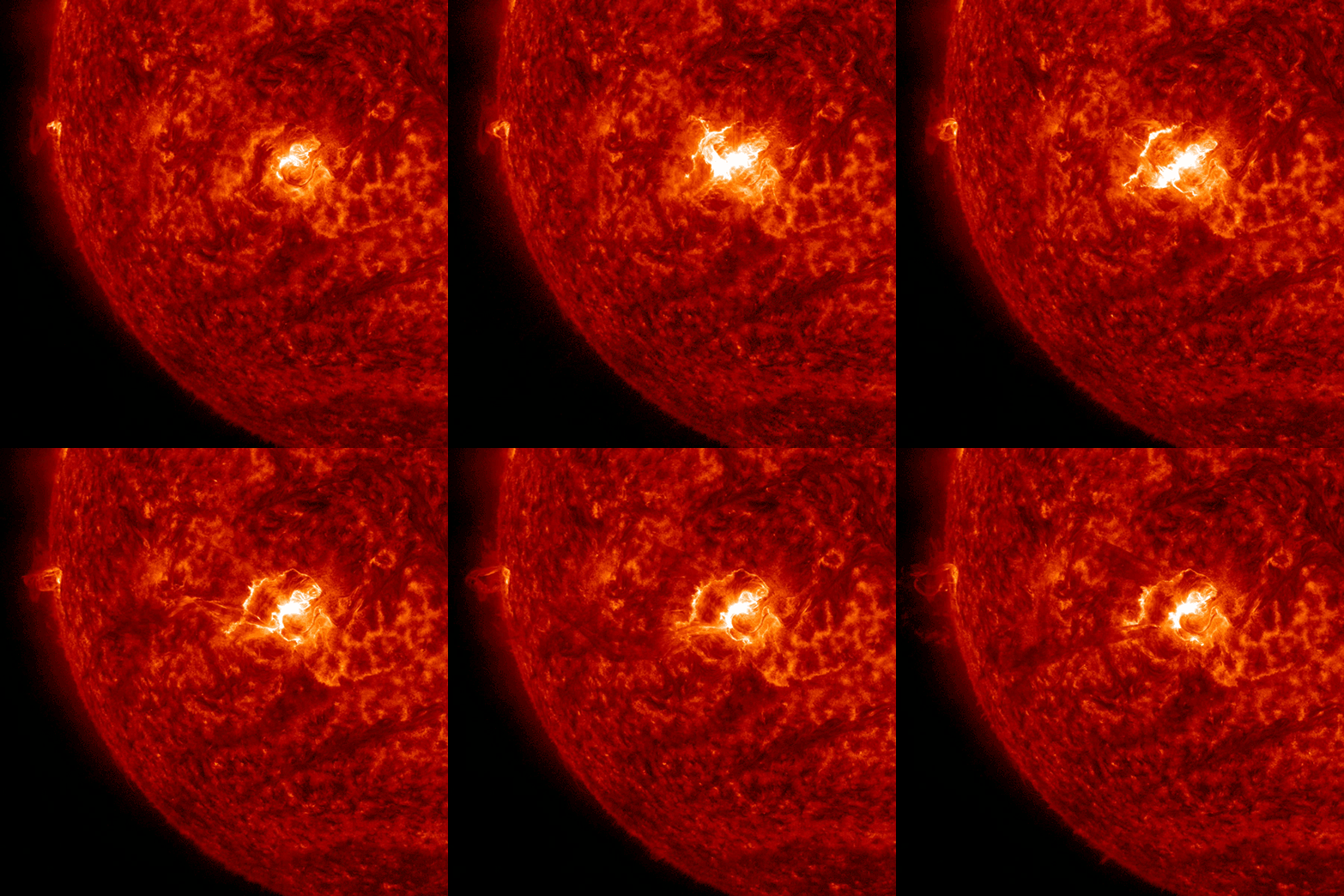
Sun emitting solar flare. From Huffington Post

Sun emitting solar flare. From Huffington Post

Check out this animated gif released by NASA earlier this week. Just a few days ago, the Solar Dynamics Observatory captured video of a massive solar flare bursting out of the Sun. To put things in perspective, the massive solar flare would have engulfed the earth easily 100 times over. NASA categorized the flare as a class X2.2, which is just below the maximum intensity rating of X3. Solar flares can do some serious damage, if they’re directed at the Earth and intense enough. In the late 80’s, a massive solar flare knocked out a ton of US Military satellites, and Quebec was plunged into darkness as the ensuing magnetic interference knocked out the hydroelectric system. The Quebec Blackout of ’89 is perhaps the best example of the destructive force that can come from our Sun, and it was far from the first, or last, time such an incident will happen. It’s amazing to think, sometimes, about the awesome forces of nature that surround our planet, and how cosmically insignificant our home is. When it comes to solar flares, all we can really to is just hope that we never end up in the crosshairs of one as massive as the one NASA just captured.

From Huffington Post


Posted in Class, Sun | Tagged , , | Comments Off on Solar Flares: Terrifying, Fascinating, or Both?