The K-T Extinction: Asteroids and Atmospheres

Let’s talk about the dinosaurs. Everyone has heard the story: Dinosaurs roamed the Earth ages ago until an asteroid hit and caused all of them to go extinct. There was a huge amount of dust thrown up into the atmosphere which blocked out the Sun and caused plants to die. This set off a chain reaction up the food chain until, somewhere, the last lonely dinosaur keeled over, its kind never to resurface. How long do you think that took? A month? Two months? A year? More? But there is a new story. A more probable story, although it may be very difficult to believe. The asteroid that hit the Earth was approximately the size of Manhattan, a truly huge chunk hurtling toward us at unbelievable speeds. The result? A great impact, sure, but is that enough to kill every dino? Not by itself. Recent experiments show that the asteroid would vaporize the rock as it digs deep into the Earth, and that rock gas was shot into space. It then cooled and began to condense into small glass balls which spread around the planet. They then began to fall back to Earth. Most disintegrated in the atmosphere, but some did reach Earth. Those that disintegrated each caused the atmosphere to get a little bit hotter, eventually reaching temperatures over 1000 degrees Celsius, a temperature where any organisms’ blood would literally boil in their skin. Thus, the dinos that had been around for millions of years would die. How long did that take? Scientists estimate the entire episode from asteroid -> 1000 degrees took a total of 2 hours. Want to see more? Here is the link.

 RadioLab
RadioLab

Posted in Universe | Tagged , , , , , , , | Comments Off on The K-T Extinction: Asteroids and Atmospheres

It’s All in the Rocks

As many people know, rocks are broken up into three main categories: igneous, metamorphic, and sedimentary. However, the formation processes that govern why one would find a certain type in a certain place is very important to exploration of activity of a terrestrial world. Let’s start with igneous rocks. These are rocks that cool directly from magma, or the molten rock existent beneath the crust. They are broken up into phaneritic and aphaneritic which categorize grain size found in the rock into large and fine respectively. This grain size can give a lot of information, as the longer the magma takes to cool, the larger the grain size of the resulting rock. The Moon’s seas, for example, are the result of huge basaltic flows. Basalt is an aphaneritic igneous rock that implies that the magma was exposed to a much cooler temperature very quickly, not allowing for the large grained version of this mineral composition which is called gabbro. Sedimentary rocks, specifically detrital sedimentary rocks, are very important to look for on different terrestrial worlds. To form a sedimentary rock, rocks must be weathered into sediment and then eroded and deposited before being buried deep enough for lithification to occur. Finding a sedimentary rock on another world would imply that there either is or was a set of processes in place that could weather and erode, as well as transport. This would be very integral to determining if there is or was water on that planet. Finally, metamorphic rocks can tell the story of a dead planet very colorfully. There are two major types of metamorphic rocks, those caused by contact metamorphism, and those caused by regional metamorphism. Contact metamorphism is the result of rocks experiencing a very quick jump in temperature, often caused by a nearby magma vein. These rocks can be used to show that a dead planet once had very active volcanism. Regional metamorphism results from incredible pressures when rocks are pressed against each other. Finding regional metamorphism would be very strong evidence that a planet has or had active plate tectonics. Every rock can tell a story about its environment, and they are an integral part of determining the history of a terrestrial world.

 Wikipedia
Wikipedia

Posted in Universe | Tagged , , , | Comments Off on It’s All in the Rocks

What if Earth stopped spinning?

*Warning: rather long documentary!*

I’ll sum up the documentary, but suggest you watch if you have time. In essence, a slowing Earth result in an orbit where the length of the day is equal to the entire year. Long exposure to the sun, and long exposure to space at night would result in extreme temperature differences between sides. The Coriolis effect would essentially disappear, as it requires rotation to occur, This would result in only two circulation cells on the planet (the strength of the Coriolis effect determines the number of weather circulation cells), and essentially freeze weather within particular regions. Furthermore, the Earth bulges at the center. Without a rotation to hold the extra water in place, all of the equatorial waters would move toward the poles, flooding regions at extreme latitudes, and drying up those at lower ones. Likewise, breathable oxygen would undergo much the same process, and also float toward the poles, depriving the tropics of most of its air. No spinning would also severely reduce weaken the magnetosphere of Earth, resulting in more dangerous sun rays penetrating into the surface. Essentially, the only habitable regions would be those at mid latitudes roughly south of Kansas, but north of southern Florida, trapping the remnants of humanity (most of whom would be dead by this point), within a very small band of land flowing across the equator and stretching at most 40 degrees away from the equator in both directions.


Posted in Class, Sun | Tagged , , , , , | Comments Off on What if Earth stopped spinning?

The Formation of the Universe

This video is one of the coolest things I’ve watched in a while. We’ve talked a lot in class about the formation of the universe and while it all seems to make sense, the scale (of both size and time) are not easy to wrap your head around. What makes this video so cool is the awesome graphics and illustrations that accompany it.

It’s really hard to imagine the scale of our planet let alone our solar system, so watching the video, from the star exploding, to our sun and Earth forming, gave me a whole new view on the whole process. It’s so hard to try to grasp the reality of the situation. Honestly this class is giving me a bit of an existential crisis…


Posted in Universe | Tagged , , , | Comments Off on The Formation of the Universe

The Big Bang Theory

I didn’t know much about the Big bang Theory so when I went to do research the Big Bang theory was explained to me very simply. First off the Big Bang happened for three main reasons: the universe was once very hot, the universe is expanding, and the universe used to be very dense. Correct me if I am wrong, but basically the universe was so hot and dense that there were thousands of collisions going on between protons, neutrons, and electrons and sometimes the protons and neutrons stuck together creating atoms and then these atoms stuck together to create molecules. Then as these collisions continued the universe cooled down and became less dense, allowing masses to collide less and to find their place in the universe. Now one of the things that I found very interesting is that we spend so much more time trying to figure out how we were created, but there were some questions posed by this lesson published at the Rochester Institute of Technology that were about what is going to happen to the solar system and the universe in general in the future that really startled me and were scary to think about especially this question; “Will the universe collapse again, or expand forever?” If anyone has come by any studies that have explored any answers or explanations to this question let me know I would be very interested and it would be an interesting topic.

I found a very interesting video with some really cool sounds that explains what happened as a result of the big bang that puts the speed of the creation of the universe into perspective.


Posted in Class, Historical, Universe | Tagged , , | Comments Off on The Big Bang Theory

Venus’s Atmosphere

In my opinion, one of the most interesting things in the readings was the section about Venus and its atmosphere in Chapter 10.

What I found so interesting about it was the fact that Venus and Earth are so alike in terms of size and mass, but the difference that distance from the Sun made on the two planets is astounding! Since Venus is closer to the Sun than Earth, its atmosphere wasn’t able to stabilize enough to create oceans and a hospitable place for life like Earth was. Instead, due to the runaway greenhouse effect in which greenhouse gas accumulation caused more greenhouse gases to accumulate, the atmosphere of Venus became too thick, the lower atmosphere too hot, and the planet too inhospitable. Just think, if Venus were in another position, say in Mars’s position, it may have life similar to that on Earth!

It’s also interesting that Venus is what the Earth may start to look like someday, as the Sun grows more intense and humans add more greenhouse gases to the atmosphere. It’s not just another planet – it’s what the Earth may look like in the future!

Comparison of Venus's and Earth's atmospheres!

Comparison of Venus’s and Earth’s atmospheres!

Above is a neat comparison of the atmospheres of Venus and Earth. What a difference distance from the Sun can make!


Posted in Terrestrials | Tagged , , , | Comments Off on Venus’s Atmosphere

The Future of the Sun and What It Means for Earth

728px-Sun_red_giant.svg
Red giant vs. main sequence size comparison, Wikpedia

Right now, the Sun is about halfway through its main sequence stage. It has always intrigued me how the Sun will evolve once it is past this phase. How will the Sun change? What will happen to Earth and the other planets?

In approximately 5.4 billion years, the Sun will have exhausted all of its core hydrogen through nuclear fusion. But the Sun will not go out with a “bang”, it does not have enough mass to explode as a supernova. It will instead transition to a red giant phase as pictured above. Over a billion years, it will expand into 200 times the size of the current Sun. Ultimately after all its helium is exhausted, the Sun will cool into a white dwarf. It will survive in this phase for trillions of years before fading into a black dwarf.

So what does this mean for Earth? Not much actually. The Sun will become gradually more luminous throughout its life as a main sequence star. By the time the Sun transitions into a red giant, the Earth will be hotter than Venus is today. Life will have been long extinct by this time. When the Sun expands, it will ultimately engulf Earth and the other inner planets, spelling an end to our great planet.

Source: Wikipedia


Posted in Stars, Sun | Tagged , , , | Comments Off on The Future of the Sun and What It Means for Earth

A trip to Venus?

video from phys.org

It seems like all of the talk in the field of space travel these days has been too focused on a trip to one single location…Mars.  But noticing while studying these past few chapters that Venus is actually a bit closer to Earth than Mars, that brought up a question in my mind: has it ever been considered to work on a mission to Venus?  The answer is YES.  Although there are some pretty obvious disadvantages to a trip to Venus, one of which being that you can’t actually land on the surface due to the blazing hot temperatures, there has been some talk lately about working on a mission.

This idea of this mission is HAVOC, or a high altitude Venus operational concept, basically meaning that the ship would hover above the atmosphere of Venus rather than land on the surface.  As we’ve learned in class, and as this article mentions, the temperatures and pressures on the surface on Venus are far too high for our spacecrafts to handle, and the storms and clouds of sulfuric acid within the thick carbon dioxide-filled atmosphere are far too dangerous to risk the trip. BUT it has been found that at a height of 50km from the surface, it would experience only atmospheric pressure and a hot, but not unbearable, 75 degrees Celsius temperature.  These conditions are actually much more feasible for designing a mission around than those on the surface of Mars!

There are some unanswered questions for me here though: how much useful information can we get from just hovering above Venus?  It seems like a lot more information would be obtained by doing a surface trip to Mars.  Can that much more information really be obtained at 50km above the surface than what we can obtain from further-out unmanned flyby missions?  These are questions that will hopefully be answered soon as further research is conducted on the possibility of a mission to Venus, but it sure is exciting and a pleasant change from all the Mars talk!


Posted in Space Travel | Tagged , , , , | Comments Off on A trip to Venus?

Could the sun live for over a trillion years?

1-howdoyoujump

Sun and hydrogen burning: Thinking outside the bubble

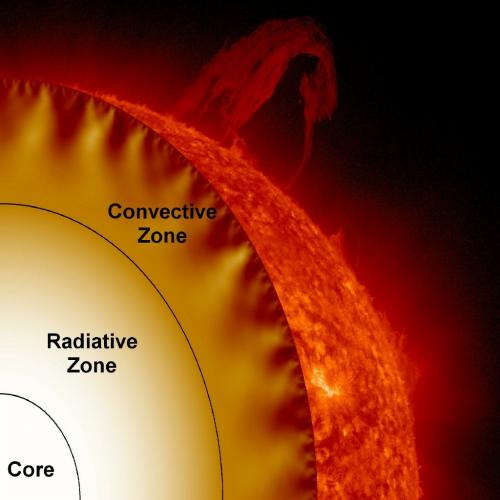
Yes it can! But not except under unusual circumstances which do not naturally occur in G-type stars as our sun. This is due to the fact that the core is the only part of the sun in which temperatures and pressure are high enough to fuse helium out of hydrogen. However, this part of the sun is only a quarter of its total radius, and about 2% of the total mass of hydrogen within the whole sun. The radiative zone, with its intense pressure and density, keeps out the vast majority of the sun’s mass in the outer radiative and convective zones, essentially depriving the core of any source to restock on hydrogen. If it were possible to connect the core and radiative zones, however, the additional source of hydrogen would allow the sun to burn this fuel for hundreds of billions, if not over a trillion years. This would allow the sun to age significantly more slowly, and perhaps allow human civilization to live on Earth for many billions of years more, assuming we haven’t died out, or that the planet’s interior is still warm enough to keep its magnetosphere. Definitely something to think about.

You can read more about this, or watch the video on this topic here.


Posted in Class, Stars, Sun | Tagged , , , , , | Comments Off on Could the sun live for over a trillion years?

Blog Post #6: Gas Giant Rings

Titan1

Universe Today

Very few people know that Saturn is not the only planet in our solar system that has rings. In fact, every single one of the gas giants have a ring system! However, we did not know this until 1979 when Jupiter’s rings were discovered.

The rings of Jupiter, Uranus, and Neptune are very faint because they are composed of almost entirely dust. They aren’t nearly as breath-taking as the rings of Saturn and can only be viewed through very powerful telescopes.

This article gives a lot of information about all the gas giants’ rings, but I will give a quick summary of the facts I found most interesting about each:

  • Jupiter’s rings are composed of dust that was ejected from impacts on its moons.
  • Saturn’s rings are mostly made of water ice.
  • Uranus’ rings are thought to have resulted from the fragmentation of many moons that used to orbit the planet.
  • Neptune’s rings are dark and faint; they were also the last of the gas giant rings to be discovered in 1989.

Posted in Jovians, Planet Rings | Tagged , , , , , | Comments Off on Blog Post #6: Gas Giant Rings