Climate change is a change in the statistical distribution of weather patterns when that change lasts for an extended period of time (i.e., decades to millions of years). (Definition from Wikipedia)
Climate change is caused by biotic processes, variations in solar radiation, plate tectonics and volcanic eruptions. Human activities have also been regarded as a cause of recent climate change, known as “global warming”.
Causes:
Ocean variability
The ocean plays a significant role in the climate system. Even a tiny change by a slow and extremely deep movement of water in ocean processes such as thermohaline circulation will cause a great variation in redistribution of heat.
Orbital variations
Slight variations in Earth’s orbit cause changes in the seasonal distribution of sunlight and geographical distribution across the globe. There is very little change to the area-averaged annually averaged sunshine; but there can be strong changes in the geographical and seasonal distribution.
The three types of orbital variations are variations in Earth’s eccentricity, changes in the tilt angle of Earth’s axis of rotation, and precession of Earth’s axis.
Solar output
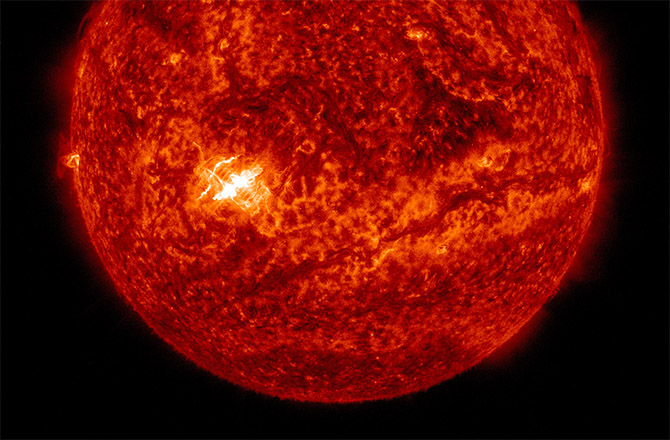
The Sun is the source of energy received by Earth. Variations in solar luminosity will affect the climate on Earth,
The Sun is emitting more power as it shines over time, causing the increase of global temperature and the change in atmospheric composition of Earth.
In addition, the 11-year solar cycle and the long-term modulations will cause climate change as well.
Volcanism
If over 0.1 Mt of SO2 is injected by volcanic eruptions to the stratosphere, the eruptions are large enough to affect the climate more than 1 year, for SO2 is a greenhouse gas.
Plate tectonics
The motion of tectonic plates reconfigures continents and oceans over millions of years. This reconfiguration can affect global patterns of climate and atmosphere-ocean circulation.
The position of the continents determines the geometry of the oceans and therefore influences patterns of ocean circulation. The locations of the seas are important in controlling the transfer of heat and moisture across the globe, and therefore, in determining global climate.
Human influences
A large part of recent changes in patterns of global climate can be attributed to human activities. Moreover, those change, such as the increase in CO2 levels, land use, ozone depletion, animal agriculture and deforestation, are irreversible or need a long time to recover.