After watching the Powers of Ten video and viewing the interactive Scale of the Universe website, it seems to me that Earth is like a speck of dust floating among countless others. In fact, the Powers of Ten video expands our perspective to 100 million light years into the emptiness of space where galaxies and planets alike are like specks of dust floating in the darkness. Some specks are larger than others, just like the Sun and Jupiter in relation to Earth, but from a larger perspective, they are all still tiny specks floating in a much larger cloud. In this way, it seems like Earth is fairly insignificant in terms of the Universe as a whole, but when one thinks of all that mankind has accomplished and all of the interesting things that have happened on our little speck of dust, it boggles the mind to realize how small we really are. To think that there are other planets out there like ours, other specks of dust that are equally or even more fascinating than our own is what fuels my interest in learning more about the Universe. It is also one of the reasons that mankind has been driven to explore the stars and hopefully one day voyage to these other specks of dust in search of more meaning and greater understanding.
That photo you’re looking at is the observable universe as we know it; it holds all we know and believe to exist from as large as a star to as small as an electron, from as physical as a touch to as obscure as a thought. The small point on it that says “Local Supercluster” is a collection of galaxy clusters that contains our very own Milky Way galaxy. Each bright point on this picture is a supercluster and each supercluster contains hundreds of galaxy groups with these groups having many galaxies of their own. Within a galaxy there are thousands up to even trillions of stars within it. Each of these stars could very well have systems of their own with several planets orbiting around them. It is estimated that there are about 300 sextillion planets in the observable universe.
With that many planets it is estimated that there may be upwards of billions of Earth-like planets which means that each human on Earth could potentially have their very own planet to live on alone. With that many planets, humans may have a chance to spread across the entire universe. With that many planets, it’s hard to believe that humans are alone in this universe.
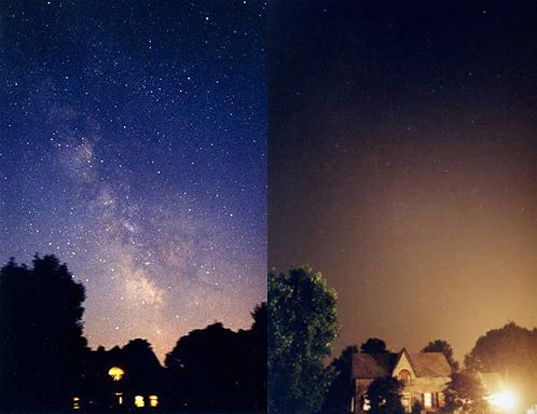
I am from a very small rural town, which equates to incredible views of the starry sky every night. Every so often, mostly on warm summer nights, there would be bonfires in the middle of a field or on a beach and the sky would be absolutely incredible to behold. It wasn’t until I moved to Nashville that I realized that I had taken those views for granted. Light pollution is the general issue of introducing too much artificial light into an area, which can result in skyglow. This drastically reduces the contrast between the stars and the sky, causing a lot of the night sky to be hidden from the naked eye. There are actually a lot of studies on the health and psychological effects of light pollution, though many have to do with the use of artificial lighting inside office buildings. I think it is an important reminder, though, that there are a lot of simple pleasures that are ignored in our industrial society.
If you’re like me, you have probably never heard of Shadow Bands. Shadow bands are a phenomenon that accompany total solar eclipses and occur just before and after totality, appearing as lines of alternating lines of dark and light moving across the ground and the sky. Why these occur is somewhat of a mystery, but the leading theories focus on crescent sunlight refracting or bending irregularly from turbulence in the atmosphere. They are best observed from a location at the edge of totality leading people to somewhat choose between a location that has totality with lesser shadow bands or a location with more shadow bands but not a total solar eclipse. When the total lunar eclipse passes over Nashville in 2017 be sure to look for this phenomenon!
Today I will be discussing solstices and equinoxes. Firstly, we will discuss solstices. This event happens twice a year (one during winter and one during summer), and is the time of the year when the sun reaches its highest or lowest point relative to the celestial equator (ie when viewing the sun at noon, the sun is at its highest or lowest point during the year). This event is typically used to signify the midpoint of summer or winter. This event is a result of the tilt of the earth, which causes the sun’s highest point in the sky to oscillate throughout the year. This even typically precedes the most extreme temperatures of its season.
Equinoxes are another phenomenon related to the tilt of the earth. This event also occurs twice a year, and is the point of the year when there are 12 hours of daylight and 12 hours of night time. This event is typically used to signify the midpoint of fall and spring. This event occurs when the earth is at the point in its orbit around the sun in which both hemispheres are exposed to equal amounts of sunlight.
Today I will be discussing the Cosmic Calendar. What is the Cosmic Calendar? This a demonstrative tool by which the age of the universe is elucidated. The universe is believed to be approximately 13.8 billion years old, however in this representation it is proportionally condensed to the length of a year. This means that each second of this Cosmic Calendar year is approximately 438 years. From this perspective, we can see how minute our history as humans (and even the age of life itself) is in the face of the monumental age of the universe.
For example, in the Cosmic Calendar, life doesn’t start until September–only three months from the end of the year. The dinosaurs go extinct as late as December 30! Modern humans don’t evolve until 11:54 of the last day of the year, December 31. Columbus didn’t discover the New World until the last second of the year. Thus, the Cosmic Calendar provides a clear demonstration of both the age of the universe and the meager part of its history we have experienced.
This website allows you to scroll and compare the sizes of from the smallest, a Quantum Foam, to the Observable Universe. Starting at the scale of the Eiffel Tower, humans disappear from view. The sizes of objects increase each time you scroll out. The Eiffel Tower disappears when you start looking at Rhode Island. Then the Earth. You can see how much larger Polaris is compare to our sun. Even the Homunculus Nebula pales when compared to the distance of one light year. The Milky Way Galaxy is tiny compared to the IC 1101, the largest known galaxy.
Everyone is familiar with the famous landmark Stonehenge located in Wiltshire, England. The first construction on Stonehenge was start about 5,000 years ago. We are still not sure what the original purpose of Stonehenge is but people have speculated that it was a temple made for the worship of ancient earth deities or an astronomical observatory for marking significant events on the prehistoric calendar, or that it was a sacred site for the burial of high-ranking citizens at the time (Britannica).
Stonehenge has been very closely linked to summer and winter solstices. The summer solstice marks the beginning of summer in the Northern Hemisphere and falls on June 21st. The timing of the solstice depends on when the Sun reaches its farthest point north of the equator (Farmers Almanac). As you can see in the picture below, the sun rises right over the Heel stone of the monument on the Summer solstice.
2014 Summer Solstice at Stonehedge
Stonehenge also aligns on the winter solstice sunset. The winter solstice marks the shortest day and longest night. It also marks the sun’s most southerly point on the celestial sphere. Below is a picture of the winter solstice sunset and its alignment in the monument.
It is amazing to consider the fact that people thousands of years ago without the modern technology we have were able to construct a monument that precisely measures the sun and its direction. We are still not sure what Stonehenge’s original purpose is, but one thing is for sure, the people who constructed it definitely had a sense about our Sun, stars, and Earth.
I have often caught myself wondering just how big are the largest of galaxies, and how small are the smallest building blocks of matter. There is an awesome tool developed in part by NASA that allows for an exploration from the smallest lengths we believe are possible to the entirety of the Universe (that we know of!).
The whole theory of the “Known Universe”, being that we have not been around long enough to be able to see anything outside ~14 billion light years, is absolutely mind boggling. I think that one of the most fascinating parts of Astronomy is that we simply don’t know what is really out there. The possibilities are pretty much endless, and statistically speaking it is very unlikely that there is nothing else interesting.
The universe is unimaginably vast; it is so enormous that the speed of the fastest wave-particle in existence -light – puts a cap on how much of the universe we can even observe. At 14 billion ly from our point of observation lies the edge of the observable universe. So if and when humanity becomes a space faring civilization, how much of this vast universe can we hope to physically explore and colonize? Unfortunately, not much at all with our present understanding of physics and aerospace technology. Let us consider something minuscule and “manageable” in the universal scale, our very 100 000 ly wide Milky Way galaxy. If we wanted to visit the edge of the galaxy 25 000 ly years away, it would take the Juno spacecraft, the fastest travelling man-made object cruising at 25 mile per second, 186 million years to get there. Nothing can travel faster than light, and if humans did devise near light speed travel, it would take us 25 000 years, 352 times the average lifespan of a human, to reach the edge of our galaxy!
Of course this inherent barrier on space travel does not faze the human imagination, as evidenced in popular culture by the myriad of stories on galaxy encompassing empires, conflicts and voyages. While Faster-Than-Light travel or space-time warps are clichéd validations used in such stories, their diversity in implementation is what’s really fascinating. For example, the world of Dune makes use of the fictional “Holtzman Effect” whereby space is folded, and a spaceship can travel a significantly smaller distance through the folds. A very similar concept is exploited in the 1997 film Event Horizon: a graviton beam is concentrated at a point, leading to the creation of an artificial black hole that bridges two points in space-time. The spaceships in Star Trek use warp drives to travel faster than light by contracting space in front of the ship and expanding the space behind it. Perhaps one of the most illustrated FTL technology is found in the Mass Effect universe, a popular third-person shooter RPG series. In Mass Effect, when current is passed through an element called “element zero”, dark energy is released resulting in a “mass effect” field. Mass contracts inside this field, countering mass dilation at relativistic speeds and hence allowing faster than light travel.
Perhaps someday science fiction will become science reality; for sure, the existence of wormholes is permitted by general relativity and the Alcubierre drive is a possibility should negative mass exist. But until such discoveries are made, imagination is the best tool we have for space travel.