Jovian s, the planets we can not touch

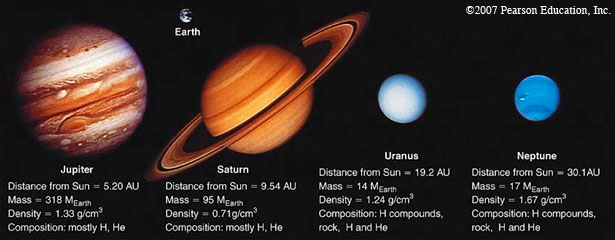
When we think of Planets we think of all of the ones that we have either stepped foot on or would like to step foot on someday.  Even though we haven’t visited any of the other planets due to their distances and weather we could hypothetically walk on all of them if we had the technology.  The planets that we can never step foot on because they have no solid surface is the jovian planets.  It’s crazy to think of something that is even larger than earth and is only made up of gas and liquid forms of elements.  No matter how good technology gets we will never be able to step foot on any of these planets like we might be able to with planets such as Mars.  As of right now we would not even be able to fly into the planet with any spacecrafts due to the extremely high temperatures and pressure.  These planets amaze us, but there’s some parts of them that we will never see.


Jovian Planet’s

jovian_planets


Posted in Class, Jovians | Tagged , , | Comments Off on Jovian s, the planets we can not touch

Solutions to the Fermi Paradox

Ever since Enrico Fermi first posed the infamous Fermi Paradox, people have been coming up with potential solutions to answer why humanity has yet to come into contact with other intelligent life. While nobody can definitively claim to have found the answer to Fermi’s question, the Steven Webb from the University of Florida has published an interesting list outlining fifty solutions to the problem of extraterrestrial life. One interesting solution is that we are viewed by other species as a zoo of sorts. It is possible that they are allowing our kind to advance naturally for the purpose of studying us or the natural development of the universe.

The most entertaining solution I came across in my search was written by American science fiction writer Terry Bisson. Entitled They’re Made Out of Meat, it details a possible (albeit outrageous) answer to the question of “Where is everybody?” A short video adaptation is included below. It is definitely worth a watch!


Posted in Class | Tagged , , , , | Comments Off on Solutions to the Fermi Paradox

The Future of Astronomy

Image

We can only discover more things out there; we can only learn more and find new questions to ask. I am very excited to see what the future holds for us, the only known intelligent life, the universe’s only known way to look at itself.

We will soon find Earth-like planets in our celestial neighborhood. We will soon be able to send probes farther than ever before with the most advanced gadgets and instruments. Maybe one day we will contact other intelligent life (though I’m not holding my breath),

All these prospects excite the (pardon me) hell out of me. Maybe I’ll be around when we send a drilling probe to Enceladus. Maybe I’ll be around for the culminating theory of the universe to unite relativity and quantum mechanics. Maybe I’ll be around for humanity’s venture forth from out pale blue dot with the purpose of colonization (and maybe terraformation).

All in all, I look ahead anticipating what is it store for the human race.


Posted in Class | Tagged , , | Comments Off on The Future of Astronomy

The Infamous Alcubierre Drive

Image

What is the true future of propulsion? Better yet what is the definition of propulsion? For most, it is the art of ejecting mass at velocity in one direction in order to, using Newton’s 3rd law, “propel” something in the other direction. Well for the rest of this post let’s forget that definition of propulsion, and widen it to anything that results in a translation from some points A and B.

Why, you ask, was that a necessary change? Well, the most advanced theoretical method of “propulsion” is the Alcubierre Drive. In layman’s terms, an Alcubierre Drive distorts spacetime such that it contracts it in front of a vessel and expands it behind a vessel. Space itself, in the confined region, is being pushed along. And it can go faster than light.

Is this physically valid, you ask? Does it obey the laws of physics? Because it’s well known that nothing can travel faster than light. Well technically it does not. The luminal speed limit only applies for objects traveling through space. In fact, assuming it is possible to create a device which does what I have just described, the speeds could be astonishing.

The only issue with this is the requirement of some sort of exotic matter in order to create the “warp bubble” necessary for a successful Alcubierre Drive. Some theoretical physicists also argue that one cannot create a warp bubble out of flat space. Those aside, I’m an optimist, and I hope to be visiting Betelgeuse before I turn 45.


Posted in Class | Tagged , , | Comments Off on The Infamous Alcubierre Drive

Astrobiology and Cinema: The Europa Report


Just last year, a film was released that questioned the viability of life on Jupiter’s moon Europa. Barring too many spoilers, the crew and their ship face several non-biological roadblocks on their quest for life in a film whose atmosphere is very similar to that of Ridley Scott’s Alien, though much closer to home. As we discussed in class, these astronauts were mainly concerned with potential life in Europa’s ocean beneath its icy surface. Like the thermal vents in Earth’s deep oceans, similar life could potentially be hidden within Europa. The prospect of life on Europa has me excited for the human race to explore Europa for ourselves and give our very own Europa report.


Posted in Class, Universe | Tagged , , , | Comments Off on Astrobiology and Cinema: The Europa Report

Vikings and Astronomy

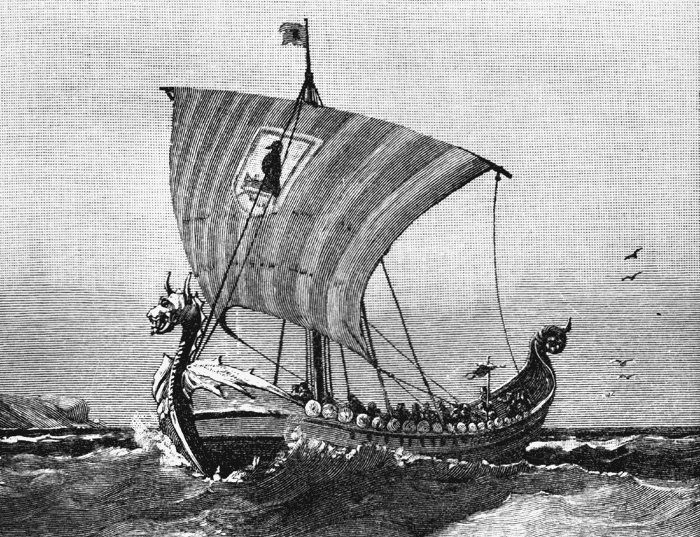
This link details how the ancient Vikings were themselves keen astronomers. As the article details, the Vikings utilized the ever-popular Polaris as a guiding light during sea travel. They would measure the angle relative to Polaris to determine cardinal directions for navigational purposes. During the day, the Vikings would utilize two special types of sundials, one of which could only be used at noon, in order to determine their orientation at sea. Amazingly, they even had what was known as a “sun stone” to help find the position of the sun during overcast periods.


Posted in Class, Historical | Tagged , , , | Comments Off on Vikings and Astronomy

Life from Earth, elsewhere

Waterbear

A color-enhanced scanning electron micrograph of a waterbear, an extremophile that has been known to survive in space.

In class, we have discussed the possibility that life on Earth did not originate on Earth, but came to Earth on an asteroid or other impactor. But another idea is that the inverse is true: Later impacts on Earth sent life to other locations in the Solar System. Recent simulations suggest that some of the known or believed impacts Earth has sustained were large enough to send some debris to Mars, Jupiter, and possibly even Saturn. We know that Mars may have once been habitable, and we suspect that one or more of Jupiter’s moons are habitable—so is it possible that some extremophiles, such as waterbears, were included in the debris that got sent to other worlds and started life there? Some scientists think so.


Posted in Class, Historical, Science, Universe | Tagged , , , , , | Comments Off on Life from Earth, elsewhere

The origins of life and the Drake equation

In using the Drake equation to discuss and estimate the probability of non-Earth life in our universe, one factor we estimated was the probability of life developing on a given planet in the habitable zone. The problem with making such an estimate as students in an Astronomy 201 course, of course, is that we all know next to nothing about how life comes to be, even when all of the right chemicals are present.

A ribosome subunit with proteins in blue and an RNA chain in orange.

A ribosome subunit containing RNA and proteins, both necessary to early life on Earth.

The thing is, nobody knows exactly how abiogenesis happens. But scientists who study it naturally have a lot of ideas. We learned in class about the Miller-Urey experiment, in which organic compounds were made from common atmospheric compounds and energy. While there is no standard model for the beginning of life, most leading models draw from the same ideas that Miller and Urey did, and rely on the results from their experiment and similar experiments.

But without a truly accepted model of abiogenesis, it is difficult to predict what fraction of habitable planets develop life, and to me this is the weakest part of our Drake equation. If any part of the equation is guesswork, then the result is just guesswork—and there is nothing concrete about our guesses on the probability of the development of life.


Posted in Class, Historical, Physics, Science, Universe | Tagged , , , , , , | Comments Off on The origins of life and the Drake equation

Standing on the Shoulders of Giants

“We are a way for the Cosmos to know itself,” said Carl Sagan.  Astronomy is not only the oldest science, but also a window through which mankind peers through in attempt to glimpse the fleeting answers to our deepest and most fundamental questions. As a direct result of the this class, I find myself looking skyward more often at night. I spy Jupiter and Mars, both high in the sky this time of year, and I can understand their significance in our holistic picture of not only the Solar System, but the Universe itself. It’s a bit eerie to gaze upon Mars and remember that Tycho Brahe stared endlessly at the same red dot of light night after night, meticulously recording its position and compiling decades of data points all so that his young assistant, Kepler, could use the data and Mars’ convenient relatively high eccentricity to derive his three laws of planetary motion. These laws were revolutionary and forever changed the way we perceive the Universe. Kepler spent his life’s work digging through data tables to come up with what has become a paragraph or two in an astronomy textbook which anyone can read and understand with ease. Progress marches on and new discoveries reveal more than anyone could have even imagined. 15 years ago exoplanets were thought to be probable, but there was no proof. Today astronomers are finding more and more that they seem mundane. Newton said of his discoveries, “If I have seen further it is by standing on the shoulders of giants.” No such truer statement rings across time: we have only come as far as we have in our understandings of the cosmos through the work of those who came before. Come another decade the universe may look very different than it does today; as we discover more among the heavens and widen our field of view, the universe gets smaller and closer to home.


Posted in Class, Historical, Physics | Tagged , , | Comments Off on Standing on the Shoulders of Giants

Are We Alone?

The famous science fiction writer Arthur C. Clarke was quoted as saying, “Two possibilities exist: either we are alone in the Universe or we are not. Both are equally terrifying.” A truer statement is hard to come by. Yet quote also sparks tremendous debate and intrigue among those whose ears come across it for the first time. We all wonder, are we reallyalone? Could we possibly be all that is out there? Is there truly no one looking back, wondering the same? Such questions have teased all of mankind, from our smartest scientists to the youngest of children and their endless curiosity. It is part of what makes us human, that we search for more than we just perceive around us. But perhaps there is a slightly more answerable question, can we quantify the possibility of life?

The answer is yes (and no). No we cannot provide hard numbers to a computer and have it spit out an answer which determines if there is life elsewhere in the universe, but yes we can get reasonable estimates. That is where the Drake Equation enters play. Postulated by Frank Drake back in 1961, the equation is an attempt to quantify, to our best estimates, the possibility of an intelligent civilization somewhere in our Milky Way Galaxy. By multiplying the estimated percentages of factors which we believe contribute to the possibility of intelligent life, and then multiplying that fraction by the total number of stars in the galaxy, out comes a simple number which guesses at the number of intelligent alien civilizations which we could theoretically make contact with. The factors of the Drake Equation include: the average rate of star formation in the galaxy, the fraction of those stars that have planets, the average number of planets per star that could potentially support life, the fraction of those planets that actually support life, the fraction of life-bearing planets with an intelligent species, the fraction of intelligent species that could develop technology to communicate across the cosmos, and finally, the length of time the average civilization lives. The first three fractions are the only ones which we actually have very accurate predictions. They are quantifiable and testable by astronomers. However, the last 4 are essentially just guesses. We may have some reason to set our guess one way or another but at the end of the day, one guess is no better than another. Depending on how one sets these factors, one could get the number of such civilizations to be 1e-10 or 1e4 and anything in between.

We can only speculate on the existence of alien civilizations. The Drake Equation is just a tool to help us along in the process. Nevertheless, considering the vastness of space and the lifetime of humans as individuals and possibly as a species, the chances that we ever make contact with another civilization may be extremely slim, regardless of how abundant life is in our universe. But until the day where either we become intelligent enough to travel these great distances or an alien comes knocking on our door, we may truly never know an answer to humanity’s greatest question… are we alone?


Posted in Aliens, Historical, Space Travel | Tagged , , , | Comments Off on Are We Alone?