Metallic hydrogen

The interior of Jupiter

The interior of Jupiter is believed to contain a large quantity of liquid metallic hydrogen, depicted here in grey.

In learning about the interiors, we’ve heard a lot about metallic hydrogen. To me, it was a confusing idea, simply because I only really hear about hydrogen in the context of being a gas or being a compound such as water or methane. Furthermore, it was not clear what phase metallic hydrogen would be, since usually “metallic” is not actually a phase, just a set of properties.

Dr. Grundstrom told us that the main thing we need to know about metallic hydrogen is that it is conductive, and in fact this is the primary characteristic in its definition. As it turns out, metallic hydrogen has never been created experimentally on Earth, because it requires more pressure than we currently know how to create. However, it is theorized that metallic hydrogen takes a liquid form, rather than the solid one might expect at such pressures. As we discussed in class, several celestial bodies—most notably, Jupiter and Saturn—are believed to be full of liquid metallic hydrogen, thanks to the huge amount of gravity produced by the mass of those objects.


Posted in Class, Physics, Science, Universe | Tagged , , , | Comments Off on Metallic hydrogen

Life in the Periphery

Astrobio
Astrobio

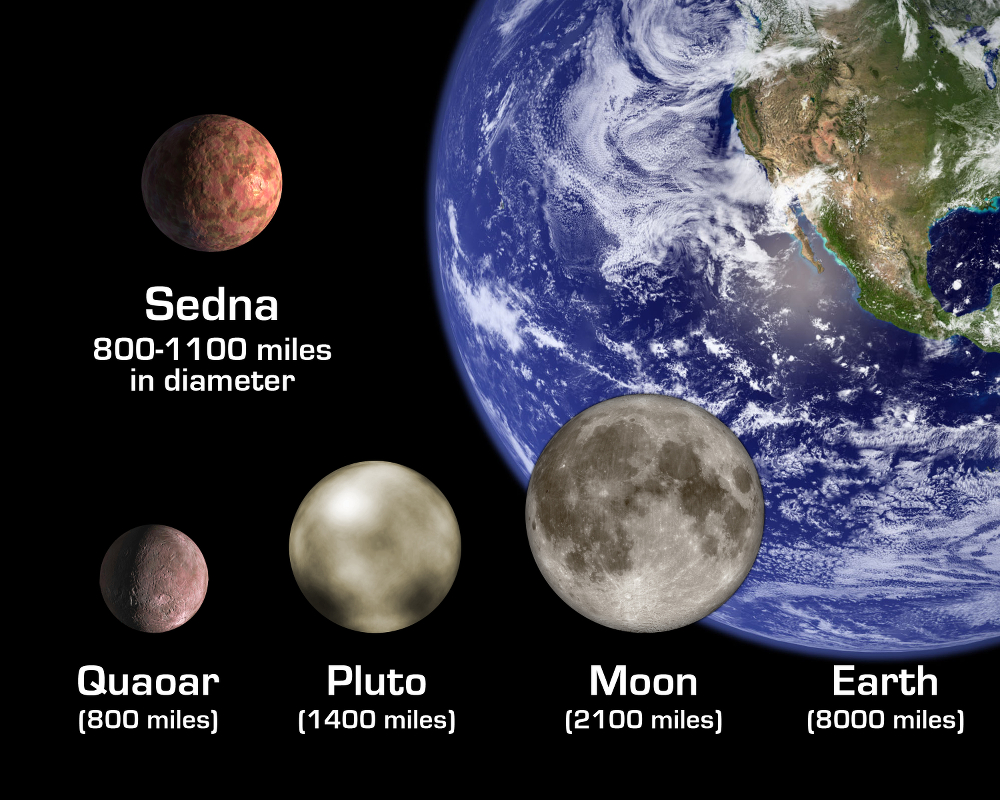
Sedna is a dwarf planet existing outside of the Kuiper Belt; in itself that makes it fairly distinct as there is only one other dwarf planet existing beyond the Kuiper Belt and that was only discovered in late March. The other thing that makes Sedna interesting is that it has ultra-red material which is indicative of organic material. That is to say that the materials which are the building blocks of life are present in the far outer-Solar System.

But this is only one place in the far periphery of the Solar System that this ultra-red material has been detected. Objects in the Kuiper Belt share a resonance with Neptune have also been found to contain these organic materials. In the search for line in the Solar System it is very interesting to find materials so far out in the Solar System. There is evidence that these objects are related to each other, many of them share the same argument for perihelion, which is an angular measure of the closest approach of the sun and the point at which the objects cross the plane of the solar system. There are three primary theories as to why this might be the case, the most favored theory postulates that a star passed 200 AU from our sun and asserted gravitational influence on these objects.

source: Dwarf Planet Discovery Could Help Show Life’s Spread Through Solar System


Posted in Small SS Objects | Tagged , , , | Comments Off on Life in the Periphery

What are we even looking for?

Three Greys from AlienWiki

Three Greys from AlienWiki

So recently we’ve been looking at different planets. Some of the planets that we tend to find most interesting are those that we think could possibly support life. But instead of tackling the life question from an excited human standpoint, I’m looking at it in a slightly wary, totally suspicious one. What are we looking for?

Whenever we search for life, we look for us. We look for planets with oxygen, with water, and with environments habitable to human-like creatures and terrestrial life. And I suppose that looking at the way the human species has expanded, it makes sense that we would look for a new home (although I don’t personally see why we need one when we barely take care of our own – planets beware, we don’t play nicely with others.) But at the same time, I wonder if we’re overlooking something. Is it possible that there are creatures that exist on other planets, but they’re so different than what we would consider a human being or life that we don’t notice them? And I guess that may be a stupid question, since with the advances of science we’ve surely found lots of interesting things out there, but just what if?

On that suspicious note, I found this very funny article here from the Onion (very credible, obviously), on a planet’s fear of catching humans.


Posted in Aliens, Class | Tagged , , , , , | Comments Off on What are we even looking for?

Life on Moons

Image

<Image for this post taken from here>

The Galilean moons, especially Europa, have been objects of interest for decades for scientists interested in finding life in our own solar system. Europa’s relatively young surface is, for the most part, devoid of the pockmarked landscapes that signify a geologically inactive world, meaning that there must be some geologic activity beneath the surface of Europa that is covering up the geologic remnants of the impacts that the world must’ve endured. Scientists claim that the geologic activity is due to orbital resonances that stretch the world due to the gravitational attractions of Ganymede and Io, which would generate friction within the world and warm the material beneath the icy surface to liquid water. Since it has a magnetic field as well, scientists believe that the water present below the surface is also salty, much like Earth’s ocean waters. A world that is geologically active with a planet-wide, sub-surface ocean rich with minerals is an exciting prospect in the search for extraterrestrial life, and finding life in a world like this one would broaden the scope of possibilities for worlds with life on them. This would also mean that instead of only looking for extrasolar planets, we might also start looking for the moons of those respective planets as well (which would certainly require better ways of finding and observing these extrasolar worlds).


Posted in Moons, Science | Tagged , , , | Comments Off on Life on Moons

Pluto hitting Neptune?

solarsystem

Some time between elementary school and high school, you probably heard that Pluto and Neptune’s orbits crossed and that one day “far into the future” (to not scare kids) they would hit each other. Well, in reality, that collision will never take place. The reason Pluto and Neptune will never collide is that their orbits are in resonance. In fact, they won’t ever even get close to each other. Though you were told incorrectly, you can’t really blame your 2nd grade teacher for trying to simplify the solar system and only make you memorize the 9 planets in order (at the time – Pluto doesn’t count anymore). Even ignoring the resonance factor, Pluto’s orbit doesn’t quite cross that of Neptune. Though it appears to in pictures, the orbits are actually separated a bit.


Posted in Class | Tagged , , , | Comments Off on Pluto hitting Neptune?

Unaccountable Freak: A Story of Halley’s Comet

I’ve been interested in Halley’s comet for a long time. Something about the fact that it always come back, and the times when it will are so utterly predictable while being huge in terms of human conceptions of time, has had a grip on me for years. Not only is Halley’s comet beautiful to look at, but it has an interesting history with one of the most famous American authors of all time: Mark Twain.

Mark Twain was born in 1835 and died in 1910. Halley’s comet came around in both those years, and Mark Twain never forgot it. He reputedly said, “I came in with Halley’s Comet in 1835. It is coming again next year, and I expect to go out with it. It will be the greatest disappointment of my life if I don’t go out with Halley’s Comet. The Almighty has said, no doubt: ‘Now here are these two unaccountable freaks; they came in together, they must go out together.'” I don’t know about other astronomy students, but I am an English student in astronomy, so any connection I can make between what I know and what I’m learning help me immensely, and I also just think that story is really cool.

Halley’s comet is the most popular and well-known of the short period comets, and hits up earth once every seventy five years or so. It is the only short-period comet we can see without the aid of telescopes (a.k.a. with our naked eye) and it is also the only one which can appear twice within a human lifetime, unless something extraordinary happens in the field of medicine really soon. Astronomers have been observing Halley’s comet since 240 BC, possibly earlier, but it was only named in 1705 by Edmond Halley, an English astronomer who determined its periodicity (how often it comes back around) and from whom the comet takes its name. Halley’s next predicted perihelion is scheduled for July 28th, 2061. I will be 58 years old.


Posted in General | Tagged , , , , | Comments Off on Unaccountable Freak: A Story of Halley’s Comet

Asteroids and Orbital Resonance

asteroids
Why is there an asteroid belt in our solar system, and why is it located where it is? The main asteroid belt is located between Mars and Jupiter, and it was formed by an effect called orbital resonance.

Orbital resonance occurs when the gravity fields of two objects align. Because Jupiter was so large during the early stage of the formation of the solar system, it was able to exert enough influence to prevent the planetismals in this region from coalescing into a planetary body.

Because of all the collisions in the asteroid belt, larger asteroids are always being broken down into smaller ones, so there will never be a planet in that region.


Posted in Class | Tagged , , | Comments Off on Asteroids and Orbital Resonance

Avoiding Asteroids

images-1

We currently do not have any way of deflecting asteroids coming dangerously close to us. Although there aren’t any predicted impacts in the near future, how could we avoid such a disaster on Earth?

Two methods that have been considered and that we could pull off are those of bombing the asteroid with a nuclear device or ramming the asteroid with a spacecraft. NASA considers the nuclear option to be more effective at the present time. Indeed, if for some reason a large asteroid were very close to impacting Earth at this moment, bombing the asteroid would be our only truly effective means of deflecting it. There is some risk involved in just handling such a device, so it is not necessarily the best option.

Ramming, although is seems rather primitive could also be effective against single, small asteroids. The kinetic impact would alter the momentum of the asteroid – hopefully knocking it off-course from Earth. However, to effectively pull off such a maneuver, the asteroid would have to be a considerable distance from Earth.

Currently, some more elegant and effective methods are being developed, such as the use of focused solar energy and mass drivers. They unfortunately will not be able to be put into effect until 10-20 years from now.


Posted in Class, Instruments, Universe | Tagged , , , | Comments Off on Avoiding Asteroids

Life on Europa?

images

The icy surface of Europa

Europa is proposed to be a top contender in the possibility of having extraterrestrial life. Under the ice, the oceans on Europa would simulate a very similar environment to that of the deep parts of oceans here on Earth. Because of tidal heating, Europa would have a degree of geothermic activity and would most likely have hydrothermal vents. These vents support chemosynthetic bacteria, which form the base of the food chain here on Earth. It is entirely possible that this is the case on Europa as well, since the discovery of similar bacteria on Earth has debunked the idea that the Sun is necessary to sustain all types of life. There has been a lot of effort to send a probe over to Europa to melt through the thick top layer of ice in order to explore and perform tests of the ocean. Who knows what we’ll find!


Posted in Class, Moons, Universe | Tagged , , , , | Comments Off on Life on Europa?

Ganymede Has a Hidden Ocean, and I Think That’s So Cool

Ganymede is my personal favorite moon (sorry, Luna) because it has a hidden ocean inside of it, and I cannot get over that! I mean, sandwiched in between an external layer of icy matters and the core is an entire liquid ocean! Personally, I picture light filtering down into the water and dappling the backs of marine animals the likes of which we’ve never seen on earth, kind of like the way your friends legs look when you’re under water in a pool, though logically I know that no light reaches this water. A girl can dream.

Ganymede, like most celestial bodies, takes its name from Greek mythology. The Ganymede of old was called the most beautiful of mortals (sorry, Helen of Troy–also, I’m making a lot of parenthetical apologies!) and was a great classic hero. Zeus took him up to Olympus to serve as a cup-bearer. In later years, Ganymede became known as a symbol of homosexual or erotic love (heck yes!).

Ganymede the moon is awesome! It’s huge, almost 2 times the mass of earth’s moon, and like I said, there is a hidden ocean inside, like a fun secret level. Ganymede is the only moon the Solar System that produces a magnetosphere, that we know of, and it completes n orbit in about seven days a.k.a. a week. And, to make it even more awesome, Ganymede is credited as being discovered by Galileo Galilei, a man with a wonderful name whom I made a blog post about earlier in the year.


Posted in General, Moons | Tagged , , , , , | Comments Off on Ganymede Has a Hidden Ocean, and I Think That’s So Cool