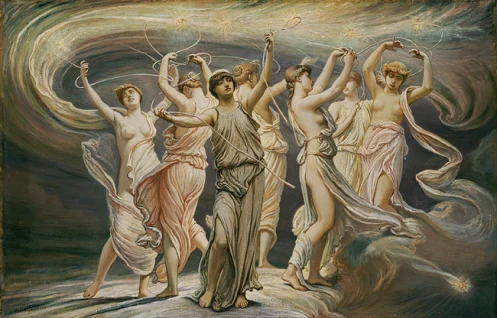
The Pleiades Myth

The Pleiades Myth

In Greek Mythology the pleiades are seven daughters of the Titan Atlas and the nymph Pleione. They were said to be extremely beautiful and served as companions to the goddess Artemis. When their father was forced to carry the weight of the world for all eternity the great hunter Orion began to pursue them. Orion was a notorious fiend for women and pursued them to the point that Zeus attempted to turn them into doves. The myth claims that in panic the seven sisters finally committed suicide together, but to comfort their father Zeus immortalized them as stars. Yet event this was not enough to escape mighty Orion who was also cast into the sky. Now the Pleiades seek shelter on the back of Taurus as Orion chases them in an eternal struggle across the night sky. Source: Pleiades Mythology Constellations: The Sky


Posted in Historical | Tagged , , , | Comments Off on The Pleiades Myth

Europa’s Ocean

We often think that liquid water is the answer to life in the universe. While it certainly makes some forms of life possible, it doesn’t guarantee their existence. If it did, we would certainly not be alone, even in this solar system, as several Galilean moons are thought to have sub-surface water oceans. The most interesting of these cases is Europa, one of Jupiter’s moons.


Europa is believed to have a global ocean underneath its ice crust. The main reason for this belief is the presence of a magnetosphere around Europa, which requires a layer of electrically conducive material somewhere in the interior of the world. An ocean would make this possible, whereas more ice would not. In addition, this ocean would be salty, about the same level as Earth’s oceans, but the amount of water in Europa’s ocean would be nearly double the contents of all of Earth’s oceans combined. The imagination runs wild with possibilities for life in this ocean, and scientists hope to send a probe to Europa in the future to find out whether or not any of these possibilities could be true.


Posted in Class | Tagged , , , | Comments Off on Europa’s Ocean

Could Titan hold life?

A joint mission with the NASA and ESA called Titan Saturn System Mission (TSSM) will explore Titan’s surface more in depth. It will allow us to see if the liquid-water features have allowed life to form on Titan. If there were life, it would obviously have to be adapted to the -180⁰C surface temperature and the nitrogen-rich atmosphere.  The TSSM mission will include an orbiter, a balloon in the atmosphere, and a lander to go into the liquid-water lake on the northern side of Titan. However, this mission was postponed because the Europa Jupiter System Mission (EJSM) won priority over TSSM. Therefore, the TSSM may not get to go out until the late 2020s. For more information about this mission, see the video below.


Posted in Moons, Space Travel | Tagged , , | Comments Off on Could Titan hold life?

The Biggest Astronomical Question of Our Generation

Why is Pluto not a planet anymore? I mean, seriously? It makes us have to do things like rewrite textbooks and change our mnemonic devices.  What if we never find out the end of “My Very Earthly Mother Just Served Us Nine____”. Nine, what?!  Anyway, the bigger point here is what exactly defines a planet.

In 2006, the International Astronomical Union (IAU) decided to give planets a definition. It is as follows:

A “planet” is a celestial body that:

  1. Is in orbit around the Sun,
  2. Has sufficient mass for its self-gravity to overcome rigid body forces so that it assumes a hydrostatic equilibrium (nearly round) shape,
  3. Has cleared the neighborhood around its orbit.

So this, my friends is the definition that kicked Pluto out of the running as our ninth planet. However, if THAT is the definition then I’m afraid a few more planets need to be kicked out as well. Let’s see, it has to orbit the Sun? That rules out the 1500 extrasolar planets confirmed. And what’s next?  It has to be a celestial body? Well, that rules out Earth (#planetformerlyknownasEarth).  And finally, the last part? Clearing out its neighborhood? Well, that takes out Jupiter too because there are things on either side of it orbiting with it. So, our mnemonic device becomes “My Very ____ Mother ____ Served Us Nine ___”. And, I’m sure more planets would be ruled out by this very limited definition. So why pick on Pluto, IAU?

Image

It’s okay Pluto, apparent we aren’t a planet either


Posted in Dwarf Planets | Tagged , , , , | Comments Off on The Biggest Astronomical Question of Our Generation

Planetary System

It amazes me how small Earth is.  I find it difficult to comprehend even the size of Earth alone.  Flying to other continents can take days.  Then I look at a scale model like the one below and I realize how small we are in comparison to the rest of the planets.  Jupiter and Saturn are massive in comparison.  If I was to attempt to fly anywhere on Jupiter it would take days!


Posted in Class | Tagged , , | Comments Off on Planetary System

Neptune

When I was in elementary school, I had to do a project on a planet.  I chose Neptune!  I spent hours coming up with a presentation and making a model.  Sadly, I don’t remember a lot from that presentation, but I’ve decided to brush up on my knowledge.  Neptune is a bright blue color and has many unique features including a giant spot as seen on the left side of the picture.  Additionally, it has extremely strong winds.  The idea of there being winds as strong as there are on Neptune is difficult for me to understand.  On Earth, the greatest winds we have tend to be during large storms out in the ocean, but Neptune’s winds can be in the 1000s mph!

Source: Neptune


Posted in Class | Tagged , , | Comments Off on Neptune

A TITANIC COLLISION…but not really

Collision: col·li·sion (kəˈliZHən) – noun: an instance of one moving object or person striking violently against another.

Now imagine the outcome of a collision between Andromeda and the Milky Way which, according to the dictionary definition, should be a violent impact between two massive galaxies with millions of stars hurtling towards each other 2000 times faster than a fastball. It even looks dauntingly beautiful.

Andromeda (collision sequence, 558px)

So magic. Much smashup. Such future.

So…..we should be scared right? Wrong. Firstly because this collision isn’t going to happen for another 4 billion years. Considering human beings have only been around for a fraction of that time (0.0005 to be exact) we should really be worrying more about our existence than this collision.

Secondly, and most importantly, the collision will…(spoiler alert) not really be a collision in the first place, by which I mean it does not fulfill the dictionary definition of a massively violent impact because since there is so much space between the stars in both the galaxies, nothing will really happen to the individual stars other than the fact they will end up in a different position than where they were before. So our solar system will stay intact, and barring the night sky looking a bit different, we won’t really be affected much by that.


Posted in Galaxies, Universe | Tagged , , , , | Comments Off on A TITANIC COLLISION…but not really

Schwarzschild Radii and You

So what is a Schwarzschild radius? And is it a concept that is dangerous for us?

First of all, the second question is silly: nearly every concept in astronomy and/or physics has implications or applications that are dangerous to us. So we’ll ignore that one.

Second of all, the Schwarzschild radius is a property of a given quantity of matter. In astronomy terms, if you compress a given amount of matter into a non-rotating (don’t worry about that part unless you’re REALLY into astrophysics, in which case go to town) sphere with its associated Schwarzchild radius, you get an object with a surface escape speed which equals the speed of light. In Layman’s terms, you squish a bunch of stuff down into a bottomless pit of black-holeishness.

By the way, the Schwarzschild radius is the exact radius of the event horizon of a black hole.

For more information about some Schwarzschild radius stuff, click here.


Posted in Class | Tagged , , | Comments Off on Schwarzschild Radii and You

The Curious Case of the Two-Tailed Comet

We’ve all pictured it in our heads: a comet, whizzing through the solar system, leaving behind a long, bright, stunning tail showing where it’s been and implying its prograde (forward) velocity direction. I used to think this was the case too. and then I learned later in life that a comet’s tail is only visible near the sun and always points away from the sun (as it is caused by the solar wind ionizing little comet particles).

Recently, however, I’ve come across some interesting information about these elliptically orbiting bodies.

Comets have two tails!!

The first, most prominent and more popular tail is the plasma or gas tail. It points, as many of us learned, directly away from the sun and is caused by solar wind interaction with gases released from the comet through sublimation. The second tail, however, is where things get a little more interesting. The dust tail contains particles too big to be pushed by solar wind. Instead, these particles experience what is called “radiation pressure“, or a push from the light bouncing off of the molecules. This causes the dust that should remain even with the parent comet throughout the orbit to be pushed away from the sun, though not as strongly as the ions are pushed in the gas/plasma tail. This light pushing causes the particles to lag behind the comet in orbit as their solar radii are increased; one more point for conservation of angular momentum: thanks astrophysics!


Click here for a decent but informative article.


Posted in Class | Tagged , , | Comments Off on The Curious Case of the Two-Tailed Comet

The definition of “planet”

Ever since the IAU gathered in Prague in 2006 and published a new scientific definition of “planet”, there has been debate on how well they did, and whether they were right to “demote” Pluto from planet to the new “dwarf planet” classification. I aim here to critique the IAU’s definition of a planet.

Artist's concept of the New Horizons spacecraft as it approaches Pluto and its largest moon, Charon, in July 2015.

Artist’s concept of the New Horizons spacecraft as it approaches Pluto and its largest moon, Charon, in July 2015. Both Pluto’s low mass and the relative masses of Pluto and Charon led to the IAU’s new definitions of “planet” and “dwarf planet”.

First, here is the final definition the IAU came up with:

Resolution 5A

The IAU therefore resolves that planets and other bodies in our Solar System, except satellites, be defined into three distinct categories in the following way:

(1) A “planet”¹ is a celestial body that (a) is in orbit around the Sun, (b) has sufficient mass for its self-gravity to overcome rigid body forces so that it assumes a hydrostatic equilibrium (nearly round) shape, and (c) has cleared the neighbourhood around its orbit.

(2) A “dwarf planet” is a celestial body that (a) is in orbit around the Sun, (b) has sufficient mass for its self-gravity to overcome rigid body forces so that it assumes a hydrostatic equilibrium (nearly round) shape², (c) has not cleared the neighbourhood around its orbit, and (d) is not a satellite.

(3) All other objects³, except satellites, orbiting the Sun shall be referred to collectively as “Small Solar-System Bodies”.

¹ The eight planets are: Mercury, Venus, Earth, Mars, Jupiter, Saturn, Uranus, and Neptune.

² An IAU process will be established to assign borderline objects into either dwarf planet and other categories.

³ These currently include most of the Solar System asteroids, most Trans-Neptunian Objects (TNOs), comets, and other small bodies.

Here’s my take on what they published, point-by-point:

  • Right off the bat, the IAU is restricting the definition to objects “in our Solar System”. On the one hand, this caveat is good: it makes sure to not preclude extrasolar objects from being considered planets. That is, if you discovered one of the over 5000 other known planets in the universe, nothing here is suggesting that you can’t call it a planet. On the other hand, nothing here says you can call it a planet either. All of these other objects are explicitly not defined here. Shouldn’t a brand-new definition of “planet” in this age of extrasolar discovery make sure to actually define the word for all—or at least most!—possible scientific uses? I think it should, and thus find the very premise of this definition lacking.
  • A planet or a dwarf planet must be a “celestial body”. Technically, “celestial” means an object in the sky outside of Earth’s atmosphere, precluding Earth from being a planet. This technicality is ignored in practice, but it is still a mistake that should not be in the definition.
  • A planet and dwarf planet must orbit the Sun. Since the definition only covers the Solar System already, this is fine. But it would be easy enough to replace “the Sun” with “a star or star system” here for a broader definition.
  • A planet and dwarf planet must have enough gravity to be basically a sphere. This seems to be an agreeable requirement, and is well-defined within the broader definition.
  • A planet “has cleared the neighbourhood around its orbit”, while a dwarf planet “has not the cleared the neighbourhood around its orbit”. This is the primary distinction between planet and dwarf planet—and its meaning is not at all clear! The read of this definition is given no clues as to what a large space object’s “neighborhood” is, let alone what it would mean to “clear” such a neighborhood. In my opinion, it is completely unacceptable to publish a definition, meant primarily to create a distinction between Pluto and the other original planets, wherein this primary distinction is itself undefined. As the saying goes, “YOU HAD ONE JOB.” In practice, it seems that “cleared the neighbourhood” is interpreted as meaning that any of the object’s moons have their orbital center of mass within the object itself. Thus, Pluto is a “dwarf planet” rather than a “planet”, because the center of mass between Pluto and it’s “moon”, Charon, is between the two objects, rather than inside Pluto. But official definition should lead to the practice; not be left open to a broad interpretation, and it is still not clear to me why other dwarf planets, such as Eres, are not considered to have cleared their neighbourhood.
  • A dwarf planet cannot be a “satellite”. This just means it can’t be orbiting another planet or dwarf planet or moon or whatever, because a moon would still technically fit the “in orbit around the Sun” requirement (by way of orbiting another body that orbits the Sun). It is not clear why the definition for “planet” does not need this rule, which ultimately leads back to the ambiguity of “cleared its neighbourhood”.
  • Everything else is a “Small Solar-System Body”. OK, I’m not sure what the capital letters are for, and it’s a pretty pedantic name, but this is fine I guess.

Overall, I find the definition lacking, particularly in its prime objective of defining exactly why Pluto et al. are not strictly planets (but they are still dwarf planets, which is apparently not just a regular planet with a modifier before it). It makes sense that the IAU didn’t want to open the door to adding potentially dozens of new planets to our Solar System, but it doesn’t make sense that they couldn’t write the official definition in a more robust manner.


Posted in Class, Historical, Physics, Science, Universe | Tagged , , , , , , | Comments Off on The definition of “planet”