80% of the Universe That We Can’t See

80% of the Universe That We Can't See

Image Source

Over the past couple of centuries, we have learned a great deal about our Universe. However, the more we seem to learn about the cosmos, the more we realize that we do not understand. When Jan Oort and Fritz Zwicky first hypothesized the existence of dark matter in our Universe, a breakthrough in our view of the Universe took place. Both Zwicky and Oort had hypothesized the presence of this dark matter to explain the rapid orbital velocities of stars in the Milky Way as well as the surprisingly small mass in the orbital velocities of galaxies within clusters. Although dark matter is thought to make up about 80% of the entire Universe, it is quite difficult to study dark matter considering the fact that we can’t see it.

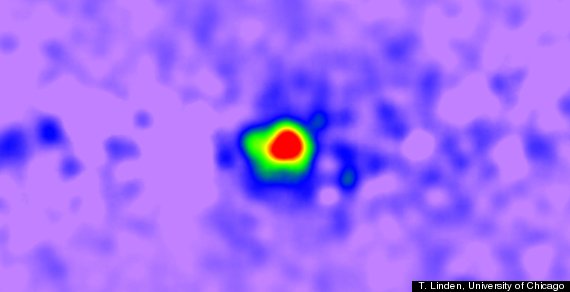
Today, it was posted in a Huffington Post Article that scientists from the Fermi National Laboratory are claiming that they may have just found one of the most important and clear signals for the presence of dark matter. The scientists produced the picture above, which shows the Milky Way with all known sources of gamma radiation removed. However, the red part of the image depicts a healthy source of gamma rays at the center of the Milky Way. The team at Fermi National Laboratory has come to the conclusion that these gamma rays must be emanating from dark matter, as they have ruled out all other known possibilities. Although it has been confirmed that no other known astrophysical sources can account for the gamma rays, this still does not prove the existence of dark matter entirely. For all we know, it could be something entirely different that we have yet to discover. Nevertheless, it seems as though the scientific community is getting closer and closer to understanding dark matter with each and every discovery.


Posted in Instruments, Physics | Tagged , , | Comments Off on 80% of the Universe That We Can’t See

Wobbling Stars

Most people would be surprised to know that every star in the sky is not a “stationary” center of their solar systems. Of course, the entire solar system is flying through space, orbiting the center of its galaxy. But many would look at the Sun and say that relative to the rest of the Solar System, it is “fixed” while the planets are the ones orbiting around it.

Actually, this statement is only half true. While the planet said to be orbiting the star, each one is actually orbiting their center of mass as shown in the picture below.

Wobble
A star and planet system orbiting a common center of mass

In the case of most star-planet systems, the center of mass is inside the star. That means from an outside perspective, the star will appear to “wobble” around a fixed point. We use this in astronomy to detect the planets of far-away stars. In any system with two or more bodies, the center of mass will almost be directly in the center of either body. This means that pretty much every single star in the entire universe (assuming it has at least one planet) is wobbling, at least a little.


Posted in Stars | Tagged , , | Comments Off on Wobbling Stars

Is Pluto a Planet?

Image


I can recall sitting and listening to an astronomy presentation during my eighth grade year. The man who presented told us that Pluto was no longer a planet. For some reason this bothered me because all my life I had been told that Pluto was in fact a planet. I can also recall taking the introductory Astronomy class my freshman year in college and doing a book report on whether Pluto was a planet. I read Dr. Weintraub’s book “Is Pluto a Planet?” Dr. Weintraub seems to believe that Pluto is in fact a planet but acknowledged it as a “Dwarf Planet.” So the obvious question that looms is whether or not Pluto is a planet. After reading through some articles, I picked one I felt resolved this scientific dilemma best. I like to learn through analogies to objects I see as relevant. The article was titled “Neil deGrasse Tyson: Pluto is Not a Planet So ‘Get Over it.’” He compares Neptune to a Chevy Impala as compared to Pluto which would be a matchbox car. This is incredibly small. He also says Pluto is just an icy body in Kuiper belt. I guess I will just have to get over it. After all, we only call Pluto a planet because we did not know what to classify it as before. It shares more properties with other celestial bodies. I feel it is fair to say Pluto is not a planet.


Posted in Dwarf Planets, Small SS Objects | Tagged , | Comments Off on Is Pluto a Planet?

Weird Life on Titan?

Weird Life on Titan?

Image Source

People are fascinated by the Universe for a variety of reasons. Some are intrigued by black holes, while others may be obsessed with the formation of stars and planets. But one thing is for sure, the possibility of life elsewhere is definitely an exciting topic no matter what you’re interested in.

When we think of the possibility of life elsewhere, we often assume that liquid water and oxygen is required. Moreover, our commonly accepted image of extraterrestrial life is often a green being with 2 legs, 2 arms, and a head just like ourselves. We are basically assuming that life elsewhere would look not that much different than the life we are accustomed to. People usually overlook the possibility that extraterrestrial life can be unimaginably different than our own, living off of different types of chemical compounds than we would guess. Titan, Saturn’s largest moon, may be the place where weird life such as this could be harbored.

Most people are unaware that Titan is somewhat Earth-like. Like that of our own, Titan has a thick, nitrogen atmosphere. In addition, Titan and Earth are the only two worlds in our solar system that have stable liquids on its surface. Like we see on Earth, these liquids form rivers and streams, which flow into lakes and seas as well. The difference, however, is that Titan’s liquid is made up of hydrocarbons. Considering Titan’s extremely cold temperatures of around -180 degrees Celsius, compounds such as methane and ethane are liquid on Titan’s surface. Moreover, these frigid temperatures cause water ice to be as hard as rocks. Such rocks of waters are actually in abundance around Titan’s surface. Astrobiologists are considering the possibility that Titan may harbor very weird life that may be liquid methane or liquid ethane based rather than water-based. If we were to ever find weird life such as this, it would open up a whole new realm of possibilities for life in the Universe. We would no longer be concerned with finding liquid water, but other liquid compounds as well. However, until we find life that is supported by other compounds such as those mentioned, we can only assume that life forms from liquid water.


Posted in Aliens, Moons | Tagged , , , | Comments Off on Weird Life on Titan?

Is Pluto a planet?

A few weeks ago, I was discussing my astronomy class with a friend, when he interrupted to tell me his summation of the subject: “Spoiler Alert,” he told me. “Pluto isn’t a planet after all.”

It wasn’t as thrilling as the end of the Sixth Sense, but I told him that may not be entirely true.

After our discussion of the International Astronomical Union’s definition of a planet (you can read the full ruling here), I think we can define Pluto as a planet simply because our definition of a planet is incredibly inadequate.

As is stated in Resolution 5A, our definition of a planet is defined by our own existence on Earth, as if to say that Earth is almost an entirely different category separate from other “planets.” Using a term like “celestial,” for instance, is a misinformed way of establishing distinctions within our solar system. We should be working towards one overarching definition, one that includes Earth as a like-body to the other planets of our solar system.

However, aside from our definition of a planet, we must also consider the lack of judgment in categorizing Pluto as a “Dwarf Planet.” For if the term “planet” is used in its new categorization, how can we say that it is NOT a planet?

Maybe, we need to change the name “dwarf planet.” Or maybe, we need to stricken the rules behind all shapes in space. But, one thing is for sure – changes must be made to the 2006 ruling.


Posted in Dwarf Planets, General | Tagged , , , , , | Comments Off on Is Pluto a planet?

Jupiter: Magnetosphere Explained

One feature of Jupiter that may come as a surprise is that it contains a magnetic field more than 20,000 times as strong as that of Earth’s. But, how is this possible if the Gas Giant is comprised of only hydrogen and helium?

As you may recall from our study of Earth’s magnetosphere in Ch. 9, there are three basic requirements of a planet needed to create a magnetosphere:

1) Its interior region (core) is capable of conducting electricity; and

2) Convection occurs in that layer of fluid; and

3) Rapid rotation must exist

It’s safe to say that Jupiter is rotating at a fast enough rotation for a magnetosphere to be formed. But, what about requirement number one and two? How could Jupiter contain a fluid in its core that conducts electricity? The answer, as explained in this NASA article and this YouTube video, is that Jupiter’s core consists of “metallic hydrogen.”

Pressures are so high in the core of Jupiter that hydrogen compresses into a metallic-like state, thus allowing the conduction of electricity to exist. This, paired with Jupiter’s rapid rotation allows Jupiter to claim hold of the strongest magnetosphere in our solar system. In fact, Jupiter’s magnetosphere is so strong, that it actually sends ionic particles to its surrounding moons. Io, for example, developed its thin atmosphere from the collection of these ionized particles.


Posted in Physics | Tagged , , , , , | Comments Off on Jupiter: Magnetosphere Explained

NASA’s Collaborations for Commercial Space Capabilities Initiative

For more information, click on this link

For more information, click on this link

NASA has had a lot of success with their commercial space flight initiatives, and so is looking to branch out and extend offers to work with US private enterprises to offer more, new commercial space experiences. NASA is looking for ways to expand people’s access to spaceflights and the benefits associated with the commercial spaceflight industry by having partnerships with new private groups.

The Collaborations for Commercial Space Capabilities initiate, which has just launched, will help entrepreneurs and private companies advance their technologies in spaceflight by giving them access to NASA’s extensive spaceflight resources and infrastructure and enabling collaboration between them and NASA’s experts. This is an unfunded project, so those companies whose proposals are chosen for this initiative support their own costs, as does NASA.

This is only one of several collaboration projects NASA has launched with US companies and entrepreneurs in the commercial space industry. Another is the Lunar CATALYST project, which asks for proposals for commercial robotic lunar landing capabilities. These and other projects done by NASA demonstrate their effort to maximize success in space exploration by collaborating with the private sector.


Posted in Class, Historical, Instruments | Tagged , , , | Comments Off on NASA’s Collaborations for Commercial Space Capabilities Initiative

The Tunguska Asteroid

On June 30, 1908 an asteroid about 120 feet across entered Earth’s atmosphere and exploded above the Podkamennaya Tunguska River in Siberia. At an elevation of about 28,000 feet, the combination of pressure and heat made the space rock explode and created a fireball. It produced as much energy as about 185 Hiroshima bombs. The impact on Earth was expansive. Eight hundred square miles of remote forest had been knocked to the ground. The trees all fell in a certain pattern, pointing away from the impact’s epicenter. The trees by ground zero of the explosion were left standing upright but with their branches stripped off. To have this result, there needed to be fast enough shock waves that could break the branches off before the shock could be transferred to the trunk. There was a report by a man who was 40 miles from the impact location that he was thrown from his chair and felt as though his clothes were on fire, it was so hot. He said that the entire northern part of the sky was covered in fire – the result of the asteroid burning up in space. It is lucky that the asteroid exploded in space before hitting the ground – it would have produced a huge crater.


Posted in Class, Historical | Tagged , , , , , | Comments Off on The Tunguska Asteroid

Much Stars So Wow 2014-04-06 17:17:05

This charismatic account of the first rogue planet discovered touches on many interesting points. The video discusses our ever-changing definition of what constitutes a planet. At first, we simply defined a planet as anything we observed that was similar to our 8 local planets. However, after incredibly massive planets (around ten times the mass of Jupiter) were discovered orbiting distant stars, we had to amend our definition of planet to include these massive beings. In 2012, we again had to reconsider what constitutes a planet, as a “rogue planet” was discovered without any parent star. The video explains how we now have a somewhat “fuzzy” classification of what separates a Brown Dwarf from a rogue planet, and touches on how the rogue planet came to be, describing how it was most likely ejected from a distant solar system by a gravitational encounter. Overall, the discovery of this rogue planet forced scientists to again re-define what is a planet, and shed light on how little we really know about the universe in which we live.


Posted in Exoplanets | Tagged , , , , | Comments Off on Much Stars So Wow 2014-04-06 17:17:05

Lagrange Points

This video by Sixty Symbols gives an in depth look at lagrange points, delving into the physics of orbiting bodies. The video outlines the five lagrange points of the Earth-Sun system. L1 is between the Earth and Sun, L2 is slightly farther from the Sun than Earth, and L3 is on the opposite side of the Sun in Earth’s orbit. These three “locations” in space represent unstable gravitational equilibria. This means that any objects in these locations will eventually drift out of position due to the gravitational effects of other massive bodies. Despite this, these locations, namely L1 and L2, are very useful locations to put telescopes.

The video gives the example of the Herschel Space Observatory, which observed light in the infrared spectrum. Because Earth itself emits infrared radiation, scientists wanted to place the telescope far away from Earth, but in a location that allowed for easy communication with the satellite. The L2 point ended up being the chosen location for the satellite, as it allowed the telescope to remain in an orbit 1.5 million kilometers away from Earth. This distance ensured that the telescope could make the necessary observations without Earth’s IR radiation interfering. However, because L2 is an unstable equilibrium, the Herschel Space Observatory needed rockets to fire regularly in order to maintain its position.

The video also explains how L4 and L5 are stable gravitational equilibria, meaning that any objects at those locations will stay there. It explains how lagrange points can occur for any system of two massive bodies in orbit, and gives the example of the Trojan asteroids trapped in L4 and L5 of the Jupiter-Sun system. Overall, this in-depth video gives insight into the gravitational phenomena of Lagrange points, and explains their applications in today’s world.


Posted in Physics | Tagged , , , | Comments Off on Lagrange Points