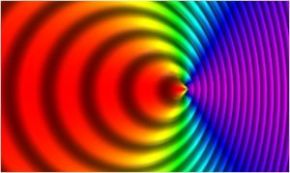
Have you ever heard an ambulance fly by you and noticed that the pitch changes as it approaches you, and changes again when it goes past you? This phenomenon is known as the Doppler effect (or Doppler shift). What happens is that as the ambulance approaches you, each of its successive sound waves are emitted closer to you, which raises the frequency (or pitch) of the sound. When it recedes from you, the sound wave is emitted further from you, which deceases the frequency and pitch of the sound.
Interestingly, the use of the Doppler effect is not limited only to the world of sound, but to almost everywhere where any kind of wave is involved. The same shift in sound waves seen above is also applicable to light waves, since light acts as a wave and as a particle.
In astronomy, the use of the Doppler effect is used to measure the speed at which stars and galaxies move relative to us. It doesn’t tell us the exact speed, but informs us of their radial velocity.
For example, if a star is moving toward us, light waves will get “bunched up” as it approaches and the light’s frequency will increase. This is known as blueshift because in the visible color spectrum, light with increased frequency will become bluer. If the star is moving away from us, the light waves will get spread out and the frequency will decrease and a redshift will occur. In the visible color spectrum, light of less frequency approaches red, which is the color of lowest frequency.
However, blueshift and redshift is not only related to the visible color spectrum. Astronomers use the terms in any kind of color spectrum, since they are useful for describing whether or not light waves are increasing or decreasing in frequency.