Historical Astronomers in Context

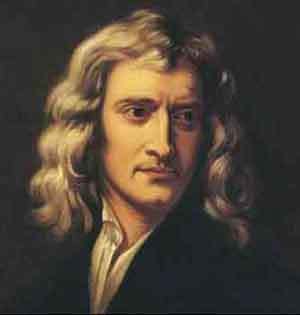
Isaac Newton is one of the most important scientists in history. Although he lived during the late 17th century, his work has impacted the fields of mathematics, physics, and astronomy of today’s world. His notable accomplishments include the establishment of modern Physics, and the discovery of both the gravitational force and the three Universal Laws of Motion. Moreover, his work provided the proof for heliocentricity, as first put forth by Nicholas Copernicus. This discovery alone “served as the basis for our understanding of how the universe functions and why it is the way it is” (Jessa, 2009).

Major Historical Events During Isaac Newton’s Lifetime:
On February 3rd, 1690, paper money was issued for the first time by the colony of Massachusetts.
Another important even during the lifetime of Isaac Newton was in June of 1654, when Louis XIV was crowned king of France in Rheims.

Another Historical Figure During Isaac Newton’s Lifetime:
A famous historical figure that lived during the time of Isaac Newton is John Locke. Locke was born in England on August 29th, 1632, and died on October 28th, 1704. Locke contributed greatly to the field of philosophy during the enlightenment period. Among his philosophies was his theory that everyone was born with natural rights. Of these rights were life, liberty, and property. It is not a coincidence that such philosophy made its way onto the constitution.

Reflection:
Throughout this assignment, I came to the realization that several of the most important scientific discoveries and developments occurred around the time of the aforementioned astronomical figures. It was interesting to learn of how impactful Isaac Newton’s work has been on the fields of mathematics, physics, and astronomy. Without his work, we could never have reached the level of knowledge that we are at today; so much of what we know in science is based upon Newton’s accomplishments. It was also interesting to note that although there was a plethora of accomplishments in the field science during those centuries, there were also several other important events around the world as well.


Posted in Historical | Tagged , , | Comments Off on Historical Astronomers in Context

Historical Astronomers in Context

galileo
Painting by Joseph-Nicolas Robert-Fleury depicting Galileo on trial for his heliocentric views.

Galileo Galilei (15 February 1564 – 8 January 1642), often given the title “father of astronomy” or even the “father of science,” lived during the start of modern science and faced much persecution for his contradiction of commonly held Aristotelian cosmology.

The 16th and 17th century were very tumultuous times in Western history. The end of the 1500s saw the beginning of the colonization of the Americas by Europe, and in 1611, the King James Version of the Bible was completed and released, soon becoming the most used Bible in Europe and America.

Francis Bacon lived in the same time as Galileo. He is known as the creator of empiricism and the scientific method. His works marked a turning point toward modern science as we know it today.

Galileo Galilei lived in a time when people did not treat science as they do today. If someone in the modern era makes a claim (especially an extreme one like heliocentrism was at the time), scientist simply test and attempt to reproduce it and accept it if it appears to be consistent with what we know. However, the claim of heliocentrism made by Galileo and others was considered to be heresy. The scientists of that time had to deal with people in the Church arresting them and bringing them to trial for simply practicing science and reporting their results. The steadfastness of great men like Galileo, who stood by truth in the face of arrest and the threat of torture, helped the world progress and helped bring about modern science. It was amazing to learn how resistant people were to change, and how people today who do not want to accept scientific facts are on the wrong side of history. It is just as important today as it was in the 16th century to form our opinions and beliefs about the natural world by what science shows us can be tested and reproduced.


Posted in Historical | Tagged , , | Comments Off on Historical Astronomers in Context

Historical Astronomers in Context

2) Johannes Kepler made a groundbreaking discovery when he determined planets’ orbits are ellipses, not perfect circles. This is important because it explained why previous models of our solar system were flawed. Additionally, Kepler’s laws give important information on how exactly orbits work. For example, his second law tells us that planets will cover area (between planet and sun) at a constant rate.

3)         a) During Kepler’s lifetime, there were many other important events in world history. Sir Walter Raleigh founded Roanoke Colony in 1587, and it was found deserted 3 years later. Additionally, the Mayflowers Compact was signed in 1620.

b) Along with important historical events, there were some very famous people who lived at the same time as Kepler. One of these people was William Shakespeare (birth date unknown – 1616) . His works are some of the most well known in all of literature and odds are you have read at least a couple of them. Pocahontas (c. 1595 – 1617) also lived during this time. Though most people get facts about her wrong thanks to the Disney movie based on her, she really did save John Smith’s life. She was about 8 years old at the time.

4) I knew many of the facts about these people and events already, but I never thought about them happening at or around the same time. Context in history always makes things more interesting (at least for me).


Posted in Class, Historical | Tagged , , | Comments Off on Historical Astronomers in Context

Historical Astronomers in Context

Johannes Kepler (1571-1630) was important to astronomy because he was a master mathematician and calculator. He worked in conjunction with Tycho Brahe who, through his brilliant eyesight made a lot of readings. Kepler used these readings to make deductions of how the solar system and the universe work. His three laws still hold true today:

The path of the planets about the sun is elliptical in shape, with the center of the sun being located at one focus. (The Law of Ellipses)

An imaginary line drawn from the center of the sun to the center of the planet will sweep out equal areas in equal intervals of time. (The Law of Equal Areas)

The ratio of the squares of the periods of any two planets is equal to the ratio of the cubes of their average distances from the sun. (The Law of Harmonies)

During Kepler’s lifetime, other significant events also took place:

1600: The English East India Company was founded, setting in motion a series of wars which would eventually establish India as a British colony until 1947, when Pakistan and India finally got independence.

1619: A Dutch ship brought the first African slaves to North America. The rest is history.

Mary Queen of Scots also lived around the same time as Kepler (from 1542–87). She had the strongest claim to the English throne after the death of Henry VII. Hence the new ruler, Elizabeth I, considered her a threat to her legitimacy as a ruler and had her executed.

Having previously studied world history, it seemed as if up until the 20th century, all that happened in the world was wars and countries ruled by monarchs and feudal lords. This helped me realized that alongside all these things, important scientific discoveries were also taking place.


Posted in Historical | Tagged , , | Comments Off on Historical Astronomers in Context

Historical Astronomers in Context

Johannes Kepler (1571-1630) is important to astronomy because he was the first person to develop laws governing planetary motion. Our understanding of orbital motion is based on the work that Kepler did.

The following are events that occurred during Kepler’s life.

The British East India Company was founded in 1600. This company heavily influenced British policy in Asia and therefore set the course for the British Empire.

The Thirty Years War began in 1618. This war would ravage Europe and lead to the creation of modern armies under the command of Gustavus Adolphus.

The following important figure lived concurrently with Kepler.

Rene Descartes (1596-1650) was a famous mathematician and philosopher. He developed the Cartesian plane and is remembered for his statement “Cogito Ergo Sum” or “I think therefore I am”.

It is so interesting to think about how all of these things happened at once. Past events usually seem to stand by themselves when we learn about them, but they are all interconnected. It seems strange how these connections are so easily forgotten when they are so interesting.


Posted in Historical | Tagged , , | Comments Off on Historical Astronomers in Context

Isaac Newton

Isaac Newton (25 December 1642-20 March 1727) was an English physicist and astronomer. He made significant contributions to the world of science by detailing the laws of motion and created the first reflecting telescope. He also further proved the heliocentric theory by using Kepler’s laws with his mathematical principles of gravity and removed the little doubt that still surrounded the heliocentric theory. Additionally, he studied the laws of cooling and the speed of sound. During his time, the great plague of England (1665) occurred. It killed an estimated 100,00 people, which at the time represented 15% of the population. It was the last outbreak of the bubonic plague, which was the cause for the black plague that occurred approximately 300 years ago. Another historical event that happened during Newton’s lifetime was the formation of the Kingdom of Prussia. Under King Frederick I in 1701, the Kingdom of Prussia was established. This included parts of Poland, Russia, Lithunia, Denmark, Belgium, and the Czech Republic. The capital of the kingdom was Berlin.

What was most interesting about learning about these past historical facts was that Isaac Newton lived during the great plague of 1665. He lived in England during this time, and the plague must have somehow affected him directly or indirectly. While it is unclear if the great plague affected anyone he knew, this was a major event in England’s history and while the plague was killing thousands of people, Newton was making scientific advancements.


Posted in Class | Tagged , , | Comments Off on Isaac Newton

Sir Isaac Newton’s World

Sir Isaac Newton was born Christmas day, December 25, 1642 in the small hamlet of Woolsthorpe in the county of Lincolnshire in the English countryside. He lived a full 84 years, in which he revolutionized our fundamental understanding of the universe by discovering his Law’s of Motion, Law of Gravity, and laws of Optics; as well as inventing the Newtonian telescope; and independently inventing Calculus. He has gone down into the history books as one of the smartest individuals to ever live, as well as one of the most influential scientists to ever live. He later died peacefully in his sleep on March 20, 1727. For more specific details on his life, check out this article by Dr. Robert Hatch at the University of Florida.

Newton’s lifetime overlapped with a very interesting part of history. Here are two events which occurred during his life:

February 1692 (Newton, age 50): The Salem Witch Trials took place in Salem, Massachusetts.

This famous event in the young colony of Massachusetts was a widespread public hysteria of the presence of witches in the small, rural town of Salem. Public fear over evil spirits and sin brought forth public trials of those who were accused of witchcraft. These trials were unfair and unjust, often leading to the death of the accused after a dubiously justified trial.

1689 (Newton, age 47): John Locke publishes his Two Treatises of Government.

        This essay later heavily influenced the American revolutionists in the British Colonies, and thus was a major source of inspiration towards the founding of a new and independent United States of America. In it, Locke outlines his idea of the “State of Nature” whereby all men are born into the world free of tyranny, but eventually we give up some of these freeborn instilled rights in order to join a society where we all mutually benefit. But he warned of society and those in charge of it becoming too powerful and tyrannical.

As well as fascinating historical events, Newton’s lifetime overlapped with many famous and influential people, including other scientists, political figures, artists, and many others. One example is Johann Sebastian Bach.  Bach was a famous composer of the Baroque Period, especially writing with the piano and violin. His major works include Mass in B Minor, The Well-Tempered Clavier, and his Lullaby. 

As I think about Newton and the world he inhabited, I think it’s very useful to sometimes step back, away from your subject of interest, to investigate the world in which the subject lived it. Often times we isolate our subject, choosing to focus in on him/her entirely, but we forget that any person is product of their environment. Therefore it is important to understand that environment. That is why I found learning about the world around Isaac Newton to be almost as important as learning about the man himself. For example, Newton of course was this trailblazing explorer in the day’s most cutting edge fields, but yet we look across the ocean to the America’s and we see that the people of Salem, Massachusetts still believe in and live in a fantasy land where superstition and rumor overwhelms facts and reality. Newton was an exceptional human being for not only his time, but even by our standards today.


Posted in Historical | Tagged , , | Comments Off on Sir Isaac Newton’s World

Historical Astronomers in Context: Galileo Galilei

Galileo Galilei (February 15, 1564 – January 8, 1642) is a mathematician and astronomer most well known for supporting and publishing the heliocentric model, suggested by Copernicus. Galileo helped overturn objections to Copernicus’ model by making discoveries about motion, the imperfectness of things in the sky, and providing evidence that the stars are much farther away than previously thought. These contributions, and his use of the telescope (which helped him see moons revolving around Jupiter), provided sufficient evidence that the Earth is moving around the Sun.

During Galileo’s lifetime other important historical events were taking place:

  • The counter-reformation in the Catholic Church started before Galileo was born and continued throughout his life as a response to the Protestant Reformation that started when Martin Luther posted his 95 theses. The goal of the counter-reformation was to spread Catholicism and limit Protestant growth. Later in the 16th century, the counter-reformation led to the Roman Inquisition. During his time, the Catholic Church heavily prosecuted individuals who committed heresy, including Protestantism and blasphemy, among other things.
  • The Thirty Year’s War took place during Galileo’s lifetime between the years of 1618 and 1648. This war took place in Europe between many nations over religion and territory. Protestant and Roman Catholic leaders fought for dominance.

Another important historical figure alive during the time of Galileo was Queen Elizabeth I of England. Queen Elizabeth I was born September 7, 1533 and died March 24, 1603. She came into power during a time of internal turmoil in England (especially religious tension), but helped it become a leading power. She restored England to Protestantism and became the ruler of both church and state. The period between 1558 and 1603 is now known as the Elizabethan Age.

During the time period Galileo was alive and making new discoveries about the Universe, religious tension was a major problem throughout Europe. The Catholic Church’s power was threatened as Protestantism spread and people and nations became deeply divided. Religious tension made both sides react strongly to people who threatened their believes and questioned their teachings. The tension over territory, leadership roles, science, and anything that might go against church doctrine caused violence and war. It was interesting to see that all nations in Europe had this common theme of religious tension during this time period and that it affected almost all aspects of life and culture.


Posted in Historical | Tagged , , | Comments Off on Historical Astronomers in Context: Galileo Galilei

Historical Astronomers in Context: Isaac Newton

Isaac Newton (December 25, 1642 – March 20, 1727) spent some time working on gravitation and how it affects the orbits of planets. He eventually published the Principia Mathematica, which introduced Newton’s law of universal gravitation, i.e. F=G\frac{m_{1}m_{2}}{r^{2}}

In September 1666, when Newton was 23 and attending Trinity College, Cambridge (in England), the Great Fire of London occurred. This enormous fire burned down basically the entire medieval City of London, destroying about 70,000 homes. In 1692, while Newton was starting the later years of his life and writing religious tracts, the Salem witch trials began in Massachusetts. The Salem witch trials are one of America’s most famous historical examples of mass hysteria, and in the most famous trial, 20 people were hanged after being accused of being witches.

King Charles I of England, Scotland, and Ireland was alive from November 19, 1600 – January 30, 1649. He was beheaded after being convicted of treason after losing the English Civil War. After his death, royalists viewed the King as a martyr, but England became a Commonwealth nonetheless.

Often, history is taught as separate events, and while some context is usually given, it is generally taught separately as scientific history, political history, etc. To see that monarchies were finally going out of style as Newton’s life started, but that such a fanatical sort of event like the Salem witch trials were happening still at the end of his life, is really eye-opening—Newton didn’t make his discoveries in a vacuum, but was in fact greatly affected by everything that went on in the world around him, especially in Europe.


Posted in Class, Historical, Science | Tagged , , | Comments Off on Historical Astronomers in Context: Isaac Newton

Historical Astronomers in Context

Johannes Kepler’s contribution to astronomy can be matched by few. The laws of planetary motion appropriately named Kepler’s laws are still used to this day for approximating planetary orbits. His equations and observations gave us insight into the relationship between orbital period and orbital distance. Ultimately, Kepler’s contributions to astronomy played a key role in the scientific revolution, and blazed a path for future generations of astronomers to follow.

Mary Queen of Scots Executed in 1587 – Mary Queen of Scots was executed for treason by Queen Elizabeth I. This is generally believed to be the catalyst for Philip II launching the Spanish Armada.

Jamestown Settlement Established in 1607– Jamestown Virginia was the home of the first permanent english settlement in what would later become the United States. It served as England’s foothold in the west, and paved the way for future colonization.

John Winthrop (1587 – 1649) played an elemental role in establishing the Massachusetts Bay Colony. After Plymouth Colony, this was England’s most important Colony in Northeastern America. Although criticized for being too authoritarian, Winthrop served 12 consecutive terms as Governor, and allowed the colony to run smoothly throughout his governance.

I find that when learning about history, it is often difficult to realize what important events happened at the same time. We usually study a specific culture or civilization over the course of multiple centuries, rather than look at the world as a whole at a specific time. Because of this, important connections between different cultures and fields of science are often missed. Therefore, the implications regarding simultaneous events are often lost. Looking at what was going on during the life of Johannes Kepler has given me a perspective of just how groundbreaking his discoveries were, given the lack of technology and focus surrounding astronomy at the time.


Posted in Historical | Tagged , , | Comments Off on Historical Astronomers in Context