The Precession of Earth’s Axis

I’m a very visual learner, so when trying to understand the phenomenon of axial precession, I sought out a visual representation of what exactly is going on. This video perfectly explains (for this level class) the causes and implications of axial precession. It leaves us with an advanced understanding of how axial precession affects our lives without delving into complicated physics. Even if you feel like you’ve got a complete understanding of the topic, give this video a watch. The air gyroscope used to demonstrate precession is a much better visual representation of what Earth actually does than the traditional spinning top analogies.  Overall, the balance struck between information and understandability in this video make it a must-watch when looking into axial precession.


Posted in Physics | Tagged , , , | Comments Off on The Precession of Earth’s Axis

A Slower Speed of Light

The open source MIT game “A Slower Speed of Light” is a first person game in which the player collects orbs that slow down time. As the game progresses, the user will find that the game becomes harder as the speed of light decreases, approaching the player’s own speed of movement. This brings many strange effects into play that we don’t notice in our daily lives because the speed of light is so fast. Some of these effects include time dilation, the Doppler effect, the searchlight effect, and many others. This game is not only fun and challenging, but it brings to light (ha ha) many abstract concepts and forces players to overcome the challenges posed by them.


Posted in Light | Tagged , , , | Comments Off on A Slower Speed of Light

SkyCube: A Personal Satellite

Project Explanation Video:

SkyCube Project Overview

While skimming through a list of start up projects on Kickstarter.com, I noticed a project that peaked my interest a while back, the SkyCube. This project gave “backers” the opportunity to control the soon to  be launched satellite, effectively becoming the  first crowd source funded satellite intended for crowd-sourced use. I found this concept to be very unique. With formerly government owned space exploration programs now becoming privatized, this new method of space exploration allows for hobbyists to explore space and expand upon astrological science without having to have million dollar research and design budgets. I foresee this pooling of scientific resources becoming far more common in the near future.

Skycube Project:


Posted in Class | Tagged , , , , | Comments Off on SkyCube: A Personal Satellite

The Hidden Universe

Image

It’s amazing to think about how much there is that we cannot yet see. Even the famous Hubble Deep Field image can only show us so much. The objects pictured are incredibly far away, but what lies beyond them is important too, since it may give us clues as to the formation of the universe. Only time will tell if our technology ever allows us to see the universe as it truly is.

http://heasarc.nasa.gov/docs/cosmic/farthest_info.html


Posted in Class | Tagged , , | Comments Off on The Hidden Universe

Stellarium

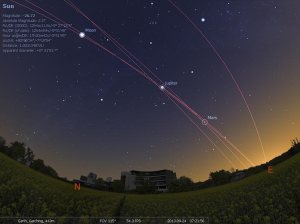
I found the program Stellarium to be incredibly interesting and also very informative. The benefit of Stellarium is that it creates a visual and interactive representative of what can only be demonstrated through words and images in the textbook. Because the student can manipulate time, date, location, distance, and more, they are able to see and adjust their view of the sky, sun, planets, and constellations in order to best understand it. I found the program to be especially helpful when trying to understand how the movement of the sun in the sky changes based on latitude. I viewed the pattern of the sun both throughout the day and throughout the year at different altitudes across the globe. This enabled me to better grasp how the time of year, the earth’s orbit around the sun, and the axis tilt interact to produce the different seasons. Viewing the movement of the sun throughout the day also emphasized how the path the sun travels and the amount of sunlight on the earth varies based on the altitude.

Stellarium

Stellarium


Posted in Class, Stars, Universe | Tagged , , | Comments Off on Stellarium

Light Travel Time: An Impediment to our Knowledge of the Universe

Despite common misperceptions, a light year is a measure of distance, not time. It is the only feasible way to measure distances in the universe because the universe is so vast that measurements of distance used on earth would quickly get too large to be comprehensible. One light-year is the equivalent of six trillion miles, and scientists often discuss and study stars that are hundreds of thousands of light-years away.

The other reason light-years are a necessary unit of measurement when discussing outer space is that much of what we see in space (stars, galaxies, etc.) are so far away that we are actually looking back in time when we see them from earth. Light-years are needed as the unit of measurement because it reminds us of the speed of light – that light can only travel so fast, and so what we observe is limited by the amount of time it takes the light to get to us.

Our universe is likely much larger than we know, as we can only see 14 billion light years away because the universe has only existed for that amount of time. Therefore, the farthest we can see is 14 billion light-years away, but this also means that what we see at that distance is as it existed 14 billion years ago. This severely limits our ability to know the universe surrounding us, as what we see will always be in the past. It doesn’t effect us substantially on earth or even when viewing our solar system, but it is undeniable an impediment to our knowledge of the rest of the universe. Thinking about our inability to know the extent of the universe really puts earth and our lives here into perspective.

The Observable Universe

The Observable Universe


Posted in Class, Light, Universe | Tagged , , , , | Comments Off on Light Travel Time: An Impediment to our Knowledge of the Universe

Is Light The Limit?

Image courtesy of Flikr user Rafoto

Image courtesy of Flikr user Rafoto

Albert Einstein once theorized that speed of light serves as somewhat of a global speed limit. It is assumed that nothing in the universe is capable of traveling faster than the speed of electromagnetic radiation. According to his observations, this makes sense. How could something composed of atoms of mass travel faster than a beam of photons? This global speed limit must exist.

WRONG. According to recent experiments, there is a possibility that the speed of light may be surpassable. Just like the speed limits set on highways, it appears that the global speed limit is sometimes broken. When theorizing how this process may be done, the solution comes down to a matter of perspective. Rather than try to move something faster than light, the theory focuses on contracting and expanding the universe around it. While and object may always move slower when compared to a light source moving through the same space, it is possible that by moving an object through a different space, it may arrive at a location before the light does.

Information Source:

http://www.telegraph.co.uk/science/science-news/8783011/Speed-of-light-broken-at-CERN-scientists-claim.html

Photograph Source:

http://www.flickr.com/photos/rafoto/2653254686/


Posted in Class | Tagged , , , | Comments Off on Is Light The Limit?

Thinking and Observing

Night Sky and Mountains
I think it’s fun to simply look up at the stars sometimes and think about what might be out there. There’s so much we don’t yet know, so much to be discovered. We thought we had conquered the final frontier when Amundsen had finally reached the South Pole at the beginning of the 20th century, but little did anyone know at the time that there are still an infinite amount of frontiers left to explore. The possibility of life on other celestial bodies, the origins of time and space, the boundaries of the universe, and the possibilities of multiple universes are but a few of the mind-boggling things to think about. And what better a time to mull about these things than while observing the stars of our galaxy at night?

I would love to go camping one day and try to capture an image like the one posted here. A setting like this would be perfect for observing the heavens through a telescope and capturing pictures of the stars through a DSLR camera. If I grow weary of observation, or if I find time between the long exposure shots of the stars, I can simply roll out my sleeping bag, lie down, look at the stars, and think.


Posted in Stars | Tagged , , , , , | Comments Off on Thinking and Observing

Blurry Telescope

Image

This is a picture captured by the famous Hubble space telescope. It looks blurry, because the team that designed the giant main lens didn’t properly account for the effects of gravity, causing the light to be refracted improperly. It took many years and many expensive maintenance trips to fix this error, but in the meantime, special graphics software was used to maximize the amount of useful information that could gained from the images.

http://newswatch.nationalgeographic.com/2010/04/26/hubble_space_telescopes_new_cl/


Posted in Class | Tagged , , | Comments Off on Blurry Telescope

Balancing eggs on the spring equinox

Balancing eggs

The equinoxes don’t make it any easier to balance raw eggs.

It is a popular myth that the spring equinox is the one day of the year that raw eggs can be perfectly balanced on end. When I was in elementary school, entire classes at my school would go outside with a bunch of eggs and try to balance them in a row. More often than not, we would just end up with a bunch of egg splattered on the sidewalk. Despite the popularity of the myth, there is no scientific basis to it. The equinoxes—both Spring and Fall—are the two days every year when the tilt of the Earth’s axis is angled neither toward nor away from the sun. Unfortunately for egg-balancing enthusiasts, however, this has no effect on how gravity on Earth works. Furthermore, there is no scientific reason to believe that only eggs would be affected by this apparent gravitational phenomenon. While it may sometimes be possible to balance a raw egg on its end, this would be achieved with great patience and concentration, not a certain tilt of the Earth’s axis.


Posted in Class, Physics, Science | Tagged , , , | Comments Off on Balancing eggs on the spring equinox