The Scale of the Universe (Interactive)

(Scroll to zoom through the universe, magnitude of zoom at the bottom right, click on things for a short description)

This program is designed to give us a chance to fathom the scale of our universe relative to things we can fathom. At the beginning we see ourselves, humans. Scroll just for a second and we become too small to see or to big to notice. The grand scale of the universe is so unimaginably vast. This interactive picture goes from our observable universe (93 billion light-years according to the program) to the smallest possible distance that makes any physical sense, a planck length (10^-35 meters, the scale at which the space-time fabric exists and the theorized strings from string theory). Everything imaginable can be found between these two extremes of the universe, from the biggest galaxies to the smallest nuclei, from the largest superstructures in our known universe to the smallest quarks described by the Standard Model. The scale of the universe is grand, and I hope you guys can appreciate the great job the developers did with this program. Enjoy having your mind blown!

(http://htwins.net/scale2)


Posted in Class | Tagged , , | Comments Off on The Scale of the Universe (Interactive)

Beyond The Speed of Light?

Wormhole, conceptual artwork

How concrete are our laws of physics? Could there be a way to bend the laws and essentially travel beyond the speed of light? Could such an ability open the possibilities for interstellar space travel? These are some of the questions that surround the intriguing idea of wormholes. Two wormholes could in theory act as a gateway between two fabrics of space. In such a case, the wormholes act as a bridge between two points in space. But what if these two points were immensely far apart? We would then be traversing a great distance in little time, possibly defying the cosmic speed limit: the speed of light. However, this is purely theory; the idea of wormholes can be seen as “cheating” the speed of light, considering that an object is simply traveling through bent space and not actually traveling the entire distance from one point to another.

Wormhole Imagery


Posted in Light, Physics, Space Travel | Tagged , , , | Comments Off on Beyond The Speed of Light?

Hybrid Solar Eclipse

Eclipses can be very beautiful things. We can all go online and look up images of solar eclipses taken from Earth. You can either see a total solar eclipse, where the sun in completely covered by the moon, or an annular where the sun is only partially covered by the moon because the moon is closer to the sun than usual. These can both be amazing to see. However, there is a rare form of solar eclipse that is called a hybrid solar eclipse. This is a mix between a total and an annular solar eclipse where only a small outside ring of the sun is observed. This can be seen in the image above or in an article from Wired.com. This image is even more special because it is taken from out in space instead of from Earth. This shows how the shadow cast by the moon travels across the Earth, and that it is actually as large as it appears from Earth. It is quite a unique image.


Posted in Class, Sun | Tagged , , | Comments Off on Hybrid Solar Eclipse

The Speed of Light is Pretty Speedy

Everyone appreciates illustrations of any sort that put very large things into perspective. These illustrations can come in many different forms, but I think that the most effective ones are the ones that use comparisons. These comparison illustrations can take something that is absolutely massive and crunch it into something almost manageable. This is a valuable tool in the field of astronomy because so many of the topics that are dealt with have ‘astronomical’ size. In class we saw this effectively done when using a calendar to convey time in our Universe. I managed to find an illustration of the speed of light compared to some speeds that we are more aware of. This illustration shows the speeds of commons things like a cheetah and a bullet train. Their individual speeds were represented as a portion of a circle. Now the helpfulness of this illustration comes into effect when you notice that these portions of the circle aren’t very big at all. You then realize that the speed of light would go around the circle 18,135 times. Once you have a slight grasp on this information you can take it and apply it to many of the terms of scale that astronomy deals with. Think about the fact that it takes light about eight minutes to reach the Earth from the Sun. Now think about the speed that is represented with the illustration. It really blows your mind.


Posted in Class, Light | Tagged , , | Comments Off on The Speed of Light is Pretty Speedy

Blog Post #2: Solstices and Equinoxes

As in the olden days, the sun was used to measure and chart the passing of time.  The sun is the life-source for all living things here on earth and is a vital part of the ecosystem.  The fact that the length, intensity, and the spot of the sun’s glow on earth determines the seasons, once again reemphasizes the concept that existence depends on the sun.  The winter and summer solstices and the equinoxes mark the beginnings of the different seasons and therefore decide earth’s calendar and yearlong time frame.  Since the earth’s axis’s tilt remains constant, one is able to measure the changing of the seasons in how and where the sun hits on earth.  The summer solstice is when the northern hemisphere is hit with the most amount of sunlight and the winter solstice is when the northern hemisphere I facing way from the sun and thus the majority of the sunlight falls on the southern hemisphere.  The equinox can be regarded as the transition stage between the two opposing seasons and positioning of the sun.  The equinoxes are an equal distribution of the light-light between hemispheres.

Korea Taste

Korea Taste

Growing up as a Korean American, it was often interesting to see how my parents tried to maintain and uphold ancient traditional celebrations even though we were in the United States.  The Winter Solstice Festival (동지) was one of those celebrations, where I felt connected to the Korean side of my cultural heritage.  For me, it was a time where I got together with family relatives and ate ricecakes and red-bean porridge while anticipating the New Year.  In Asia, as exemplified by Korean culture, many look to the sun as the main teller of the seasons and of time.  It is interesting to see how impactful the sun is in our everyday lives.


Posted in Class, Sun | Tagged , , , , , , , , , | Comments Off on Blog Post #2: Solstices and Equinoxes

Google Earth Sky

In the video above, Sally Ride, helps teach us how to use Google Earth as a star gazing program.  Instead of a program like Stellarium, Google Earth provides a way to actually zoom in on the galaxies around us.  The vantage point of Google Earth Sky is not on Earth.  Instead, the camera is located at a very distant point outside of our galaxy.  As of right now, the program does not allow for zooming in on things as small as planets or stars, but it does have markers at all of the various points of interest in our universe.  I wouldn’t say this is the best program for people interested in positions of constellations and planets in our night sky, but it gives a reference to where in the Milky Way all of the stars that make up those constellations are located.  It is strange to think that a program like this exists with markers on all of the points in our galaxy, when we have never and probably never will see the views of Google Earth Sky in real life because that would require us to travel lightyears into space and out of the galaxy we call home.

Sources:

Google Earth

Google Earth Website


Posted in Class | Tagged , , , | Comments Off on Google Earth Sky

The slowness of the speed of light

Image

Warp Speed

The speed of light is about 3*10^8 m/s, or in more recognizable units, over 670 million miles per hour. To observers on Earth, this is unimaginably fast and allows us to communicate almost instantly with anyone, no matter where they live. In fact, light can travel around Earth over 7 times in a single second. However, on a galactic scale, this is actually very slow. Take for instance the average sci-fi star ship about to enter warp speed. Old TV shows often illustrate this speed by using a picture like the one above. Yet if we imagine each of those lines as stars and assumed an average distance of 10 light years between each one (a good estimate within our own galaxy), then the spaceship must be traveling 8 orders of magnitude faster than the speed of light, or 2*10^17 miles per hour. Hopefully this gives an idea of how slow the speed of light is in comparison to our universe. (and how ridiculous warp speed is!)


Posted in Class | Tagged , , | Comments Off on The slowness of the speed of light

Lightspeed Activate!

Distance light has to travel from the Sun to Earth

Distance light has to travel from the Sun to Earth

The speed of light is 299,792,458 meters per second.  Nothing that we know of travels faster than light, and that’s a good thing because everything we see depends on light traveling from the object to our eyes.  Because light has to travel to our eyes, we always see things as they appeared in the past.  When looking at very close objects, the “past” that we see is only nanoseconds away from the present so it does not affect our ability to comprehend what is going on around us.  However, once you start looking at things very far away, that “past” that we see becomes a very real thing.  A lightyear is the distance traveled by light in the span of one year.  This means that if something is 45 lightyears away, the image of it that we see is actually what it looked like 45 years ago.   The light coming from this very distant object travels through space for 45 years until it reaches us.

Our Sun is only 4.5 billions years old.  This means that anything further than 4.5 billion lightyears away will have never even had a glimpse of our solar system.  It takes about 8 minutes for light from the sun to reach Earth.  If the sun were to explode, we would not even know it until 8 minutes after it happened.  Pretty crazy stuff if you ask me.

Sources:

Curious About Astronomy

Wikipedia


Posted in Class | Tagged , , , | Comments Off on Lightspeed Activate!

Different speeds of light

Although we often refer to “the speed of light” as a singular value (c = 299,792,458 m/s), the truth is that when we see light, it is actually moving slower than this speed. This is because the light we see is not moving in a vacuum, but through our atmosphere instead. Light moves at different speeds through different mediums (like air), and, interestingly, different types of light are affected differently by different mediums.

A medium's refractive index also determines how much light bends as it passes through it.

A medium’s refractive index also determines how much light bends as it passes through it. Image from DK Images.

A material’s refractive index determines how much it slows down the light that passes through it, with an index of 1 being equal to a vacuum and a higher value meaning that the light is slowed. What is strange is that some materials can have refractive indices lower than 1, and some even have negative values. This essentially means that the material absorbs light extremely quickly. But perhaps the most surprising result of mediums’ effect on light is that some particles are less affected by some mediums than light is—meaning that sometimes, particles can go faster than (slowed-down) light. Sadly, this does not mean we are any closer to time travel.


Posted in Class, Light, Physics, Science | Tagged , , | Comments Off on Different speeds of light

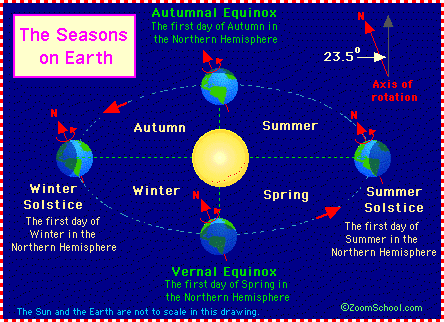
Seasons on Earth

Earthseasons


Unless you live near the equator, you have experienced how much the temperature outside varies by season (or by day in TN). Many people assume this has something to do with Earth’s orbit being an imperfect circle, but they are wrong. As pictured above, it is actually Earth’s tilt that causes seasons to change; also, why the northern and southern hemispheres are always in opposite seasons. This is because light (and the heat that comes with it) is better absorbed when it directly hits the Earth, as opposed to at an angle.


Posted in Class | Tagged , , , | Comments Off on Seasons on Earth