Is it a parallax or only one? ;)

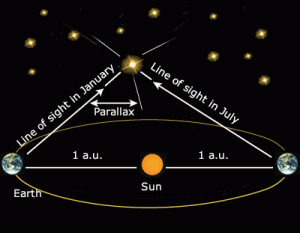
Diagram of Stellar Parallax

So one feature of star observation that has allowed us to figure out that we’re not the center of the universe is this really neat and slightly tricky idea of stellar parallax. It’s the phenomenon where based on our position in orbit, a star may appear to have moved based on the stars behind it. To give a more relatable definition, it’s when if you hold your finger in front of your face and close one eye and then switch it looks like it’s moving compared to the background. (For a nifty animation that may help visualize this go here.)

One of the cool things about stellar parallax is that it allows us to calculate distances to stars. (It’s some very fancy calculus that I can’t personally explain, but if you’d like to try your hand and closed eye at the European Space Agency(ESA)’s Stellar Distances then kudos!) This is especially handy because we can’t really go out and measure those distances ourselves, although the ESA’s Hipparcos is certainly going at it! This gives us a whole new catalogue of stars to study.

So then my question is, how accurate can we be? Considering the amount of time it takes light to reach us from certain stars, what is the limit of the accuracy of parallax if we’re comparing the position of stars we’re not sure are still there relative to other stars that are also potentially already stardust?


Posted in Class, Stars | Tagged , , , , , , | Comments Off on Is it a parallax or only one? ;)

I swear the universe doesn’t even know I exist

So I was watching this video called Powers of Ten, yes? And this video takes you from looking at a view that’s 1m^2 and then increases that by a factor of ten every ten seconds (so after the first ten seconds you’re looking at 10m^2, then 100m^2, and so on and so forth), and by the end of the video (which is under ten minutes, just by the way) you’ve gone to the edge of the universe and back and then all the way to the little itty bitty subatomic particles in your skin and then back. It really puts into perspective how little we are compared to the universe. There is so much out there…Although at the same time there are also large spaces of nothing the farther out you go, which is cause for a whole other cry of existential anguish.

Universe


It’s pretty cool though! To be able to look at billions upon billions of stars all at once and know you’re somewhere in there. And so are thousands of other stars. It’s pretty mind-blowing!


Posted in Class | Tagged , , , , | Comments Off on I swear the universe doesn’t even know I exist

Star Walk: Planetarium in Your Pocket

The app icon for the Star Walk app that shows constellations, stars, and planets in the sky.

The app icon for the Star Walk app that shows constellations, stars, and planets in the sky.

When holding your smartphone up to the sky, Star Walk locates you and shows you on the screen all the things you can see, labeled for easy identification.

When holding your smartphone up to the sky, Star Walk locates you and shows you on the screen all the things you can see, labeled for easy identification.

When looking up into the sky at night, usually I can’t identify all the constellations above.  The Star Walk app knows where you are and tells you what stars and planets are above you.  You can hold it up wherever you are and it is like having a mobile planetarium.  Even in the city where some stars are not visible because of light pollution, Star Walk shows you where they should be.  It even labels planets and stars that you may not be able to see with the naked eye, but you know where they are in relation to visible stars and planets in the sky.

Every summer my family and I go to a small lake in upstate New York.  The area is very rural so at night you can see tons of stars!  The app tells us what stars create what constellation so we know what we are looking at.  It is especially helpful when you are looking for a specific planet in the sky and you are having trouble finding it.  The app moves very smoothly and is accurate in naming and locating celestial bodies in the sky above you.  It uses the location services of your phone to place and orient you to your local sky.  I would recommend this app to anyone who wants to observe the sky and does not have telescope and does have smartphone!


Posted in Observables, Stars | Tagged , , , , , | Comments Off on Star Walk: Planetarium in Your Pocket

Humans: Only Around for a Blink of an Eye

This is a calendar that puts the entire history of the universe into one calendar year.

This is a calendar that puts the entire history of the universe into one calendar year.

The universe has been around for 13.8 billion years.  In the grand scheme of things, this means that human life has only been around for the blink of an eye.  When 13.8 billion years is put into one calendar year, homo erectus does not appear until 10:48 pm on December 31.  All of our human history is packed into the last few hours and minutes of the last day of the year.  For most of the universe’s history, humans weren’t even on the radar.  On the Cosmic Calendar, Christopher Columbus’ voyage to America happened one second before midnight.  All of America’s history, the founding of the United States, our independence from Britain, happened in less than one second.  All of industrialization and technology and human development that has lead to the Earth’s surface and climate changes have happened in the blink of an eye.  It is disconcerting to think that the Earth was around for billions of years with no humans, and in the time that humans have inhabited the Earth, we have greatly impacted the climate like nothing ever has before. The concept of the sheer vastness of time that the Universe has been around makes human life and society seem insignificant, yet we have had very significant effects on the health of our home planet.  Hopefully, we can reverse our detrimental effects and minimize our damage to the Earth to keep it proportional to the amount of time we have been around.


Posted in Historical, Science, Universe | Tagged , , , , | Comments Off on Humans: Only Around for a Blink of an Eye

The Grandest Experiment

The majority of physics experiments take place in a small lab found in the basement of a university science building. However, for a grand hypothesis, one needs a grand experiment. The year was 1919 and a nervous Albert Einstein awaited the results of an experiment on the scale never before seen nor bested up to the present day. Four years earlier, Einstein published a paper outlining his Theory of General Relativity, the bold claims of this paper brought on skepticism at first, but soon he would win over the hearts and minds of every scientist and civilian alive. Einstein postulated that the immense mass of large bodies, such as the Sun, would bend the fabric of space-time and thus, light waves would be bent as they travelled near these gravity wells. Such a proposition goes against the days accepted theory put forth by Newton 200 years earlier: that all light travels in straight lines. So how could Einstein prove that light can be bent by gravity?

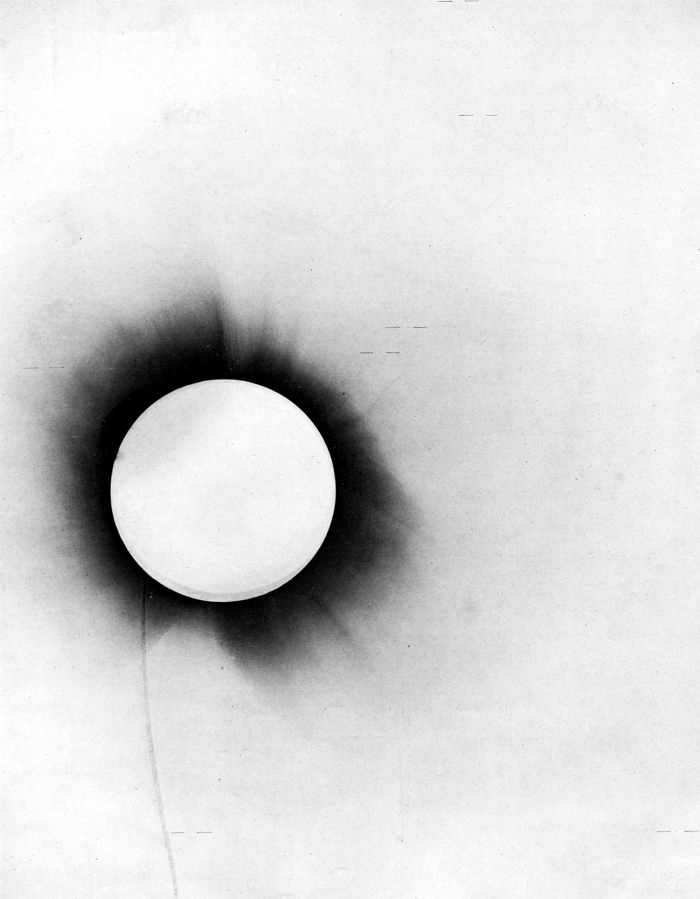
The answer would come courtesy of one of nature’s most awe inspiring events, a total solar eclipse. A solar eclipse occurs when the Moon passes directly in front of the Sun, and thus blocks the sunlight from reaching Earth. These eclipses can only occur when the Moon is new in its phase. Not because the Moon is biggest at that time, it is always the same size no matter the phase! But rather because that is the only phase in which the Moon can possibly be in line with the Earth and Sun. We have a new Moon 13 times per year but we don’t experience 13 solar eclipses a year due to the Moon’s 5 degree orbital tilt. The total blockage of the sun during a solar eclipse only lasts about 7.5 minutes, but for that time the sky darkens and the stars come out. Einstein’s theory postulated that the light from distant stars which were hidden behind the Sun would be bent around the Sun and therefore be observable. Normally, this theory would be impossible to test since the Sun’s light drowns out any observable stars. But the uniqueness of the eclipse allowed just enough time for Sir Arthur Eddington, who took on the challenge of capturing the picture on Einstein’s behalf,  to take a photograph of the sky, including stars. The idea was, if we know the exact celestial coordinates that the Sun blocks, we will know the exact stars that lay hidden behind the Sun. When the lights go out during the eclipse, if those stars are visible at the fringe of the eclipse, then we know their light has been bent, thus proving the theory.

Once the picture (see the original negative here!) was developed and scrutinized, it was determined that Einstein was correct. He became an overnight celebrity not only in the science community, but among everyday people too. His theory still stands as accepted in the physics community to this day and has been verified by the eclipse test many more times, and by other tests designed in years to come, but none used tools as grand as a total solar eclipse!

Want to learn more about the factors that go into how and when a solar eclipse can occur? Check out this awesome video!


Posted in Historical, Light, Physics | Tagged , , | Comments Off on The Grandest Experiment

The Cosmic Speed Limit

It was Einstein who only came up with his Theory of Special Relativity after having been inspired by a daydream of himself riding on a beam of light across the cosmos. What a journey that must have been, despite its fantasy; our only idea of what travelling at the speed of light may look like comes from Star Wars. But what does it mean to travel alongside a speeding photon and what are some of the consequences of a finite, universal speed limit? For starters, it logically follows that the bright stars of our night sky, given their vast distance from Earth, appear not as they are, but rather as they were. The illumination of a room only seems immediate given the extraordinary speed of light coupled with our very close proximity to the source. But when the distances are stretched to the celestial scale, the light takes more than just an instant to reach our lonely planet. In fact, just looking outside our solar system, it takes years for even the light of the nearest object, Proxima Centauri, to reach us. This effect of delayed reception leads to one of the strangest, yet most sought after idea…time travel. We, in the present, observe a star in the past. AND…the further one looks in distance from Earth, the longer back in time one sees. Such a result allows us to pear behind the curtain to see the development and aging of the universe. Looking back far enough and one sees long dead stars alive and well; look back further and one sees the first stars birthing from clouds of hot gas; yet further and the first galaxies shaping up. The set maximum of the speed of light gives us a true snapshot of the universe at every birthday for the last 13.8 billion years.

Want to see the snapshot of the universe for yourself? Find it in this image of the Hubble Ultra Deep Field! Note that every point of light you see is no star, but an entire galaxy!


Posted in Class, Light, Space Travel | Tagged , , , | Comments Off on The Cosmic Speed Limit

Blog Post #0: Hi world!

By me

By me

I went to Ecuador this Thanksgiving Break with Vanderbilt’s Manna Project.  It was a life-changing trip where we worked on building a greenhouse out of recyclable material.


Posted in Class | Tagged , , , , | Comments Off on Blog Post #0: Hi world!

First Post

Ben and nate

My brother Nathan and I at his lacrosse game – Summer 2012


Posted in Class | Tagged , | Comments Off on First Post

Westin Hotel


Wikipedia

Wikipedia

Westin Hotel

Wikipedia


Posted in Class | Tagged , | Comments Off on Westin Hotel

First Post

By my father

By my father

This is a photo of my sister and me from our trip to Italy last summer. She’s a really awesome person and it was a great trip :)


Posted in Class | Tagged , | Comments Off on First Post