TWINKLE,TWINKLE, LITTLE STAR

Twinkle, twinkle, little star,
How I wonder …

WHY DO STARS TWINKLE?
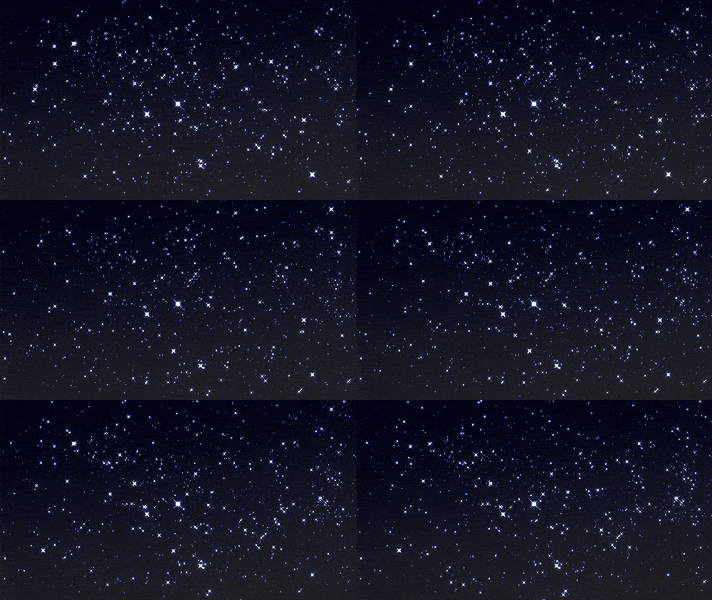
Twinkle,twinkle , little star by GIPHY

To explain this phenomenon, first, we need to know the exact definition of twinkling. The scientific name of the twinkling stars is astronomical scintillation. Twinkling/ scintillation, is a general term for variations in apparent brightness or position of a distant luminous object when viewed through a certain medium.

The main reason for this occurrence is due to the presence of thick layers of air turbulence (moving air) in the Earth’s atmosphere. This air turbulence causes twinkling because it is a continuous process of changing how starlight bent. In other words, as a starlight travels into our atmosphere, each stream of starlight is refracted .This refraction change the direction of the star, slightly due to the temperature gradient and different density layers in the Earth’s atmosphere.The random refraction of the starlight results in the twinkling of the star.

Hence, stars tend to twinkle more when they are closer to the horizon and windy (extreme turbulent) nights. WHY?  This is because the light of stars near the horizon has to travel through denser layer of air compared to the light of stars overhead. Thus, more refraction occur. Above the atmosphere, if we viewed from outer space (or from a planet that didn’t have an atmosphere), stars do not twinkle at all.

Why do Stars Twinkle?

A misconception holds that planets don’t twinkle in our sky. In reality, they actually do, but planets shine more steadily. This is because they are closer to the Earth,hence they appear big enough that the twinkling is not realizable although the light from these planets is also refracted by Earth’s atmosphere.Besides, the size of a planet on the sky cancels out the turbulent effects of the atmosphere, hence a stable image is presented to the human’s eyes.

Illustration by Tom Callen of Cosmonova
Why stars twinkle, but planets don’t from EarthSky

However, we might see the planets twinkling if we see them lower in the sky. This phenomenon occurs because there are more turbulence effects and in the direction of any horizon, we are looking through more atmosphere compared when we look overhead.

Now, shall we continue with our song earlier?

Twinkle, twinkle, little star,
How I wonder what you are!
Up above the world so high,
Like a diamond in the sky.

Extra link for this song is available here (just kidding :P) :

EarthSky.org


Posted in Class, Stars | Tagged , , | Comments Off on TWINKLE,TWINKLE, LITTLE STAR

Absolute Speed

Light travels the Earth seven times per second, 8.3 minutes to reach the Earth from the Sun, 43.2 minutes to reach Jupiter and the list goes on. One would assume that light travels at an infinite speed because an observer will instantaneously see the light after turning on a torchlight. It is not the case as the distance between him and the light source is incomparable to the speed of light.

                   Image result for galileo measuring the speed of light

The GIF above summarizes their experiments, in the end, both of Galileo just shrugged his shoulders-Galileo’s Experiment

In 1638, Galileo Galilei tried to measure it with his assistant’s help. They went to two mountains each holding one lamp. One of them lighted up his lamp and once the other person saw it, he must light up his. They wanted to divide the distance between them and the time taken traveled by the lamps’ light. Sadly, his attempts was futile.

Then, a Danish astronomer  Ole Romer was successful to measure the speed of light (220000 km per second) although it is a little off due to inaccurately known Earth Sun  distance. As he was studying one of Jupiter’s moons, IO, he realized it did not rise at the predicted time, sometimes earlier and sometimes later. It is due to Earth Jupiter distance, later of the distance is large and earlier if closer.

The actual speed of light in vacuum is 299792458 m/s and it is the highest speed that cannot be achieved by any other things in the universe. 

Light Years????

Image result for buzz lightyear

Nahhhh, this is not what I was talking about even though he is the “lightyear”-Buzz Lightyear.

My family enjoys watching Discovery Channel, and it is how we spend our time watching television together. First time hearing those words, I could not brain what it actually is. So, what it actually is? One light year is the distance traveled by light in a year and it is equal to 6 trillion miles. It is used for the distance of stars and galaxies.

2.537 million light years is spent by light traveling from the nearest galaxy, Andromeda to the Earth. This means that, if we are observing Andromeda, and we see something is happening there on during our observation, we are actually observing an event that already happened 2.537 million years ago. And if there is a living soul in Andromeda observing the Earth, they must be observing chimpanzees and other related species.

Links: Time for light to travel to planets,Light year,Evolution of life on Earth,The speed of light’s experiments


Posted in Class | Tagged , , | Comments Off on Absolute Speed

Aristarchus of Samos (c. 310 – c. 230 BC)

A long time ago, in a galaxy far far away……too much of Star Wars (inside joke). I bet most of us in the entire world probably heard of Copernicus. However, only little of us knew about Aristarchus of Samos, ( Ἀρίσταρχος ὁ Σάμιος, Aristarkhos ho Samios-his name in Greek) an ancient Greek astronomer and a mathematician I would say who first proposed a ‘Sun-Centered Solar System’ eighteen centuries before Copernicus.WOW! ( I can see the face of the enthusiasm among all of you).

Image result for aristarchus of samos
The image of Aristarchus of Samos

However, the Greeks rejected his astronomical ideas that the Earth goes around the Sun especially from the two famous astronomers:  Aristotle and Ptolemy, which are now known to be incorrect. Do you know why did they reject the real explanation for planetary motion?

reactions why ryan reynolds but why
GIF of curiosity taken from GIPHY 

Although there were many reasons the Greeks were reluctant to abandon their original idea (Earth-centered universe), the most ultimate reason was their inability to detect stellar parallax. Stellar parallax is a parallax on an interstellar scale, means that there is slight apparent shifts in stellar positions over a course of the year. Since stellar parallax is only detectable with telescopes, his accurate astronomical theory was unprovable at the time. Besides, his theory did not gain wide acceptance until almost 2000 years later.To know more about the stellar parallax, there are few links that I shared in this post.

Stellar Parallax

Stellar Parallax Video

South Park eric cartman night butters stotch looking
GIF of seeing a telescope

Since there is no observable stellar parallax, he suggested that the Stars were extremely very far away.Why? This is because parallax is a function of distance. In other words, distant objects exhibiting smaller parallax than nearer objects. To further strengthen his argument, he estimated the sizes of the Moon and the Sun. He estimated the Moon’s size by observing the shadow of Earth on the Moon during a lunar eclipse and measured the angle between the Moon and the Sun at first and third quarter phases of the Moon. Based on these experiments, he concluded that the Sun must be larger than the Earth hence he believed that Earth should be the one that is orbiting the Sun.

Warner Archive oh eye roll sci fi i see
I finally understand from GIPHY

Today, we can detect stellar parallax with the aid of the telescopes. Thus, Aristarchus of Samos was right and we have a direct proof that the Earth really does orbit the Sun.


Posted in Class | Tagged , | Comments Off on Aristarchus of Samos (c. 310 – c. 230 BC)

Space Shuttle Challenger Disaster

On January 28th, 1986, the space shuttle Challenger broke apart 73 seconds into flight, killing all seven of its crew members. These were the first american deaths on board a spacecraft during flight. The disaster was triggered by the failure of an O-ring seal, which allowed hot gasses to escape from the rocket booster and burn up other parts of the spacecraft.

The failure was in large part due to the icy cold conditions on the morning of the launch. The outside temperature was much colder than anticipated, and the O-ring seal was not designed to function properly in these conditions. Although many NASA engineers were aware of the risks, they all downplayed it due to a what is called “go-fever”. Essentially, many employees felt they were so close to a successful launch that they disregarded the warnings at the risk of the lives of the crew.

After this accident, the workplace culture at NASA was highly scrutinized and all flight missions were postponed for over two and a half years. More conservative safety precautions were subsequently put in place and the rocket boosters were redesigned. Watch the chilling flight sequence here.


Posted in Space Travel | Tagged , | Comments Off on Space Shuttle Challenger Disaster

Friday Night Spectacle

Tonight, on this February 10th, there is supposed to be a full moon, a lunar eclipse, and a comet, all of which are supposed to be visible.

This month’s full moon is called the “Snow Moon.”  This name came from Native American tradition, in which the full moons of each month bore different names.  However, this full moon will not be alone tonight.  Around 5:30 pm (EST), the penumbral lunar eclipse will begin.   The penumbra of Earth’s shadow, the outermost part of a shadow, will cover the Moon, dimming the pale white surface into a darker grey.  The eclipse is expected to last until 9:55 pm.  Though it may not seem as spectacular as a total lunar eclipse, seeing the shadow of our planet cover the Moon may still be an interesting experience.

In addition to the full moon and lunar eclipse, there will also be a green comet passing by Earth later tonight.  Comet 45p/Honda-Mrkos-Pajdušáková, also known as the New Year’s Comet, was discovered in 1948.  It is supposed to as closest to the Earth as it was in 2011.  Unlike the full moon, this comet is not visible to the naked eye, so a telescope or binoculars are necessary for viewing.  Hopefully, tonight’s skies will be clear enough to see the three part spectacle.  It is not likely that one can witness so much phenomena in the sky, but it is a rare sight that should not be missed.

For more on tonight:

Here’s How to Watch a Full Moon, Lunar Eclipse and Comet Light Up the Sky on Friday–TIME

A full moon, lunar eclipse, and comet–The Washington Post


Posted in Class | Tagged , , , , | Comments Off on Friday Night Spectacle

Manhattanhenge

Four-thousand years ago, early Europeans’ connected with the Cosmos every Summer Solstice by watching the midsummer sunrise directly over the Heel Stone in what we now call Stonehenge. These early people recognized that where the sun rises and sets on the horizon cycles North and South with the seasons. Today, thousands of people gather four times a year for a similar event along the streets of downtown Manhattan. Coined as a portmanteau of the island name and the ancient architecture, Manhattanhenge describes the four days a year when the setting or rising Sun aligns perfectly with the gridding of North America’s largest city.

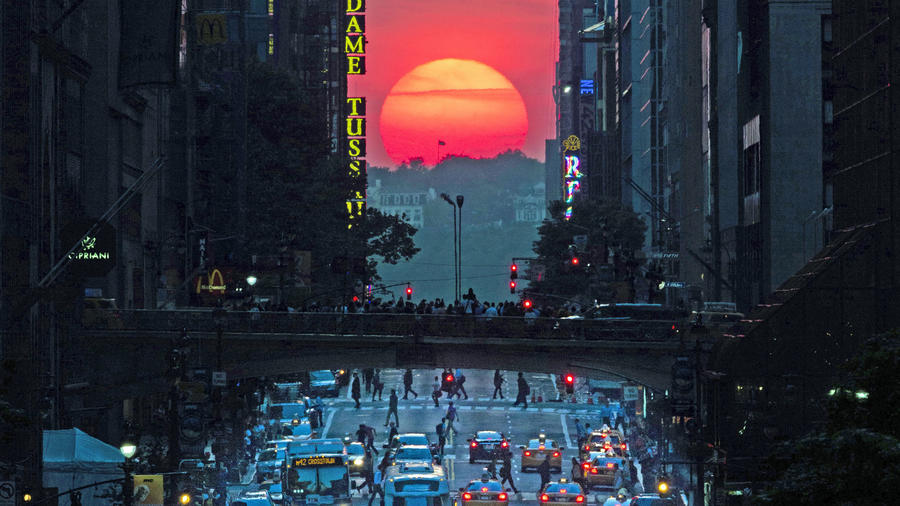
la-trb-manhattanhenge-20150529-001
Manhattan Sunset

Manhattan’s avenues are rotated approximately 29 degrees from true North-South, so the streets are rotated 29 degrees clockwise from true East-West. At 40 degrees North of the equator, the Sun in NYC rises and sets farther South during the winter and rises and sets farther North during the summer. Between these two extremes, the rise and set positions slowly march their way across the horizon to the two extremes. Twice a year, once while nearing the Summer solstice, and again soon after it, the Sun reaches far enough North by sunset to peer down the Big Apple’s gridded streets. Because the sunset and sunrise locations are approximately mirrored from East to West, two similar days straddle the Winter Solstice, during which the rising sun appears between the city’s towering building.

Astrophysicist Neil deGrasse Tyson popularized Manhattanhenge as an opportunity for city dwellers to connect with space, but Manhattanhenge is not the only serendipitous alignment between the Sun and our infrastructure. Similar phenomenon such as Chicagohenge, Torontohenge, Montrealhenge, and MIThenge occur whenever an approximately East-West corridor lines up with the rising or setting Sun. So next time the Sun is in your eyes on the way to work, you can cheer yourself up with a new name, maybe follow the tradition by enjoying your newly discovered “driving-to-work-henge.”


Posted in Class, Outreach, Sun | Tagged , , , , | Comments Off on Manhattanhenge

“Just a Theory”

A theory in science is very different from the use of the word in daily life. Colloquially, a theory is an unsubstantiated claim about why something happens, little more than a guess or an idea.  In science, this kind of speculation does not reach the status of theory, but is instead called a hypothesis.A scientific theory is actually quite the opposite of its common counterpart. A scientific theory is the most reliable and rigorous form of scientific knowledge.
A scientific theory starts out as a hypothesis, simply a possible explanation for why a phenomenon occurs. To be elevated to a theory, a hypothesis must be consistent with previous experimental results, make testable, repeatable predictions, and be able to be proven false through experimentation. As more data is gathered, a theory can be modified or rejected if it does not fit observations. Because of the rigorous requirements to become a theory and the relative ease with which one can be shown to be false, accepted theories are some of the most powerful and comprehensive results of scientific inquiry.
What about scientific laws? Laws are fundamentally different from theories. A law is descriptive; it describes what happens in nature, and is sometimes stated as an equation. However, a law does not attempt to explain why things happen. Theories are wider in scope, and may contain several laws within them in order to explain observations.
Calling something “just a theory” in science is misleading. Being called a theory is not disparaging; a successful theory has withstood the trials of the scientific method, and stands proudly as the closest thing to proven that anything in science ever can be. So when someone tries to refute a scientific claim by saying it’s “just a theory,” remember that if anything that strengthens your argument, and be sure to explain to them why that is.

Posted in Class, Science | Tagged , | Comments Off on “Just a Theory”

Telescopes

Have you ever thought about telescopes closely? What are they made of? What type of lens is used in a telescope? Who invented it? I got really interested in this topic and in this blog-post I will try to share the information I found with you.

“The telescope is one of humankind’s most important inventions. The simple device that made far away things look near gave observers a new perspective. When curious men pointed the spyglass toward the sky, our view of Earth and our place in the universe changed forever,” – says Lauren Cox, SPACE.com contributor. 

The first person to apply for a patent for a telescope was a Dutch eyeglass maker named Hans Lippershey, however, there is no evidence that he was the first one to make a telescope and that he did it independently. One year later (1609) Galileo Galilei made his own telescope even without looking at Lippershey’s blueprints. Galilei was the first to paint a telescope skywards: he was able to see mountains and craters on the Moon’s surface, the Milky Way, discover that the Sun had sunspots, and Jupiter had its own set of moons. World largest single-aperture optical telescope was built in Spain (2007), its hexagonal primary mirror is 10.4 meters in diameter and is made up of 36 hexagonal segments.

A telescope consists of an optical system (the lenses and/or mirrors) and hardware components to control the optical system. Lenses must be made from optical glass (much purer than ordinary glass). The most important raw material used to make optical glass is silicon dioxide, which must not contain more than one-tenth of one percent (0.1%) of impurities. A telescope mirror is usually made of a glass which is kind of less pure than glass to make a lens, it is composed of silicon dioxide, boron oxide, and aluminum oxide.

It is crazy to think that we can see the space from the Earth using telescopes, these small and simple (kinda :)) devices. I hope you liked my short post about them, and, hopefully, it inspired you to do your own research on them to find out much more interesting facts.


Posted in Class | Tagged , , , | Comments Off on Telescopes

Black Hole Eats Star for Ten Years!

tidal

A supermassive black hole at the center of a galaxy about 1.8 billion lightyears from Earth has been slowly “eating” a star for about a decade now. This baffled researchers because no star death by black hole has been this long. What this means is either the star was incredibly, incredibly massive, or the black hole has completely ripped a smaller star apart and has taken its time doing so. From studying the tidal disruption events, researchers can tell that the black hole is actually growing; this is a impressive find for scientists, as it gives more information about how black holes specifically work and change over time.

It’s amazing that this process can be observed from such a far distance, and can be observed with enough precision to make conclusions about the black hole’s changes over time. Especially, also, because there is still so much to learn about black holes and their behavior, structure, and history. Read More About Black Hole XJ1500+0154

Read More About Supermassive Black Holes


Posted in Class | Tagged , , | Comments Off on Black Hole Eats Star for Ten Years!

Blog 3-Spectroscopy

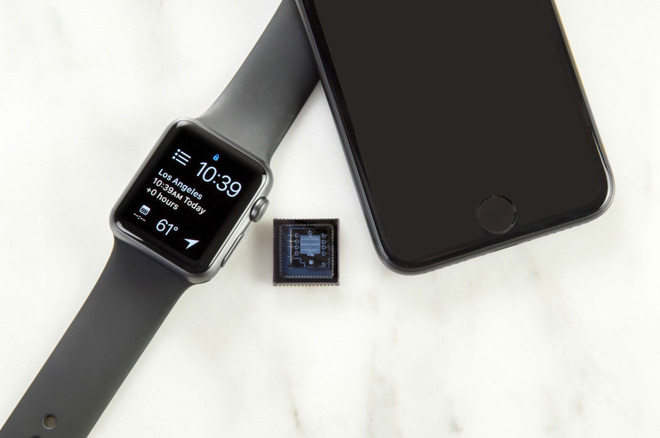
Spectroscopy is a scientific technique that “measures light that is emitted, absorbed, or scattered by materials and can be used to study, identify and quantify those materials” (Source).  Therefore, spectroscopy can be used to provide invaluable information about different objects based on the light they emit and absorb (which is referred to as the emission or absorption spectrum).  Spectroscopy has many applications, many of which are related to our Solar System.  For instance, during the Deep Impact Mission, the flyby spacecraft was equipped with a Spectrometer in order to take “snapshots” that captured the infrared fingerprint of different objects.  While this is very interesting, I am also intrigued by the personalization and commercialization of spectroscopy.  I just read an article that talked about how a new iPhone compatible spectroscopy chip was just created.  While it has not been integrated into the iPhone yet, the implications of doing so could be huge.  For instance, people could use this built in spectrometer to ascertain caffeine levels in an individual cup of coffee, or find out how much gluten was in a particular entree.  This would theoretically be possible because, as mentioned earlier, each object has an “infrared fingerprint”.  I’m always interested to see how seemingly obscure technology developed by either the military or very practical scientific research can be integrated in to the average consumer’s life.


19887-20995-neospectramicro-l
Spectrometer next to iPhone and Apple Watch. Source


Posted in Class, Instruments | Tagged , , | Comments Off on Blog 3-Spectroscopy