These Are Not the Droids We’re Looking For

Knowledge is power. We want more and more of it. It’s no surprise, then, that we see the Solar System as a well full of knowledge we’ve never encountered before. So, we send spacecrafts out into the Solar System, looking for information. We want pictures, data, surprises, and (now) soundWe’re obsessed.

But we too often forget to give credit where credit is due. We wouldn’t be near as deep in our understanding of the Solar System if it were not for spacecrafts.

In the Solar System, spacecrafts face many challenges and have been tweaked so as to cross incredible distances, overcome the forces of gravity that try to suck them back down to Earth, and reap heaps of data about our spatial neighbors.

The “special forces” versions of spacecraft, so to speak, are landers and probes. These machines kick in the doors of obstacles on other planets and face excruciating conditions head-on. Perhaps the most famous examples of such machines are the Martian rovers, like Curiosity.

NASA’s Curiosity Mars Rover at Namib Dune (360 view)

According to our text (“The Cosmic Perspective”), Curiosity landed on Mars in August of 2012 and underwent an intense operation that allowed it to gently rest on the planet’s surface. The landing required a parachute, which served to slow the spacecraft down as it flew through the Martian atmosphere (about 350 km/hr). Rockets attached to the spacecraft then guided it toward the surface, where a “sky crane” placed the rover on the surface of Mars.

It is difficult to discern just how far the rover has trekked, since the Martian terrain is very loose in some areas and rovers could sometimes simply dig ruts in the ground as their “distance” travelled increases. However, this machine has overcome an atmosphere and climate that no human could penetrate without protection, and it has spent nearly three years on the red planet – time we humans would much rather spend interpreting data.

In essence, spacecrafts in the Solar System – whether they probe planets for organic compositions or take pictures of icy rings from a distance – are a major contributor to the information we have. Without them, our current knowledge of the Solar System (the knowledge we obsess over) might not be near as in depth as it is today. These mechanical heroes may not be what we’re looking for in the Solar System, but we certainly wouldn’t see much without them.


Posted in Class, Observables | Tagged , , , | Comments Off on These Are Not the Droids We’re Looking For

What the Heck is a Pulsar?!

Have you ever heard of something called a pulsar?  If not then you are missing out because they are one of the strangest and most fascinating objects in the universe.  A pulsar is a special kind of neutron star, that means that the star is pretty much entirely made up of only neutrons held together by gravity.  A neutron star can be between 1.1-3 solar masses while only being about the size of Manhattan.  The only reason a neutron star doesn’t simply collapse into a black hole is due to neutron degeneracy pressure, i.e. the quantum theory that no two objects can be in the same place at the same time.  The gravity is very very strong and the light given off is due to the immense heat created on the surface.  Most of the light is in the X-ray range due to the extreme heat on the surface (1,000,000 K compared to 5,000 K for the Sun).

A pulsar is a neutron star that is spinning really really fast, up to 716 times every second.  The spin of a pulsar is so fast that energy flies off the poles of the star as a form of light.  Basically pulsars are somewhat like a lighthouse out in space.  The energy in a pulsar is unimaginable, making pulsars one of the coolest things in the universe.

Artist_s_impression_of_a_pulsar_eating_a_companion_star.jpg
The tiny dot on the right is a pulsar.  Its rapid spinning is causing an ejection of light from its poles and its incredibly strong gravity is causing it to absorb the gas of a star. Source: Sky and Telescope


Posted in Physics, Science, Stars, Universe | Tagged , | Comments Off on What the Heck is a Pulsar?!

What the Heck is a Pulsar?!

Have you ever heard of something called a pulsar?  If not then you are missing out because they are one of the strangest and most fascinating objects in the universe.  A pulsar is a special kind of neutron star, that means that the star is pretty much entirely made up of only neutrons held together by gravity.  A neutron star can be between 1.1-3 solar masses while only being about the size of Manhattan.  The only reason a neutron star doesn’t simply collapse into a black hole is due to neutron degeneracy pressure, i.e. the quantum theory that no two objects can be in the same place at the same time.  The gravity is very very strong and the light given off is due to the immense heat created on the surface.  Most of the light is in the X-ray range due to the extreme heat on the surface (1,000,000 K compared to 5,000 K for the Sun).

A pulsar is a neutron star that is spinning really really fast, up to 716 times every second.  The spin of a pulsar is so fast that energy flies off the poles of the star as a form of light.  Basically pulsars are somewhat like a lighthouse out in space.  The energy in a pulsar is unimaginable, making pulsars one of the coolest things in the universe.

Artist_s_impression_of_a_pulsar_eating_a_companion_star.jpg
The tiny dot on the right is a pulsar.  Its rapid spinning is causing an ejection of light from its poles and its incredibly strong gravity is causing it to absorb the gas of a star. Source: Sky and Telescope


Posted in Physics, Science, Stars, Universe | Tagged , | Comments Off on What the Heck is a Pulsar?!

Look Back at It

The surfaces of the terrestrial planets tell us a lot about their histories. The geological surface features of the planets give insight into the geological processes that have occurred in the planets’ pasts. There are four main processes that have lasting geological impacts on the terrestrial planets in our solar system. The processes are impact cratering, volcanism, tectonics, and erosion. Mercury and the Moon provide some of the best evidence of impact cratering in our solar system. These craters occur when an asteroid or a comet slams into the planet at a tremendous speed. The impact is so forceful that it vaporizes the solid rock and leaves behind a crater in its place. These circular indentations can be seen all over Mercury and the Moon, and the debris can give important clues about the geological conditions of the planet.

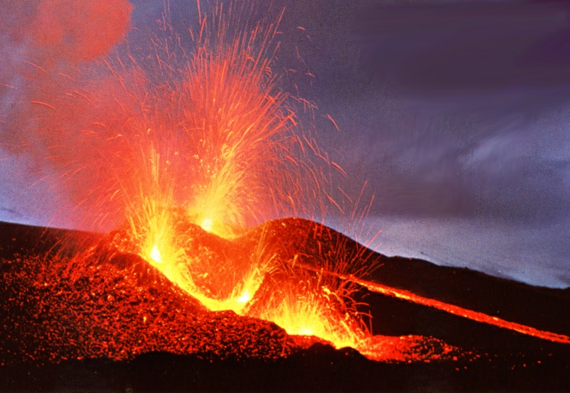
Volcanism on Earth
Volcanism on the Earth

Volcanism is the eruption of molten lava from underground. Depending on the thickness of the lava, different geological fingerprints can be left behind after the eruption. Runny lava flows a great distance and flattens out before solidifying creating volcanic plains. The thicker lava does not travel as far and solidifies as a tall shield volcano. Finally, the thickest lava does not travel far at all and solidifies as a steep stratovolcano. Additionally, tectonics is the building of surface features by stretching, compressing, or the affects of other forces on the lithosphere of the planet. Most tectonic activity arises from mantle convection and can compress the crust of the planet. Finally, erosion is the breakdown and transportation of surface rock across the planet. Erosion is most commonly thought to breakdown the surface of the planet, but it also builds features on the surface. All of these geological processes have major impacts on the planets they occur on, and it is interesting as an observer to see their effects now and think about what occurred in the past.


Posted in Class, Terrestrials, Universe | Tagged , , | Comments Off on Look Back at It

Why We Should All Love Earthquakes

Earthquakes are one of the most obvious consequences of Earth’s plate tectonics.  The crust slowly moves along the with the “current” of the mantle as the Earth surface constantly rearranges itself.  Without plate tectonics, it is very possible that life could not have taken a foothold on Earth.  On Mars, which does not have plate tectonics, for example the lack of tectonics contributed to the runaway volcanic activity and massive volcanoes like Olympus Mons.  If plates existed on Mars then Olympus Mons might look more like Hawaii, where the crust constantly moves over a hot spot and many smaller volcanoes form instead of one massive one.  In other words, plate tectonics keep the volcanic activity in check.

globe.0720
An “Earthquake Map” of Earth, every yellow dot is an Earthquake. Plate boundaries can easily be seen. Source: NASA

Yes earthquakes and volcanoes are bad but without them our planet could have ended up like Mars.  Or Earth could have ended up as a giant snowball.  Some believe that the time period known as “Snowball Earth” was caused by the position of the continents, blocking certain warm currents from flowing to the poles and causing the poles to become exceptionally cold.  The ice reflected more sunlight which in turn made the Earth colder and the entire planet was covered in ice.  This time period ended for two reasons: volcanic activity warmed the planet and the tectonic plates moved off of the poles so the warm currents could warm the poles once again. Earth is the only planet in the Solar System that has plate tectonics and is the only one with life which, in my opinion, is no coincidence.


Posted in Science, Terrestrials | Tagged , , , , | Comments Off on Why We Should All Love Earthquakes

The Sun is still really big and still really hot, in case you forgot

captain’s blog, Stardate 69641.9

Spring Break has just ended. And, while I try to reacclimate to school life, my mind naturally drifts back to the days of Spring Break, laying on a beach in Miami without a care in the world.

I miss Spring Break.

Something I thought about a lot during the week of vacation was the Sun. How hot it was, how bright it was, and how to keep it from burning me alive. Then I realized: for me to feel such intense heat means the Sun is putting out SO much energy. Then I also realized: the Sun is SO far away.

This blew my mind a little bit — trying to imagine how much energy the Sun produces is more or less impossible, especially considering that the amount of energy I feel on a hot Miami beach afternoon is just an infinitesimally small fraction of all the energy output from the Sun. Thinking about this brought me to this video from the Science Channel which explains a little bit about nuclear fusion.

(aha! this post does have a point!)

The video talks about how fusion at the center of the Sun produces the light and energy that fuels it, cultivated under the extreme heat and pressure of the Sun created by gravity. The video also points out that the Sun comprises 99.8% of all mass in the Solar System, which I think is crazy. Just another reminder that the Sun is still really big and still really hot, in case you forgot.


Posted in Sun | Tagged , | Comments Off on The Sun is still really big and still really hot, in case you forgot

Planet 9

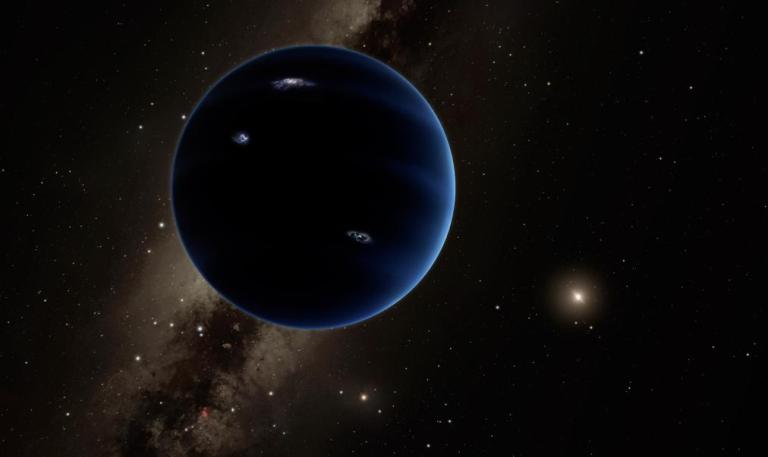
planet-9-art
An artist’s representation of Planet 9. Source

It was a sad day when the powers that be decided that Pluto was no longer fit to be called a planet. However, this January, in a shocking turn of events, scientists at Caltech may have discovered (or somewhat indirectly presume) the existence of a real ninth planet, an ice giant by the incredibly original name, Planet 9. (Side note: Ice giant? Ninth planet? They missed a killer Vonnegut ice-nine reference here).

According to this source, Planet 9 has a mass that is at least 10 times the size of Earth’s, yet is so far away from the Sun that it would take between ten and twenty thousand years to orbit. The massiveness of the planet would assuredly make it a “real ninth planet” (sorry, Pluto)—that is, if it is ever directly discovered.

At the moment, Planet 9 has only been discovered via computational and mathematical modeling, based on the gravitational orbits of the other planets in the Kuiper belt. The massive size of Planet 9 and elliptical orbit would explain the skewed elliptical orbits of neighboring planets. To be totally honest, I’m not sure if I will believe in Planet 9’s existence until it has been directly discovered, but the exciting possibility of a new ninth planet in our solar system is enough for right now.


Posted in Dwarf Planets | Tagged , , , | Comments Off on Planet 9

Positivity is Key

Nuclear fusion is the process by which the Sun survives. During fusion, the Sun converts its mass into energy that powers the Sun itself. Fusion is unique to the Sun’s core because in order to occur high densities and temperatures are needed. In the core, there are high densities of positively charges hydrogen nuclei.

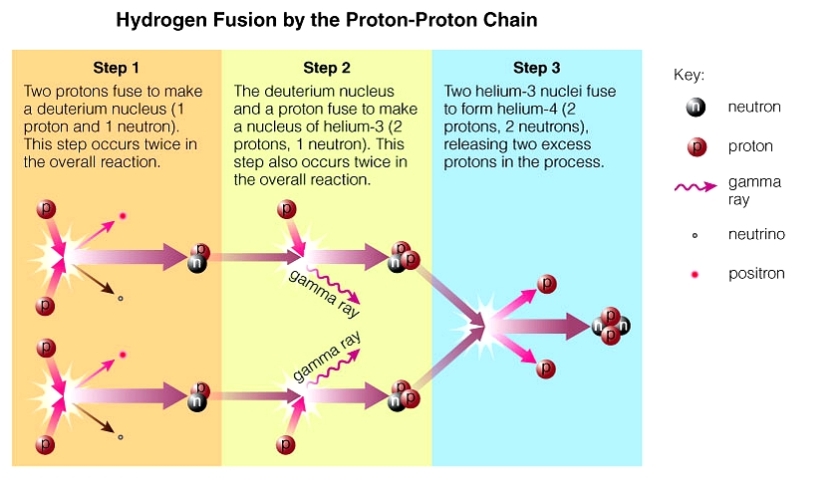
Proton Proton Chain
Proton-Proton Chain

In a multi-step process called the proton-proton chain, these nuclei move about the core at extremely high speeds due to the high temperature in the core. The concentration of protons in the core paired with the speeds at which they are moving allows for the protons to overcome the repulsive forces of their similar charges. This allows them to collide with one another and eventually create helium nuclei and release energy. Each second, fusion occurring in the core of the Sun coverts 600 million tons of hydrogen into 596 million tons of helium and 4 million tons of energy. All of the energy created is then released into space and affects the total luminosity of the Sun. Fusion occurs at a steady rate, but if there was variation in its rate, the changes in luminosity could be detrimental to life here on Earth. I think it is crazy to think about how such a minuscule occurrence can have such an impact on the entire solar system because without nuclear fusion, nothing would be the same.


Posted in Class, Light, Sun, Universe | Tagged , , , | Comments Off on Positivity is Key

The Stardust Mission

Missions that deliberately bring back extraterrestrial material to Earth are rare. The NASA Stardust, a probe that launched in  1999, sought to collect dust samples from the comet Wild 2’s tail. Prior to the mission, experts believed that the dust in comets’ tails would be pre-solar particles.

Instead, what they found from the particles retrieved was that the bulk of the comet’s mass seems to have formed very near the sun. An amino acid, glycine, was also found.

stereo_pair_03_11_04a_s

An image of the Wild 2 comet taken from Stardust


Posted in Small SS Objects | Tagged , , | Comments Off on The Stardust Mission

Earth’s Changing Magnetosphere

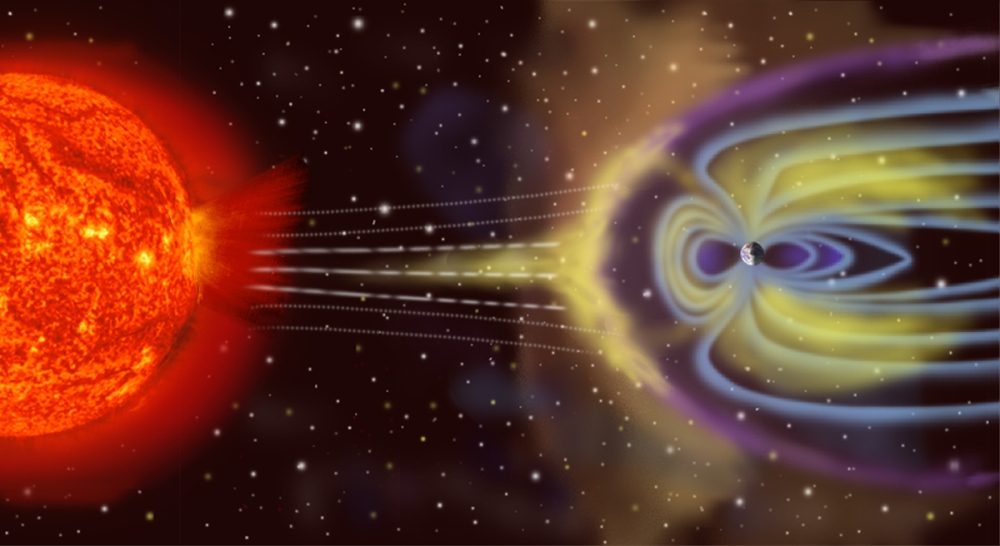
One of Earth’s most important features is its Magnetosphere.  This magnetic field that surrounds Earth deflects Solar wind that could slowly widdle away our atmosphere. Without an atmosphere, life would not have been able to develop on Earth.  In addition, if we were to suddenly lose our magnetosphere, then our power grids and other electronics would be at risk from the incoming particles from the Sun.

Magnetosphere_rendition.jpg
A depiction of Earth’s magnetosphere shielding Earth from solar particles

A possibly disconcerting trend in our magnetosphere is that it is becoming less stable.  This can be determined by the rate at which magnetic north and magnetic south swap places.  It now switches 25 times faster than it did before.  Because this decrease is so gradual, it poses no immediate threat.  However, if the magnetic field were to weaken and flip, in the near future, we would certainly have to be more aware of the security of our electronics from solar particles.


Source:

BBC Article on Magnetosphere


Posted in Class, Sun | Tagged , , | Comments Off on Earth’s Changing Magnetosphere