Blog #4 Spacecraft and “Gold Foil”

new_horizons_1
New Horizons Probe at NASA Kennedy Center

If you’ve ever seen pictures of satellites being prepped in clean rooms, you’ve probably seen the immense amounts of gold foil covering the crafts. You might think the foil’s purpose is to keep the probe clean until launch, or that gold’s conductive and malleable properties aid the function of the vehicle. For space travel, it’s neither. The foil is actually multiple layers of a special insulation. Due to the immense cold while in space, cosmic radiation sets the temperature around 3 K, spacecraft will lose heat to its surroundings and the equipment on board will start to fail. This heat loss is not through conduction or convection, but through thermal radiation. To counter this, the multiple layers of insulation (aluminum deposited on polymer layers) reflect this radiated heat back to the vehicle. On the flip side, spacecraft can experience extreme temperature differences to the point that the Sun’s radiation can overheat the probe. The polymer insulation on the outside reflects the incoming rays away from the spacecraft. So, rather than 24 carat gold foil, special vapor deposited aluminum polymer layers protect NASA’s spacecraft.


Posted in Class, Instruments, SolarSystem, Space Travel | Tagged , , | Comments Off on Blog #4 Spacecraft and “Gold Foil”

Geostationary Orbit – Calculations and GIF

Geostationary Orbit (GSO) is a specific type of orbit around the earth with a period of exactly one day, intentionally matching the rate of earth’s rotation. GSO is at zero inclination, meaning it is directly above the equator. This also means that a geostationary satellite will always be in the same point in the sky to an observer on earth.


These types of satellites are crucial for satellite communication because ground antennas can be aimed at the satellite and not have to track the satellite’s motion. This communication is necessary to watch live satellite TV, use GPS tracking, or have a wifi network connect to the internet.


I’ll now show the math behind the calculation of the altitude of a geostationary orbit.

We know the gravitational force equation:

F_G = (G * M_1 * M_2)/(r^2)

We also know that the gravitational force is equal to the centripetal force on the satellite:

F_G = (G * M_1 * M_2)/(r^2) = F_c = (M_2 * v^2) / r

which simplifies to:

(G * M_1) /(r^2) = F_c =  (v^2) / r

Note that the mass of the satellite has cancelled out, meaning that the mass of the satellite does not affect the altitude of geostationary orbit.

We know the rotational velocity of the satellite is:

v = (2 * pi * r) / t

and plugging that in we get:

(G * M_1) /(r^2) = (4 * pi^2 * r^2) / (t^2 * r)

Now solving for r yields:

r = cube root ((G * M_1 * t^2)/(4 * pi^2))

But in order to get the altitude we need to subtract the radius of the earth:

a = cube root ((G * M_1 * t^2)/(4 * pi^2)) – R_e

And plugging in the mass of earth, radius of earth, and using 1 day in seconds as t, we can calculate the altitude of a geostationary satellite, which is approximately 35,786 km (22,236 miles).

Now numbers and math are pretty cool, but I’ve got an awesome visual of what a satellite in Geostationary orbit would see. Check out this TOTALLY SWEET GIF of a satellite in GSO.

GSO Source

Math source


Posted in Class, Physics | Tagged , , | Comments Off on Geostationary Orbit – Calculations and GIF

GRAVITATIONAL WAVES!!!!

According to the this video by the New York Times, Scientists working at LIGO (the Laser Interferometer Gravitational-Wave Observatory) have made a monumental discovery that reinforces Albert Einstein’s theory of special relatively put forth almost a hundred years ago. Einstein predicted gravitational waves when he announced his theory, but until LIGO’s announcement on Thursday, no gravitational waves had ever been detected.

So how did LIGO’s team make this monumental discovery? They set up two L-shaped detectors in Louisiana and Washington, with arms over 2 miles long with a laser focusing on two mirrors. The laser light is emitted and split, sent down the 2 arms. The laser hits the mirrors at the ends of the arms and bounces back, and because the two arms of the detector are the same size, it takes the same amount of time to reach the starting point, cancelling each other out. However, if one arm contracts while the other arm expands, as would be expected as a gravitational wave hit, the beams would be off and the detector would sense the separation. This is exactly how the LIGO detectors worked to detect the gravitational wave. As one arm contracted, the other expanded, and the detector measured the degree of separation. Because this happened at each observatory, the scientists know that it is not some outside interference, and that they had actually identified a gravitational wave. What we know as a gravitational wave is the movement of spacetime caused by the acceleration of really massive objects.

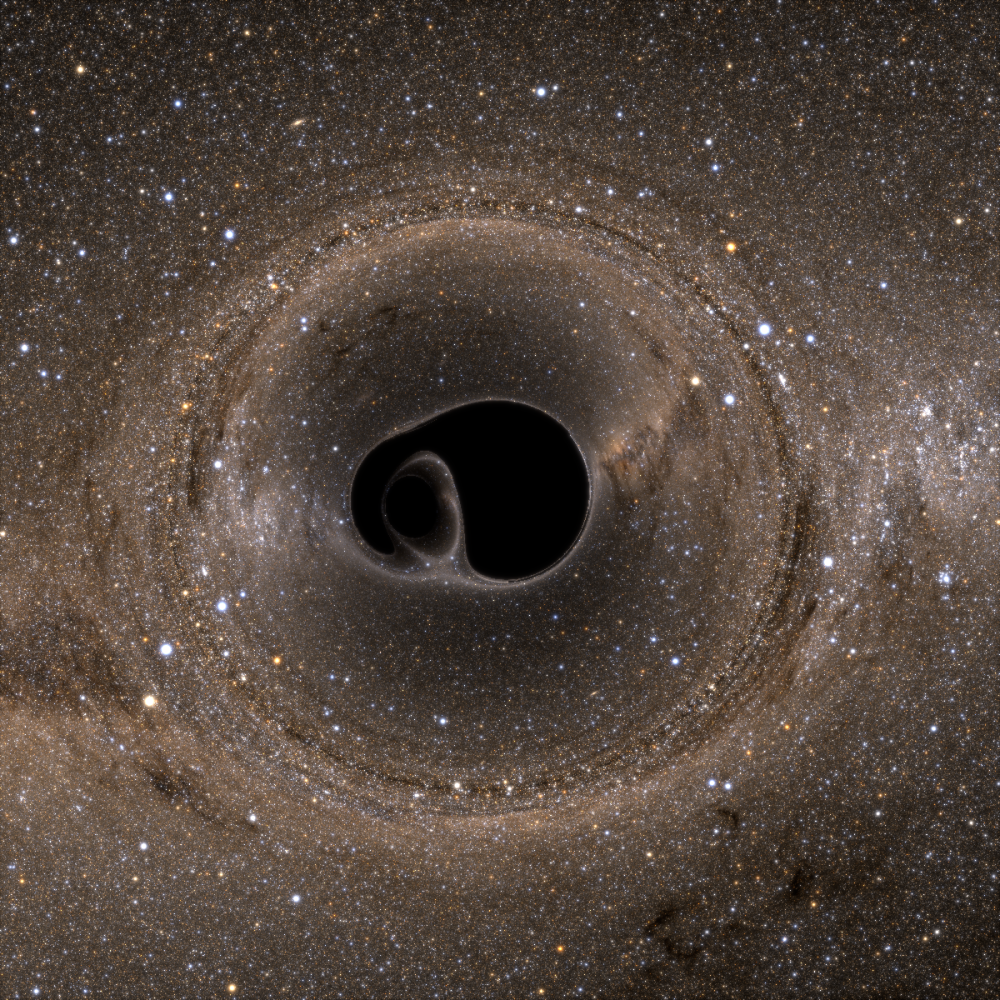
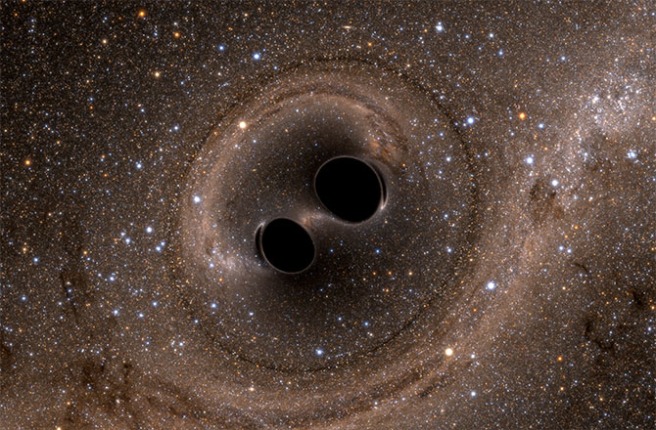
The gravitational wave was created over 1 billion years ago when two blackholes collided and merged together, “releasing the energy of a billion trillion sons in a single second” (WOW!),  giving the wave the power to travel the great distance required for us to feel its effect on Earth.

BBHmerge2.png
Illustration of the black holes merging together


This discovery of gravitational waves opens up all new types of astronomy. It is concrete proof that spacetime bends around mass. Now, not only can we see the universe (through light) we can also hear (the data from the detectors was converted into a sound-wave by LIGO, meaning we can hear gravity!) the Universe around us too. I don’t know about you, but I am excited at the prospect of astrophysicists discovering more about gravitational waves and the curvature of spacetime !

What do you think? Do you think this opens up another level of astronomy? How do you feel about the discovery? How do you think this will change our perception of the Universe? Leave a comment and let me know!


Posted in Class, Observables, Physics, Science | Tagged , , | Comments Off on GRAVITATIONAL WAVES!!!!

LIGHTSPEED, COSMIC SPEEDLIMITS, AND (FINALLY!) LOOKING INTO THE PAST (Part 2)

In one of my previous posts , I explained what a light-year was and how the speed of light remains constant in a vacuum (a.k.a. space). I also explained that there would be another post explaining some of the things that I couldn’t fit in that post. Now I am finally ready to finish–the long awaited!–part 2 of the riveting adventure that is light-speed. Read on to learn how to look back into time and other fun things about light!

As my last post (and the above paragraph) mentioned, the speed of light remains constant throughout the vacuum of space. Because the speed of light travels at a finite speed, it can take it a long, long time to cover vast distances. So, by looking at objects that are extremely far away, we are essentially seeing them as they were when the light was emitted, which can sometimes be millions or billions of  years ago. This is where our understanding of light-years comes into play.

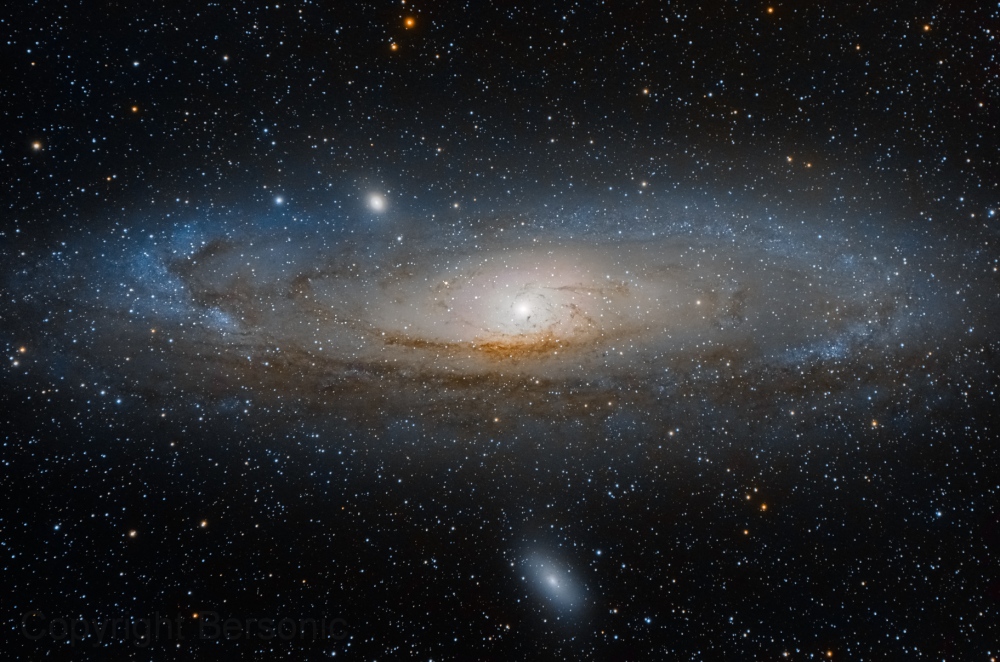
For example, the Andromeda galaxy is 2.5 million light years from Earth. This means that when we train our telescopes on the Andromeda galaxy, the light that we are seeing has been traveling through space for 2.5 million years. We are literally looking back in time by 2.5 million years! This light-time dilation works both ways. If an alien in the Andromeda galaxy were somehow able to look at light from the Earth and see what was going on, it would see the Earth as it was 2.5 million years ago. 

m31_bers_1824.jpg
The Andromeda galaxy

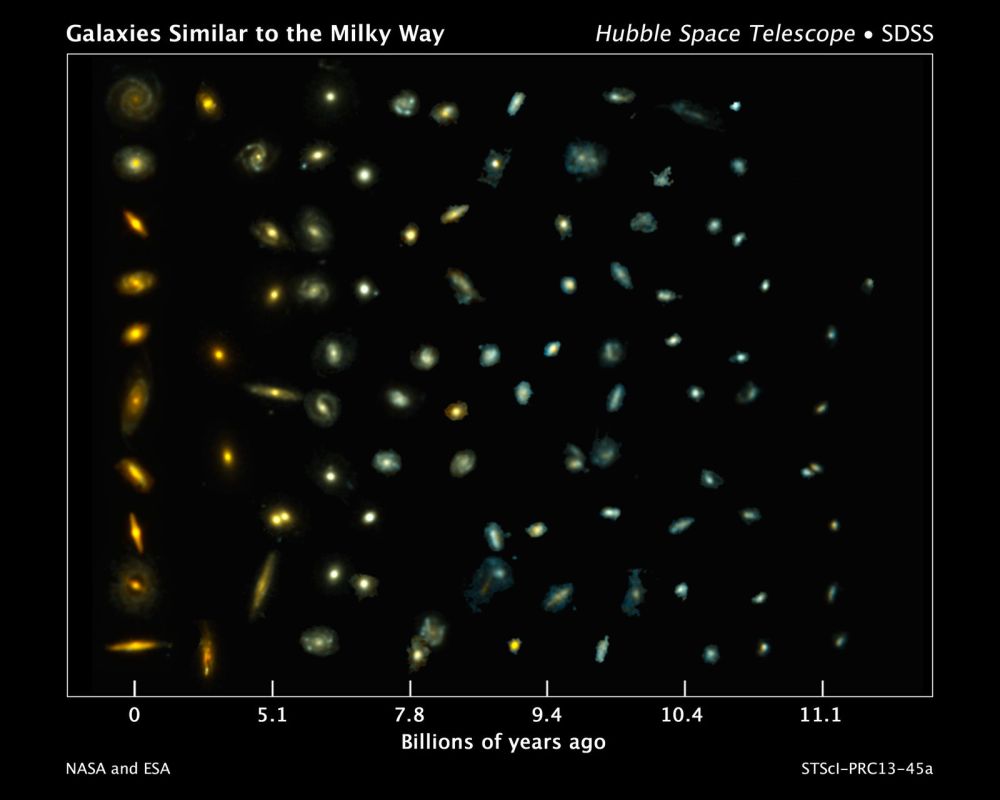
So, we may not be able to physically travel back in time, but we can see the Universe as it was millions and billions of years ago. Looking at galaxies as they appeared millions or billions of years ago can give us some information and context on how our own galaxy formed, so it is very important for scientists to understand! As this neat illustration shows, we can look farther back into the sky to discover galaxies similar to our own at different stages of their formation.

hubbles-galaxies-similar-to-milky-way
An illustration of the different galaxies similar to the Milky Ways at varying distances and stages in their growth. (If you’re trying to find the picture in the link, it is number 31 in the slideshow, I couldn’t get it to link to the exact location of the picture.)


If you’re really interested in this topic and want to read about more,  this really cool websitehas some more information on looking back in time and tracing the history of the Universe.

What do you think of looking back in time? Do you think scientists will ever be able look further back than we can now? Why or why not? Let me know your thoughts!


Posted in Light, Physics | Tagged , , | Comments Off on LIGHTSPEED, COSMIC SPEEDLIMITS, AND (FINALLY!) LOOKING INTO THE PAST (Part 2)

Hearing the Universe

One of the most groundbreaking theories in astronomy has just been proven with the announcement last week that gravitational waves have been detected. Einstein had predicted these waves in 1916 in his theory of general relativity, and they were only just found today using lasers, which Einstein also laid the foundation for one year later in 1917. These waves are ripples through space-time that actually bend matter as they pass by. The particular waves the LIGO scientists detected were originally emitted around 1.3 billion years ago when two black holes merged together. The amount of energy released in this merger was about 50 times more than the total output of all the stars in the universe put together, which gave it enough juice to reach us 1.3 billion light years away. Since these waves had minuscule energy by the time they reached us relative to other forms of waves that we know, how are they useful, and what do they even mean?

dnews-files-2016-02-grav-waves-2-670x440-160213-jpg

These waves formed by these two black holes can tell us about unimaginable concepts that have yet to be theorized or even viewed as possible. They can help us understand black holes and whether or not they even exist, as their existence is not technically proven yet. Gravitational waves can also let us utilize high-energy interactions far away in the universe as a sort of lighthouse that we can use to examine the expansion of the universe and also test the theory of universality and whether the laws of physics are consistent throughout the universe. Most importantly for astronomers, however, is that they can now study objects in the distant, dark universe without the need for electromagnetic radiation. We can now “hear” the universe, so to say, as we don’t need to rely on sight anymore to study the cosmos. (Sources: DiscoveryNews).


Posted in Class, Observables, Physics | Tagged , , , , , , | Comments Off on Hearing the Universe

Tidal Forces

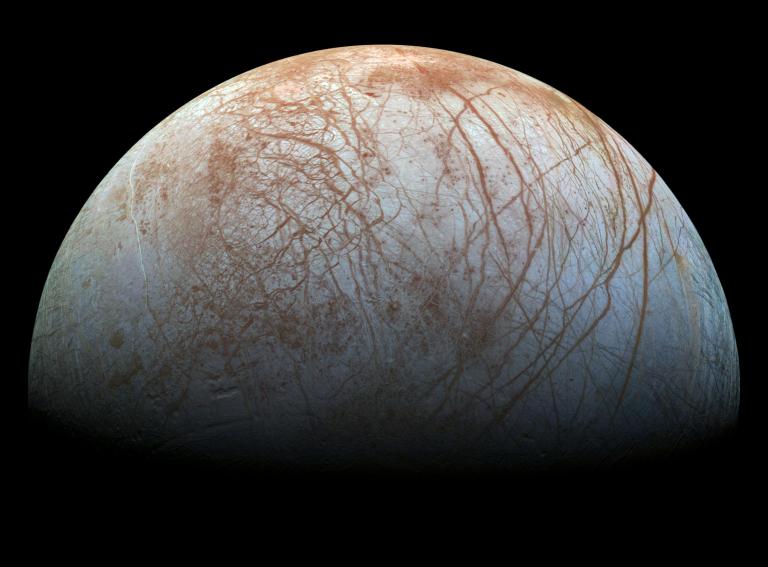
PIA19048_realistic_color_Europa_mosaic
Wikipedia

As a person that has always been happiest by the ocean, I really enjoyed learning about tides and decided to do some further research into other effects and instances of tidal forces in our solar system.

Just as the Moon causes tides on the Earth, Earth creates tidal forces acting on the Moon. This is what causes the lunar year to last the same amount of time as the lunar day – a phenomenon known as “tidal locking,” that causes the same face of the moon to be oriented towards Earth at all times. Because of this, if you were standing on the Moon, the Earth would always appear at the same place in the sky. The tidal forces between the Earth and the moon also are constantly causing the Earth’s rotation to slow and the Moon to move away from the Earth, and because of this, one day (very, very far in the future) the Earth and Moon will achieve double tidal locking as the Earth’s rotational period becomes the same as the Moon’s orbital period.

Other planets also have tidal interactions with their moons. One of the coolest examples I found of this is Jupiter’s tidal force on its moons Io and Europa, both of which are tidally locked. Because Io is a solid body made primarily of rock, Jupiter’s flexing tidal forces causes friction that generates large amounts of heat at the center of Io. This friction also is the reasons why Io has over 400 active volcanoes, more than any other object in our solar system. Jupiter’s tidal forces create similar friction-driven heat within Europa, but since Europa is composed mainly of water ice, the heat has melted the inside of the moon, creating vast water oceans under an outer layer of ice. This outer layer is full of cracks caused by Europa’s tidal flexing.

As Neil deGrasse Tyson wrote, “The next time you find yourself on a shoreline watching the tide come in, remember that the frame and operations of Nature extend to the farthest galaxies, and causes and effects of things are, fortunately, remarkably few in number.”


Posted in Class, SolarSystem, Terrestrials | Tagged , , , , , , | Comments Off on Tidal Forces

Planet IX

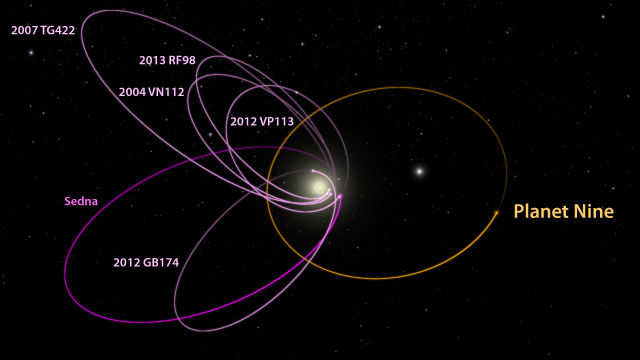
p9_kbo_orbits_labeled_1_-640x360
Orbit of Planet 9

I have been fascinated by the possibility of a new ninth planet ever since I heard about it, so I thought I would use this blog to share some information on it. First, the discovery of it came, in many ways, from Pluto itself. Once astronomers discovered that there were other objects like Pluto (Kuiper Belt Objects), they realizes that Pluto was not actually a planet. But they also discovered that these planets had unusual orbits, and had to be affected by a massive object near them that was not the Sun. This object is Planet IX. Scientists tested what orbits of KBOs would look like with different objects near them, and the one that worked the best was if there was another planet. They have not actually found the planet yet, but it works mathematically.

Source


Posted in Class, Jovians, Observables, SolarSystem | Tagged , , , , | Comments Off on Planet IX

It’s Gettin’ Hot in Herre

Do you ever wonder how we know what we do about stars? The closest stars besides our sun (Alpha Centauri) are 4.4 lightyears away which may not seem far away, but they aren’t the only stars we have data for. We know all about stars that are farther away. And even if distance weren’t an issue, our technological limitations would be. We can’t just stick a thermometer in a star to read its temperature. So how do we know things like distance, luminosity and temperature?

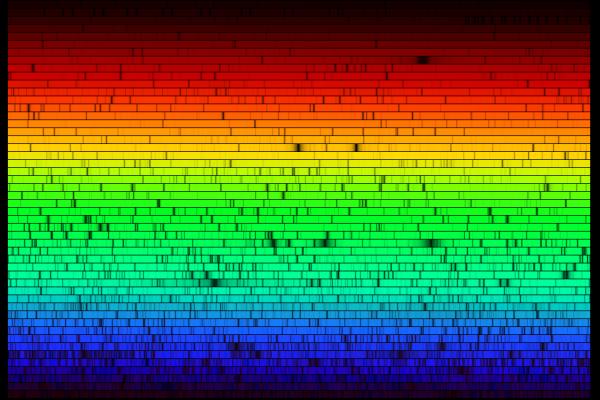
solarspectrum_noao
The Solar Spectrum (APOD)
The answer is in the picture above and others like it. This is the absorption line spectrum of the Sun. From this, we can determine the temperature and using that temperature we can find total energy emitted (and therefore Luminosity– total energy(W/m^2) x area (m^2)).

There are two relevant equations and they both apply to Blackbody Radiation. An object is a  blackbody if:

  • It’s opaque and at thermal equilibrium
  • No net transfer of heat occurs

Blackbodies have the following radiation properties:

  • They emit light at all wavelengths
  • Emit more light at all wavelengths as they get hotter
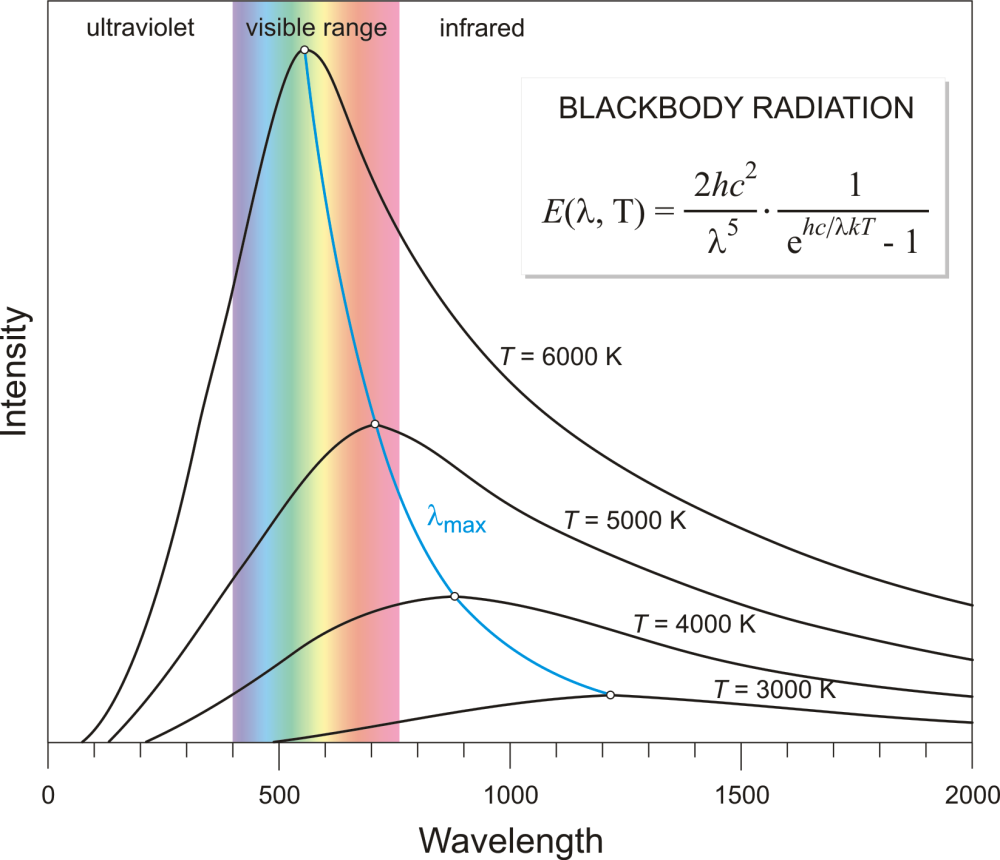
  • Their EM spectrum always follows Planck’s Law

blackbody_radiation
Planck’s Law (Chemistry Glossary)
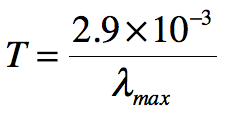
But where do we get temperature? Wien’s Law!

t-in-terms-of-l.png
Wien’s Law (IB Revision)
It’s as simple as that! Pretty cool, huh?


Posted in Class, Light, Physics, Science | Tagged , , | Comments Off on It’s Gettin’ Hot in Herre

Stonehenge

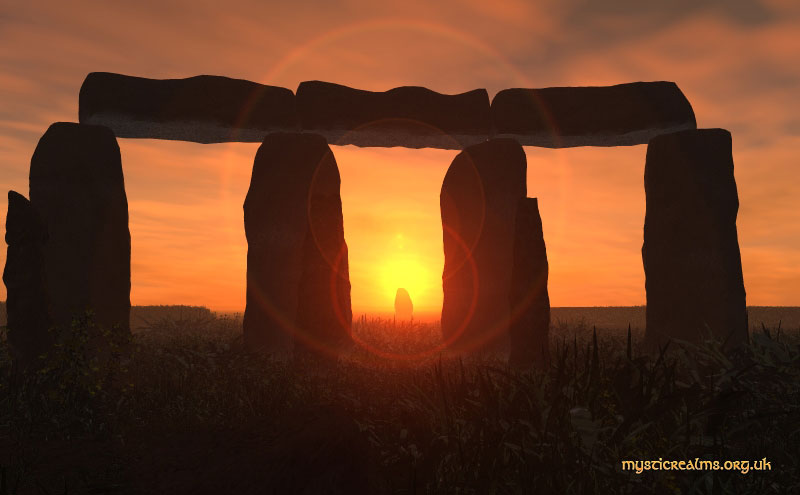
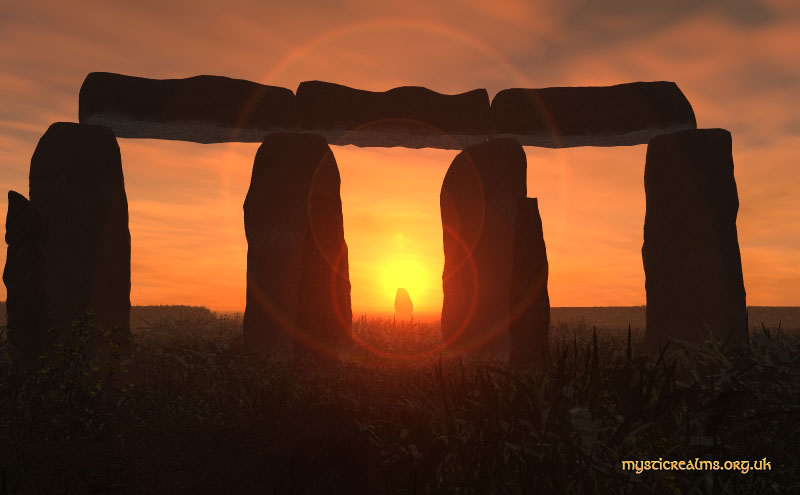
Stonehenge_heel_stone
Heel Stone at Summer Solstice

The layout of Stonehenge has confounded historians and archaeologists for years, and they still do not entirely know why it is there. But historians have theorized that at least part of the layout has to do with astronomy. One of the stones, called the Heel Stone, is lined up exactly with the Sun on the summer solstice. So the Sun rises over the Heel Stone on that day. This is a very precise calculation, so it is unlikely that it occurred just by chance. Others have argued that it can also be used to predict eclipses and other solar and lunar events. All in all, it is amazing that the people who built it could figure all this out, since it was built in ancient times. Source


Posted in Class, Historical, Observables | Tagged , , , | Comments Off on Stonehenge

Celestial NASCAR: Kepler’s Laws of Planetary Motion

kepler
Kepler’s Second Law as interpreted by our friends at XKCD

Before 1609, the scientific consensus in Europe was that the planets orbited the Earth in perfect circles; even dissenting views such as Copernican heliocentricism relied upon perfect circles to guide objects around the Sun. Johannes Kepler, however, motivated by minute errors in planetary distances discovered when attempting to construct Copernicus’ model, revolutionized astronomy with his laws of planetary motion.

First Law of Planetary Motion

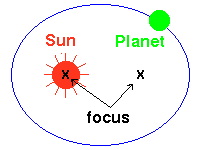
Kepler’s First Law asserts that a planet’s orbit is the shape of an ellipse, and the Sun is located at one of the foci of the ellipse.

kepler1
Source

Second Law of Planetary Motion

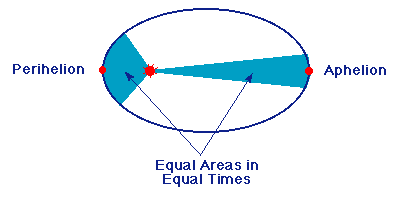
Kepler’s Second Law states that a line connecting the planet to the Sun will “sweep out” equal areas in equal times during the planet’s orbit; this means that a planet will move faster the closer it is to the Sun and it will move slower as it goes further from the Sun.

kepler2
Source

Third Law of Planetary Motion

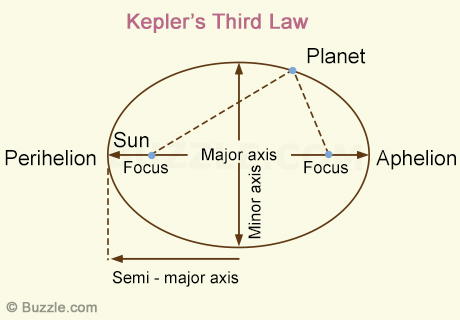
Although the Third Law was not published until 1618, nine years after the first two laws, it is no less significant than the preceding laws. The Third Law says that the square of a planet’s orbital period is proportional to the cube of its semimajor axis. This establishes that there is a positive relationship between how far a planet is from the Sun and how long it takes to orbit the Sun

kepler-third-law
Source

Read what I read!

Johannes Kepler – Britannica

Kepler’s laws of planetary motion – Britannica

Johannes Kepler’s 3 Laws of Planetary Motion – Buzzle

Johannes Kepler: The Laws of Planetary Motion – UT Knoxville Astrophysics


Posted in Class, Historical, Observables, SolarSystem | Tagged , , , | Comments Off on Celestial NASCAR: Kepler’s Laws of Planetary Motion