Dawn Reaches Ceres

Image of Ceres taken by Dawn spacecraft from a distance of almost 29,000 miles

Image of Ceres taken by Dawn spacecraft from a distance of almost 29,000 miles. Image from DailyMail

Ceres, the dwarf planet located in the Asteroid Belt, has a new inhabitant. NASA’s Dawn spacecraft has just recently entered into the dwarf planet’s orbit, and could soon reach a scientific breakthrough. You see, the surface of Ceres has these two ‘bright spots’ that have constantly baffled astronomers since they began observing Ceres years ago. You can see the spots above – both are apparently located in the same crater-basin on the ‘bright side’ of the planet. It’s been hypothesized that the two bright spots could actually be ice reflecting sunlight, which would certainly be an exciting development as we continue to explore our solar system. Finding frozen water on Ceres would be a huge breakthrough for NASA, especially when we consider how fickle dwarf planets have always been to observe. We won’t know for sure, though, for a few weeks. Since Dawn was captured into orbit on the far side of the planet, it will take a while before detailed images of the bright spots will be captured. NASA scientists have said that they expect to settle what those bright are by mid-April…until then, we’ll just have to wait on the edge of our seats!

Story from CBS News and DailyMail


Posted in Class, Universe | Tagged , , , | Comments Off on Dawn Reaches Ceres

Probing the Sun

With our current technology, the Sun is not physically explorable with its photosphere reaching 10,000 degrees F and its coreona reaching 3.5 milion degreees F. Yet, humans have multiple probes receiving data from orbiting spacecrafts. Currently there are 5 spacecrafts watching the Sun: WIND, SOHO, ACE, STEREO A, and STEREO B. The spacecrafts take in solar wind measurements, and observe the Sun’s core, corona, etc.

Source

ACE
ACE

Posted in Class | Tagged , , | Comments Off on Probing the Sun

Under the Sea

landscape-1426097714-saturn-moon-cutaway
http://pop.h-cdn.co/assets/15/11/980×490/landscape-1426097714-saturn-moon-cutaway.jpg

Earlier this week, scientists at NASA announced that Saturn’s sixth-largest moon, Enceladus, has a warm ocean at its southern pole. More importantly, it has strong evidence of hydrothermal activity on the ocean floor, the first of its kind found outside of Earth. This is a huge discovery because most scientists agree that life on Earth began around these same types of vents in the deep sea. The hydrothermal vents, located at the bottom of an ocean six miles deep, pump nitrogen, methane, carbon dioxide and a host of other compounds that form the building blocks of life as we know it. Interestingly, Enceladus’s hydrothermal vents are generated not by a molten core as they are on earth but by pure friction created from the gravitational pull of Saturn and its other moons.


Posted in Class | Tagged , , , , | Comments Off on Under the Sea

“You want me to hack the planet?”

core
http://ia.media-imdb.com/images/M/MV5BMTg0Mjg2OTE2NV5BMl5BanBnXkFtZTYwOTAwNDk2._V1__SX1857_SY846_.jpg

There are a compendium of factors that allow for life to exist on Earth, one of the most important of which is our core. Earth’s core is made up of molten metal that swirls and churns, generating a powerful magnetic field that shields the planet from radiation and solar wind. Our core is vital to the continued existence of life on earth. Without the core, we would gradually lose our atmosphere as cosmic rays charge the gas particles to the point of escape. Mars ‘died’ because it ran out of material to keep its core hot, and as a consequence the core turned solid and stopped moving. When this movement ceased, it lost its protection from solar wind and its atmosphere was stripped away over time. Needless to say, if Earth’s core were to die, that would be bad. Fortunately for us, the expected lifespan of our core is longer than the remaining lifespan of the sun, so it’s not something we really need to worry about. If it did turn off though, we could always send a team of scientists down to the center of the earth to detonate a series of nuclear explosions that should reactivate the core…


Posted in Class, Terrestrials | Tagged , , , , | Comments Off on “You want me to hack the planet?”

Venus: A Resemblance to Classical Images of Hell

Hot potato hot potato!

It all boils down to the greenhouse effect!  Yes, the greenhouse effect goes beyond causing global warming here on Earth.  It is, in fact, necessary for life on Earth; without it, the planet would be far colder than it is today.  Certain gases present in both Venus’s and Earth’s atmosphere essentially act like a blanket over the whole planet – temporarily trapping heat, thus slowing energy’s escape in the form of light.  Examples of these gases are carbon dioxide and water vapor.

Venus is so hot simply because its atmosphere is dominated by carbon dioxide, while Earth’s atmosphere only has trace amounts of greenhouse gases.  The carbon dioxide in its atmosphere bakes the surface to hotter than a pizza oven.  But what’s truly scary is that if Earth were moved closer to the sun, the same thing would happen to it.  Water vapor from the ocean and the carbon dioxide trapped there would escape into the atmosphere, warming the earth, causing more water vapor and carbon dioxide to escape.  This process that causes itself to repeat is an example of a positive feedback loop – and it would cause Earth to take on an image similar to Venus.  So next time you see Venus shining brightly as the evening star, take a moment to appreciate the fact that Earth does not resemble an image that can only be enjoyed from a great, great distance.


Posted in Observables, SolarSystem, Terrestrials | Tagged , | Comments Off on Venus: A Resemblance to Classical Images of Hell

An Ocean on a Moon?

One of the largest satellites in the solar system is Jupiter’s moon Ganymede. Though Ganymede is classified as a moon because it orbits a planet, it actually shares more features with the Earth than with our Moon. Ganymede is nearly as large as Mars and dwarfs Mercury and Pluto in terms of radius. Astronomers think that Ganymede’s surface is part of a thick layer of ice, but it also has a layer of rock beneath this ice – a more solid version of Earth’s mantle – and an inner core made of metal that gives Ganymede a magnetosphere. Though there is a very thin atmosphere, scientists have found evidence of oxygen on the surface of the planet.

converted PNM file

Jupiter’s largest moon, Ganymede (Nasa Solar System Exploration)

Since the Hubble Space Telescope has been transmitting images of Ganymede’s surface, astronomers have established growing confidence that there may be a liquid ocean of salt water beneath the icy surface of the planet. An ocean like this would minimize the effects of Jupiter’s magnetic field interrupting that of Ganymede’s, and the effects observed thus far support this claim. Though Ganymede’s aurora should shift by about six degrees due to pull from the magnetic field of Jupiter, they only shift by two degrees, indicating the presence of a salt-abundant ocean. This ocean would likely be found about 100 kilometers beneath the icy surface of the planet.

Although this idea is still forming, there will be more concrete evidence for Ganymede’s ocean after the dispatch of Europe’s JUICE (Jupiter Icy Moon Explorer) spacecraft, which should launch in the early 2020s and arrive around Jupiter shortly after 2030. The goal for JUICE is for the craft to fly by Jupiter and some of the planet’s other moons, and then fall into orbit around Ganymede in order to send pictures and other data of the moon back to Earth.

Sources: NASA Solar System Exploration, BBC World


Posted in Jovians, Moons | Tagged , , , , , , , | Comments Off on An Ocean on a Moon?

Beta Pictoris

NASA shares the comparison between the image of Beta Pictoris, a young solar system, in 1997 (top) and in 2012 (bottom).

Source: stgist.com

The formation of our solar system is still an event that deserves further study, and other areas and stars in the Milky Way offer a glimpse into the processes that hold the answers. Beta Pictoris, a young star that is 63 million light years away from us, may be such a star. Beta Pictoris is the first star to be discovered that is surrounded by a disk of gas, debris, and comet fragments. Additionally, Beta Pictoris already has a planet, which is about the size of Saturn. The image above is a comparison of Beta Pictoris from 1997 (above) and 2012 (below). The distribution of dust has not changed very much, suggesting that this system is in the final stages of formation. However, humans will need to study the system for another 20 million years to observe the dust and debris form into a planet. Perhaps travelling to the system will allow us to have a clearer picture without the 20 million year wait.


Posted in Stars | Tagged , , | Comments Off on Beta Pictoris

Where did we come from?

Formation of the Solar System

In only the recent history of astronomy, we’ve began to understand that our solar system is in fact no different than other star systems in the universe.  We now understand that stars in fact all form from a collapsing cloud called a nebula, which is composed mostly of hydrogen and helium gas, and trace amounts of other materials like hydrogen compounds, minerals, and metals which make up the asteroids and planets that orbit stars.

What is most intriguing is that we can see that it is a natural consequence of star formation for planets to form in its orbit.  Does this mean that all stars have planets in their orbit?  How does this affect the odds of another earth-like planet forming in orbit of another star?  Astronomers are still pondering these questions, but I think that there may be more earth-like planets out there than we think.  What are your thoughts?


Posted in Physics, SolarSystem, Stars | Tagged , | Comments Off on Where did we come from?

“Y” in the Atmosphere of Venus

Spanish astronomers have revealed a new theory for a 'Y' shape on Venus (annotated image from the Pioneer Venus Orbiter in 1979 shown). They say it is formed by winds pushing a 'wave' of clouds on the planet. These winds move faster at higher altitudes, creating the odd shape

Source: dailymail.co.uk

For decades, scientists have been discussing the origins of a Y shaped feature in Venus’ atmosphere. The strange feature is shown above in a picture from the Pioneer Venus Orbiter in 1979. A recent theory is that the Y shape is formed by differences in the wind speed in the atmosphere. The theory states that wind speeds are faster near the poles than at the equator, and they are responsible for moving Venus’ atmosphere in a way that produces the Y shape. In fact, Venus’ atmosphere generally moves sixty times faster than the planet’s rotation speed, which may explain why the shape is present on Venus but not on Earth. The dark color of the Y is produced by an unknown compound, which some scientists suggest is hydrobromic acid, amorphous sulfur, disulphur monoxide or even bacteria.


Posted in Terrestrials | Tagged , , , | Comments Off on “Y” in the Atmosphere of Venus

Salt Water Oceans Thought to be on Ganymede

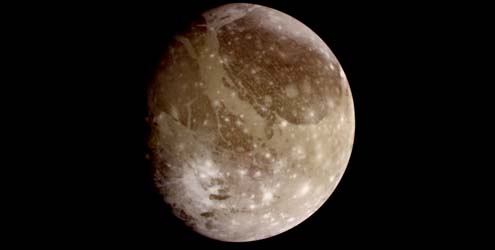
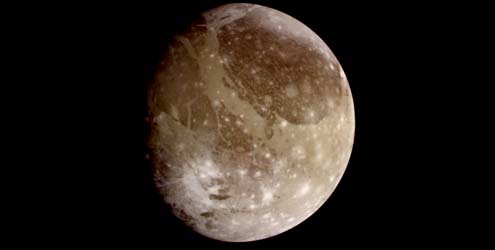
Ganymede

Ganymede

Astronomers have recently determined that Jupiter’s largest moon Ganymede likely has an ocean of salt water underneath its icy, inhospitable crust. Ganymede is the only moon in our solar system that has a functioning magnetic field; because of this it is also the only one to have auroras. Scientists in Cologne studied these auroras over a period of time in the hopes that they could learn something about the icy moon’s interior.

Ganymede is embedded within Jupiter’s magnetic field as well, which causes some interesting phenomenon. For example, it was determined that Ganymede must have a salt water interior that was interacting with Jupiter’s magnetic field. How did they determine this? By watching the auroras wobble of course! Scientists observed a wobble in Ganymede’s aurora of only a couple degrees, far off from what would be expected, and this result was used to determine Ganymede’s interior composition.


Posted in Moons | Tagged , , , | Comments Off on Salt Water Oceans Thought to be on Ganymede