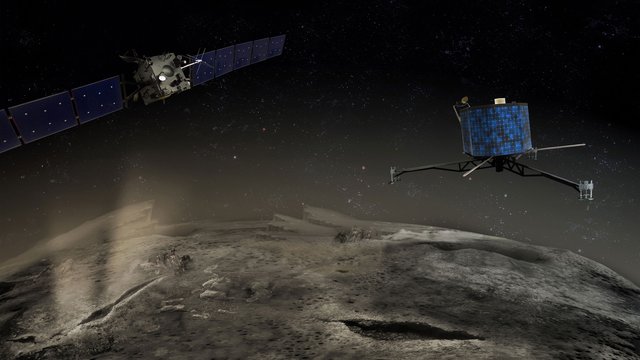
Over spring break, I came downstairs for dinner and my dad just so happened to be watching a PBS documentary on the ESA (European Space Agency)’s recent Rosetta mission. The documentary explains the behind the scenes work that went into developing the mission, giving insight into the building of the orbiter, the unique technological features, challenges the scientists faced, and the overall progress of the mission itself.
The goal of the Rosetta mission was to do something unprecedented – successfully land an orbiter on the surface of a comet as it orbited the Sun. This was already a challenge for scientists, since comets move at incredibly fast velocities that cannot be matched by any rocket, and the chance of landing on such a small surface of a comet was difficult in its own right. However, if successful, Rosetta and its lander part, Philae, could give scientists invaluable information about the formation of the early solar system and our beginnings.
Rosetta was approved for development in November of 1993, and the official launch was set for January 2003, but an issue with its launching rocket delayed the project for a year. This forced scientists to abandon the original comet they planned on landing on, and pick a new one. However, this comet was farther than the original one, so scientists had to briefly turn off almost all of Rosetta’s power in order for it to have enough fuel to last until the comet was closer. Once the comet was within an achievable distance, they reawakened Rosetta’s systems. Another way scientists helped Rosetta gain enough velocity to catch up to the comet was to fly by Mars and Earth, whose respective gravitational pulls provided the orbiter with a velocity boost (sidenote: I felt really cool explaining how that worked to my dad, since I am very much not a science person and he normally explains stuff to me).
The documentary also described the orbiter’s features and the experiments scientists did to try and equip Rosetta with the tools it needed to be successful. It was also interesting to see how the scientists chose a landing site, and responded to problems in the mission so quickly and efficiently. However, after a ten-year journey, Philae was finally able to land on the comet successfully, achieving what seemed to be a near impossible task. Sadly, Philae has since moved into a shadowed area of the comet, so its solar panels have not been able to collect sunlight and it has run out of power. The ESA hopes that the comet will soon move so that Philae is in the sunlight again, and can reawaken to continue collecting data.
Overall, this documentary was extremely informative and I enjoyed it a lot. The information was delivered in a very clear and understandable way too, which I appreciated. It also is quite relevant to the topics we have discussed in this class, and is just a cool thing in general.
To learn more about this, you can read the ESA’s information on Rosetta or watch the PBS documentary online.