To infinity and beyond (and then back to zero)!

The Universe is expanding, and at an ever accelerating rate. What does this mean, though? If we consider the Big Bang theory, then all that ever did, currently does, or ever will exist in our Universe (physical or otherwise) was all held within an infinitesimally small point at the start of existence. So, with the expansion of this point into everything we know today, how can it still be expanding? As we know from the principle of mass conservation, mass can neither be created nor destroyed. In regards to the expansion of the Universe, though, we run into a bit of an interesting notion. For expansion to happen with only the matter that’s been here since the Big Bang implies that what is here now is being stretched, so to speak. This is similar, if we consider for a moment, a balloon; the physical makeup of the balloon never changes, but as air is blown into it (dark energy in the case of the Universe), that which was already present begins to stretch until the balloon cannot store anymore energy and simply burst. Thinking of the Universe, it’s hard to imagine that scenario happening since no physical matter, as we can tell, is being stretched. What has been noted, though, is that galaxies are moving apart from one another at an increasing rate and this is the prevailing evidence on why the Universe is still expanding. A possible explanation is that the fabric of space-time itself is stretching or potentially dark matter since we can’t see either of them. This would explain why we are not noting changes in observable matter stretching, but even so I feel that we would observe changes, if even minute, in gravitational fields that we observe.

A model of the Big Bounce theory of the Universe.

Will the expansion last forever, though, is the large question at hand. Perhaps we already know what will happen if we take a moment to consider the life of a star; fusion at the core (adding energy), red giant (expansion), supernova (burst), and black hole (big crunch). The phase we’re in now is similar to that of the red giant phase since we are expanding and cooling down. Following this line of thought, we are approaching the point at which our Universe will begin to have a gravitational collapse. At that time, our Universe will probably burst out in the most magnificent explosion possible in our realm only to create the densest singularity point possible. This will absorb every bit of matter into itself until it is time for it all to explode outward once again, in an endless cycle.


Posted in Class, Universe | Tagged , , | Comments Off on To infinity and beyond (and then back to zero)!

Drake Equation: Quantifying Extraterrestrial Life

Hey Everyone,

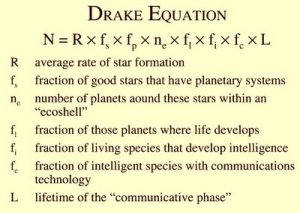
Today I’m going to discuss a major concept in the search for extraterrestrial life. Specifically, I will be discussing the Drake equation and its impact on said search. The Drake equation is an equation designed to approximate the number of extraterrestrial civilizations that exist in the Milky Way. It was developed by Frank Drake in 1961, and he later states that he didn’t make the equation to accurately quantify the number of said civilizations, but rather to spur conversation. The equation factors in many things including: the average rate of star formation; fraction of those stars which have planets; average number of planets which can support life; fraction of these planets which actually develop life; fraction of the planets that develop life which develop intelligent life; fraction of these civilization which are capable of communication; and the length of time these civilizations release communicative signals. The Drake equation had a profound impact on encouraging thought and research tailored towards the search for extraterrestrial life, and continues to have an impact today.

Source: Wikipedia 

Drake-EquationUniverse Today


Posted in Class | Tagged , , | Comments Off on Drake Equation: Quantifying Extraterrestrial Life

Spectroscopy and the identity of elements

Hey Everyone,

Today I am going to discuss the details of spectroscopy which explain why different atoms and molecules have different characteristic emission and absorption spectrum. The reason for this unique patterns lies with the the atom’s (or molecule’s) electron energy levels. Each atom and molecule has a unique separation of electron energy levels which is determined by the nature of the atomic structure of the specific element (or by the hydridization of orbitals in molecules). These different energy levels create unique energy gaps which manifest when specific frequencies of light are incident on the material. Thus specific materials will absorb or emit specific frequencies of light corresponding to their unique energy gaps.

Source: Wikipedia

SpectroscopyImage Source


Posted in Class | Tagged , , | Comments Off on Spectroscopy and the identity of elements

Dragonfly Telescope

Telescopes are instruments used in the observation of distant objects by collecting electromagnetic radiation (Wikipedia). Because of their necessity for observing the universe, telescopes are the subjects of ceaseless innovation and research. The Dragonfly Telescope just the latest of instances of innovation in telescope design.

In joint project by astrophysicists from the University of Toronto and Yale in 2013, scientists designed a telescope dubbed as “The Dragon Fly” (lenses resemble dragonfly). The telescope has been designed to detect the ultra-low surface brightness’s of galaxies at visible wavelengths. It does this using 10 (previously 8) specially coated telephoto lenses that can suppress internally scattered light.

By viewing a galaxy through multiple lenses, the Dragonfly is able to remove unwanted light. The Dragonfly Telephoto Array thus has the unique capability of making galaxy structures previously unseen to become faintly visible to us. Just this past July, Yale Astronomers discovered 7 dwarf galaxies hovering around the M101 spiral galaxy.

The advent of the Dragonfly Telescope raises new questions to be considered. “If light were able to scatter off of Dark Matter, could we observe this light?” This question raised by Jonathan Davis, a postdoctoral researcher at the Paris Institute of Astrophysics is the subject of my blog post on Dark Matter!

From the Dunlap Institute, University of Toronto

From Yale News


Posted in Class, Dwarf Planets, Instruments, Light | Tagged , , , | Comments Off on Dragonfly Telescope

Mars One Mission

In our society, the career of an astronaut has been painted as an idealistic childhood dream job or the mythical title attached to names like Neil Armstrong and Sally Ride – names only found in history books. The astronauts, past and future, who set foot on the Moon or traveled to the International Space Station will not only go down in history for their valuable exploration outside Earth’s atmosphere, but for the emotional and physical risks they took upon going into space. It’s enough to make an average citizen like you or I ask themselves, “Would I do that? Would I risk my life to travel where no one else has ever gone?”

In fact, that’s exactly what Mars One is asking. In 2011, Bas Lansdorp and Arno Wielders launched the Netherlands-based company Mars One with one mission – to settle a human colony on Mars. The founders garnered support from scientists, academics, and businesspeople around the world, starting a fundraising campaign for the project and establishing a team of marketers, ambassadors, and advisers. Though there are many notable supporters of the project, a few include representatives from SpaceX and astrophysics professors from Cornell University and University of Arizona.

living pods

Proposed design for Living Units on Mars, individual living spaces for residents connected by hallways and powered by Living Support Systems, which use solar energy and provide water and breathable air. (Mars One)

Mars One started with a fifteen-year plan to establish human life on Mars, and has kept to that plan since 2011. They have started preparation on Living Support Systems for people to use while living on Mars, pods that would provide adequate breathable air, energy, and water for residents. The colony would also require Living Units, indoor units with facilities suitable for human habitation. Though travelers would eat freeze-dried food on the ten-month journey to the Red Planet, they would be charged with growing their own food while on Mars, specific types of plants that could sustain in the unusual conditions of lower gravity and a less dense atmosphere. Mars One hopes to start transport of materials in 2022, including a rover that would find a suitable place on the planet’s surface to establish a settlement – close enough to the equator to have the most efficient solar energy collectors but far enough North to make use of water potentially contained in the rusted soil.

press conference

Press conference held by Bas Lansdorp and Arno Wielders in 2013 with the mission of recruiting interested travelers for the project. (Mars One)

One of the most important parts of the mission is the people. Who would be crazy enough to get on a one-way spaceship to Mars with very little chance of survival, saying goodbye to everything they’ve ever known – including family and friends – forever? Mars One released a request for volunteers at press conferences in 2013 and received feedback from about 200,000 applicants worldwide. This list has since been narrowed down to 600, and will eventually be cut down to just four who will leave for Mars in 2024, after undergoing eight years of intense mental, physical, and technical training. Much of this training would be in isolated environments simulating conditions on the spaceship or while living on Mars.

There are many more details regarding the funding, preparation, technology development, and social support of this project that will be unraveled in coming years as the company moves forward with the project. But now I want to hear from you – what are the potential problems with a project like this? Would you risk everything you have established here on Earth to be part of the first extraterrestrial human settlement?

For more on the history and plan of Mars One, see here.

For interviews with potential colonists, see Universe Today and BBC News.


Posted in Space Travel, Terrestrials | Tagged , , , , , , | Comments Off on Mars One Mission

How special is the Milky Way?

The Milky Way is the first galaxy that we call home since the beginning of the human race and it is very likely also the last. We know earth has many rare qualities that made life possible, looking on a larger scale, is our galaxy also a unique snowflake like our planet?

Using data collected from the Sloan Digital Sky Survey, Stanford University astrophysicist Risa Wechsler discovered that only four percent of galaxies had two bright nearby satellite galaxies like the large and small Magellanic Cloud.

The Large and Small Magellanic Clouds seen from the southern skies.

So why is this data useful? First of all, the study is good example of the usefulness in comparing computer generated data to real data in checking implausibilities in theories. Secondly, Risa Wechsler’s work provides support to the cold dark matter (CDM) theory, as insights in Milky Way’s formation history could provide clues that could show that around 80% of the universe is made up of dark matter. Below is a video of her work.

Posted in Galaxies | Tagged , , , | Comments Off on How special is the Milky Way?

How special is the Milky Way?

The Milky Way is the first galaxy that we call home since the beginning of the human race and it is very likely also the last. We know earth has many rare qualities that made life possible, looking on a larger scale, is our galaxy also a unique snowflake like our planet?

Using data collected from the Sloan Digital Sky Survey, Stanford University astrophysicist Risa Wechsler discovered that only four percent of galaxies had two bright nearby satellite galaxies like the large and small Magellanic Cloud.

The Large and Small Magellanic Clouds seen from the southern skies.

So why is this data useful? First of all, the study is good example of the usefulness in comparing computer generated data to real data in checking implausibilities in theories. Secondly, Risa Wechsler’s work provides support to the cold dark matter (CDM) theory, as insights in Milky Way’s formation history could provide clues that could show that around 80% of the universe is made up of dark matter. Below is a video of her work.


Posted in Galaxies | Tagged , , , | Comments Off on How special is the Milky Way?

“Is Dark Matter Perfectly Dark?

The Pinwheel Galaxy seen through optical and ultraviolet wavelengths. Studied in search of dark matter and light interactions. Credit: ESA/XMM & R. Willatt

The Pinwheel Galaxy seen through optical and ultraviolet wavelengths. Studied in search of dark matter and light interactions.
Credit: ESA/XMM & R. Willatt

Dark Matter is perhaps the universe’s greatest enigma. Matter that cannot be seen yet accounts for roughly 80% of universal matter. Despite its seemingly invisible existence, we are aware of its presence because it exerts gravitational pull on the observable matter of our universe. It is unseen and unknown, yet it its existence is what allows a galaxy to hold its stars together and spin at such tremendous speeds without flying apart from other galaxies.

Today, scientists still search for possible interaction between Dark Matter and light. In a new study, researchers at the Paris Institute of Astrophysics have hypothesized that if particles of light can scatter off of dark matter, “halos of light” could appear around galaxies.

In search for this glow, researchers look to the Pinwheel Galaxy using data from the Dragonfly Telephoto Array. In an attempt to diffuse light around galaxies, researchers hope that these telescopes can assist in “finding high contrast between bright galactic areas and the dim outskirts of galaxies.”

While unable to find this “halo of light” within the particular wavelength, researchers hope that his spurns interests for others to seek out the existence of these halos.

From Space.com


Posted in Class, Universe | Tagged , , | Comments Off on “Is Dark Matter Perfectly Dark?

Things aren’t always as they appear on the surface

Digitally altered representation of dark matter (blue) surrounding a galaxy, observed through the use of gravitational lensing.

When one looks at the great expanse of the Universe, they will see a mix of moons, planets, stars, and galaxies, but what about all of the open “space” in between these celestial bodies? Most are familiar with the fabric of space-time, which is best described by general relativity, as it illustrates in a logical fashion how gravity affects bodies and their movements through the Universe. However, what is mostly considered is actual matter which only accounts for roughly 5% of the Universe; what we should be looking to is dark matter when considering the curvature of space-time since it accounts for approximately 85% of the Universe (with the rest being accounted for by dark energy). Dark matter is a type of matter that cannot be seen, but that we know is there due to the gravitational effects it has on visible matter. When we look at how empty the Universe looks, it helps to have something to fill the void, so to speak. Also, as we’ve noted before with black holes, just because something is naked to the human eye doesn’t mean that it’s not there. I feel that a good analogy when considering matter versus dark matter is akin to looking at a piece of cotton candy; what we can see is the thin wisps of colored sugar, but the primary ingredient is air which we cannot see.

In considering dark matter as being uniform across the expanse of the Universe, it sheds some light on why we can still feel the effects of gravity and the curvature of the space-time fabric even in the “empty” zones between planets and even between galaxies. Currently, we have no way of proving the existence of dark matter except through theoretical equations. It may, unfortunately, be one of the great mysteries of the Universe that we may never have a chance to fully explore.


Posted in Class, Universe | Tagged , , | Comments Off on Things aren’t always as they appear on the surface

SkyView App

With the prevalence of advanced technology in today’s society, it is no surprise that there have been many mobile applications, or ‘apps’ dedicated towards astronomy that are available to purchase and peruse for astronomy lovers. One app that caught my interest was the SkyView App. The SkyView App is free on iTunes and on the Android, and is distinct from other astronomy applications that allow the user to look at the various stars. The app allows users to view various and constellations in the day or night sky directly through their iPhone or Android. When the app finds which constellations are visible on a given night, it provides statistics about that constellation. The app even allows you to set notification so you can be aware of when your favorite stars will be visible in the sky so you don’t miss the chance to see them! I recently downloaded the app onto my iPhone, and after using it several times to observe the constellations in the sky, I highly recommend it to anyone who is interested in observing the sky in an interactive and fun way. To find out more about the SkyView app and how to download it, click here.


Posted in Class | Tagged , , , , | Comments Off on SkyView App