Gravitational Redshift

Most of us know about redshifting, a phenomenon of the Doppler effect. This is the change in frequency of a wave, both mechanical and electromagnetic, for an observer when there is relative motion between the source and the observer. For example, when an observer is moving closer to a wave source, each successive wave front is emitted from a position closer to the observer as compared to the previous wave. This means that each successive wave front is getting closer to the previous one, as it has had to travel a smaller distance than the previous one. There is a reduction in wavelength and hence an increase frequency. This effect is almost always explained by the very cliched example of an approaching vehicle siren.

Doppler Shift Illustration

Dopplerfrequenz

Redshift is an example of the Doppler effect, where by the electromagnetic wave source is receding away from the observer, causing the frequency of wave to appear lower to the observer. However, did you know that redshift also occurs when there is a difference in the gravitational field strength between the source and the observer? This is called gravitational redshift and can occur in the absence of relative motion.

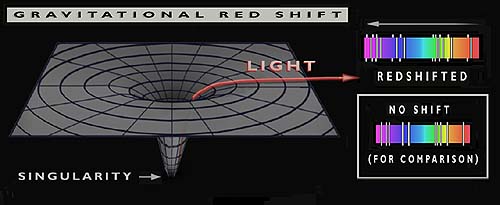
Gravitational redshift is a result of gravitational time dilation which itself is a consequence of special relativity. The closer an observer is to a source of gravitation, the slower will be the passage of time for him. Hence when an electromagnetic moves away from the source of a gravitational field, the rate of passage of the time dimension it is in increases. Since frequency is the inverse of time period, this increase in time results in the frequency of the wave to decrease – hence redshifting. An easier way to think about is that light has to light was to fight its way away from a pulling gravitation source. As it does so, it loses energy. By Plank’s equation (E = hf), this lowering of energy has the outcome that the frequency of the wave will be lower.

Gravitational Redshift Conceptual Illustration
redshift

Gravitational redshift is “easily seen” by observing white dwarfs or neutron stars, which are so massive that the light they emit is significantly redshifted. Interestingly, gravitational redshift also means that at black holes, where the gravitational field strength assumed to be infinite, electromagnetic waves can never escape since they will infinitely red shifted!


Posted in Light, Physics | Tagged , , , , , , , | Comments Off on Gravitational Redshift

The Scale of Atoms and Modern Processors

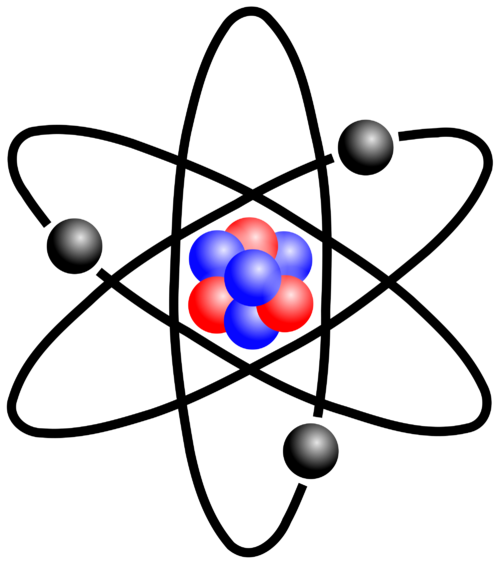
Artist's Depiction of a Lithium Atom

Artist’s Depiction of a Lithium Atom

Everyone knows that atoms are small, but exactly how small is small? This new video by Kurz Gesagt explores this question, and the sheer scale is mind boggling to try to imagine.

Among the analogies used is that of filling rooms with rice grains; if the end of your finger was the size of the room, and you filled that room with rice, and then you took one of those rice grains, made it the size of a room, and filled it with rice, and then you took the space in-between and filled it with sand, you’d have atoms! I kept expecting him to stop, but the scaling down goes on and on to a size that is truly unimaginable.

However, as technology increases, we continue to work more and more with things on this kind of scale. The processor of a modern computer has billions of transistors on a single chip barely larger than a fingernail. The transistors have become so small that they are now about twenty-two nanometers across, or a mere fifty atoms. Even more than this, the transistors are now able to process information at an astonishing rate of one trillion instructions a second. It’s hard to imagine technology advancing further than it has already, but I am sure we will find a way.


Posted in Physics, Science | Tagged , , , , , | Comments Off on The Scale of Atoms and Modern Processors

Was Life on Earth Planted by Aliens?!?!

wao

Scientists in the United Kingdom have discovered something astonishing: a tiny, metal globular object the width of a human hair captured by a team of researchers using a high-flying balloon in Earth’s stratosphere. According to University of Buckingham’s astrobiologist Milton Wainwright, the globular object “has filamentous life on the outside and a gooey biological material oozing from its centre.” A theory that is currently being formed is that it was sent by a civilization from a different planet to keep on planting life forms on Earth. As far-fetched as this theory sounds, especially because it seems like it’s from a sci-fi novel, even Nobel Prize winner Francis Crick believes this theory to be a possibility. What’s even more interesting about the object is that the sphere impacted the balloon rather than landing softly. Of course, this theory will remain a theory until there is proof of an alien civilization.


Posted in Aliens, Universe | Tagged , , , | Comments Off on Was Life on Earth Planted by Aliens?!?!

The Great Filter

When you think of the size of the universe, there must be life elsewhere. There are 100 – 400 billion stars just in our galaxy, and just as many galaxies in the universe. If we estimate that 5% of all stars are sun-like, which is on the low side. There should be 500 quintillion sun-like stars. From a PNAS study, 22% of those stars might be orbited by an earth-like planet, which means there should be 100 quintillion earth-like planets. That is equal to 100 earth-like planet for every grain of sand in the world. That means there are 1 billion earth-like planets in our galaxy alone. If 1% of those planets advances intelligent life like Earth, there should be 100,000 intelligent civilization in our galaxy.

So. Where is everyone?

Our sun is young compared to the universe. There are countless older stars with countless older earth-like planets.

Let’s look at the Kardashev Scale. It groups civilizations into three categories.

Type I: A civilization has the ability to use all the energy on their planet.

Type II: A civilization has the ability to harness all of the energy of their host star.

Type III: A civilization has the ability to harness the enemy comparable to the Milky Way galaxy.

We, humans, are around a 0.7 according to Card Sagan.

If 1% of of intelligent civilizations survive to Type III, there should be around 1,000 Type III civilizations in our galaxy.

One explanation is that is there no signs of higher (Type II and III) civilization because there are none. If there is none out of all the stars and all the earth-like planets, there must be something preventing that. That something is the Great Filter. The Great Filter theory states that at some point while trying to get to Type III intelligence, there is a wall or filter that all attempts at life hits. That there is some stage of evolution that is impossible or near impossible.

Where is the Great Filter for us?

There is 3 possibility: We are lucky, we are first, we have not hit it…. yet.

1) We are lucky. The Great Filter is behind us. We, humans, have passed the filter, which means life is rare to make it to the same level of intelligence as us. This would explain why there are no Type II or Type III civilizations as many civilizations gets caught by the Great Filter before even reaching Type I.

2) We are first. The Great Filter will not occur, but since we are the first and most advance civilization and we are on our way to becoming a Type II civilization, we will not contact life outside of Earth unless we do it.

3) We have not hit it……..yet. If we are not lucky and passed the Great Filter or we are not the first intelligence civilization to reach this level of intelligence, then we must have not hit the Great Filter yet. The Great Filter must be in our future and something will prevent us from going further and reaching high intelligence to contact other life.

Source

Source
Source

Posted in Class | Tagged , , | Comments Off on The Great Filter

ESA’s Rosetta Mission

The European Space Agency’s (ESA) Rosetta mission is probably fresh in a lot of your minds as it came to fruition in November of last year. For those unaware, the Rosetta space probe is the first probe to orbit a comet – the Churyumov-Gerasimenko. The probe also came equipped with a lander, which touched down shortly after the probe entered orbit.

The idea that humanity was able to land a probe on a comet is amazing in and of itself. Reading about the logistics involved in getting the probe there is even more amazing. The fact that the mission took a total of 10 years from launch alone should pique your interest.

Why 10 years? Given the immense speed of the comet (135,000 km/h; the ISS averages 27,600 km/h), the Rosetta probe would need to enlist the help of other planets to “slingshot” it to the necessary speeds – also known as a gravity assist. We know from Kepler’s second law that the probe should speed up as it approaches the foci of its orbit. It also suggests that it should slow down as departs, but this is the opposite of what we want. Instead, it is important to consider that a planet is moving and thus has a significant amount of angular momentum. By aiming the probe appropriately, it can “steal” some of this angular momentum to increase its own velocity. Over 10 years, the Rosetta probe would utilize four gravity assists to propel it to required speeds. Not only would it be necessary to aim the probe properly to utilize these assists, it would also need to wind up in an orbit that would approach the comet at the appropriate time.

Funny_541fda_627007Even oversimplified, it still hurts my head (Source: Rookiestew)

To see these gravity assists in action, check out the video below detailing Rosetta’s 10 year journey.


Posted in Class, Physics | Tagged , , , | Comments Off on ESA’s Rosetta Mission

The Early Telescopes

The earliest working telescopes was made around 1608 with many who claimed its discovery. The design was simple; a convex objective lens and a concave eyepiece allowed the user to see further. In 1655, astronomers had build more powerful telescopes using a design by Kepler. This design used a convex objective lens and a convex eyepiece lens. In 1668, Isacc Newton created the first working reflector to reflect the light to a eyepiece on the side of the telescope, similar to modern day telescopes.

Then with the production of larger paraboloidal mirrors in 1721, the process of coating mirrors with silver in 1857, and the usage of aluminized coating in 1932 further modernized the telescope.

Compared the jump in technology from 1608 to 1900s with the large leap of advances from the 1900s to present day and you will understand how fast technology has grown recently and the speed it is going for the future.

Source: Wikipedia

Emblemata_1624
Wikipedia

Posted in Class, Instruments | Tagged , , | Comments Off on The Early Telescopes

A Smiley Face in Space :)

smiley-in-space

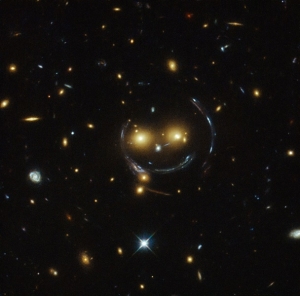
A picture taken by Hubble shows what appears to be a face complete with two eyes, a nose, and a smile. The two eyes are actually galaxies while the smile is made up of curving light that forms a partial circle around the figure. However, the smile doesn’t exist. There is lots of immeasurable and unseen mass in space that, when combined, creates strong gravitational fields. These fields are more noticeable around large objects such as galaxy clusters or black holes. When these gravitational fields get really large, they have an effect on light as it travels across distances. Space-time and light are both bent by these gravitational fields causing a lensing effect. This effect is called gravitational lensing and is something that astronomers need to take into account when observing the universe. The stronger the gravitational lensing, the easier it is spot because it causes visible distortions through telescope such as the image above. These rings of light are called Einstein rings and only occur when the source of original light, gravitational lens and observer are aligned in a straight line. In addition to creating cool pictures, gravitational lensing can also be used to help study dark matter. Though the universe is made up of 85% of invisible dark matter, we can observe its effect on the universe through images such as these.


Posted in Light, Science, Universe | Tagged , , , , | Comments Off on A Smiley Face in Space :)

The James Webb Space Telescope

The James Webb Space Telescope (JWST or Webb) is set to be the official successor to the Hubble Space Telescope, due to launch is 2018. In order to understand how the JWST will be improving on the Hubble, I think it is first important to understand some of the light aspects of space observation.

JWST_Full-Scale_Model_on_Display_in_GermanyModel on display in Germany (Source: Wikipedia)

We’ve learned about the redshifting of light due to the Doppler Effect. The Doppler Effect tells us the direction an object is traveling (toward or away) and its velocity. However, the expansion of the universe also creates cosmic redshifts which become very important in determining the age of distant objects. This redshift gives us the amount light has shifted since it was originally emitted – a higher redshift means it has “expanded” further and is thus older.

The oldest recorded object is the UDFj-39546284, as first observed by the Hubble Space Telescope in 2011. The light emitted from this object is estimated to be 13.7 billion years old – only 400-600 million years after the Big Bang.

Hubble’s capability is extensive, but it does have its limitations. Hubble’s focus is on the ultraviolet and visible portion of the light spectrum. Because distant objects are shifted to a longer wavelength (redshifted), the Hubble would have trouble seeing objects with wavelengths longer than those in the ultraviolet and visible light spectrum. Instead, the JWST is an infrared telescope that will be capable of viewing much longer wavelengths of light – up to the mid-infrared. To put it in perspective, the Hubble’s viewing capability is .1 to 2.5 microns. JWST will have a viewing capability of .6 to 28 microns.

em_spectrum_satelliteImage Source: NASA

So the JWST will allow us to observe light with a longer wavelength. What does this mean for us? Well, given that the highest redshifted light the Hubble was able to observe was emitted only 400-600 million years after the Big Bang, this means that the JWST will get us even closer. It is estimated that we may be seeing objects that were created only 200-300 million years after the Big Bang. Imagine that!

hubble-telescope-vision-graphicImage Source: Space.com


Posted in Class, Light | Tagged , , , , , | Comments Off on The James Webb Space Telescope

Earth-Like Planets?

There was a journal article released last week from the Australian National University with the title, “Scientists Predict Earth-Like Planets around Most Stars”. To summarize, using the idea of the “Goldilocks zone” (the distance from a star where liquid water can exist) and applying it to the exoplanets discovered by the Kepler telescope, astronomers have predicted that there are hundreds of billions of Earth-like planets in the Milky Way galaxy alone. Wow! The search for extraterrestrial life is one that has fascinated scientists for years, and this discovery brings us one step closer to possibly discovering it!

The Goldilocks Zone of a star in the Milky Way Galaxy.

The Goldilocks Zone of a star in the Milky Way Galaxy.


Posted in Aliens, Exoplanets | Tagged , , | Comments Off on Earth-Like Planets?

Archaeoastronomy

One of the topics I found most interesting to think about in these readings is the topic of archaeoastronomy. I had never even heard of this concept before reading chapter 3! It’s very interesting to think about how ancient civilizations viewed the sky. Some, like the Blackfoot tribes in the Americas, viewed the Sun, Moon, and stars as types of deities and worshipped them. In the book, it also talks about ancient Polynesians using the sky to help navigate, which is something that people have done throughout history and still continues to today.

Stonehenge,_Condado_de_Wiltshire,_Inglaterra,_2014-08-12,_DD_09

Some believe that the famedStonehenge is a site that ancient inhabitants of Britain used for astronomy!

The sky has remained the same as long as humans have been alive. There has always been a Sun, and a moon, and countless stars to fill the night sky. These are the same Sun and Moon and stars that we see today! And even today, with all that we know about the sky, different cultures view it in different ways – something that will probably continue for the rest of human civilization.


Posted in Historical | Tagged , , | Comments Off on Archaeoastronomy