Gravity/Space-time

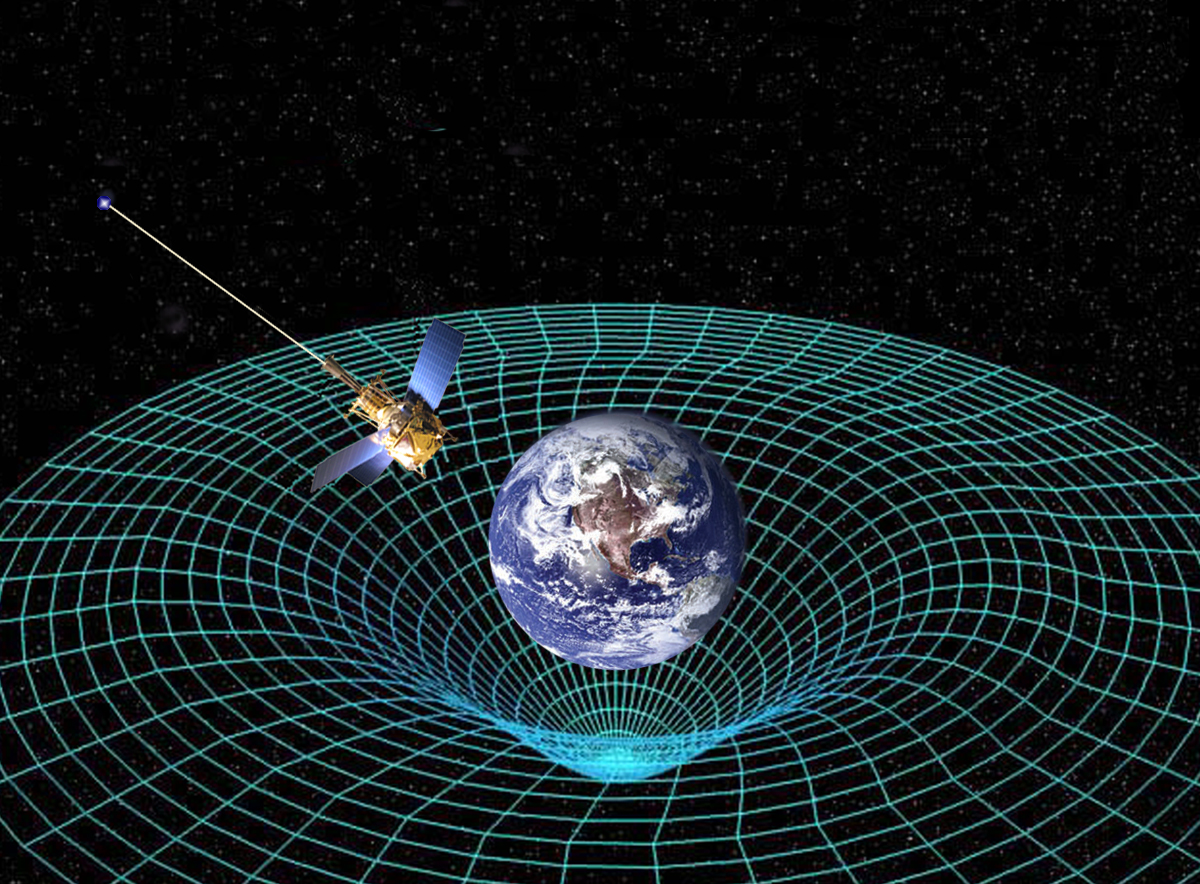
GPB_circling_earth


Gravity is the result of massive objects (any object that has mass) curving space-time and altering the paths of other objects. More massive objects alter space-time more and thus have more gravitational pull. As you can see above, Earth warps space-time and forces the satellite to travel around it. Without Earth, the satellite would be traveling in a straight line. These two paths are the same line of space-time.


Posted in Class | Tagged , , , | Comments Off on Gravity/Space-time

A terrifying gravitational encounter!

image via Wired

This is a video of astrophysicist Neil DeGrasse Tyson discussing our impending gravitational encounters with Apophis, an asteroid roughly the size of the Rose Bowl in Pasadena, CA. In this video, Neil DeGrasse Tyson explains that Apophis will come “so close to Earth that it will dip below our communication satellites” in the year 2029. Additionally, if during this pass Apophis goes through a gravitational “keyhole,” it will impact Earth in 2036. He then continues to discuss what would happen if it were to impact Earth. It should be noted that Apophis has now been determined have an extremely small chance of passing through the keyhole and impacting Earth on its second pass.


Posted in Class | Tagged , , , , | Comments Off on A terrifying gravitational encounter!

Historical Astronomers in Context

My chosen astronomer is Nicholas Copernicus. He was born in Torun, Poland (which actually was part of Germany until right before his birth) on February 19, 1473. He was born the youngest member of his family and had 3 siblings. Copernicus died on May 24, 1543 in Frauenburg, Poland at the age of 70 years old and he was still trying to convince many of his findings when he died.

Nicholas Copernicus is extremely important to Astronomy because he is considered the Father of Astronomy.  He is credited with discovering that the Sun is the center with the planets revolving around it. He stated that the further away the planet is, the longer it takes that planet to orbit the sun. He found that the moon orbits the sun and he also discovered that the stars are much further away from us than originally thought. He discovered these facts – without a telescope – because of his own questioning of the universe and his discoveries were extremely important because they set up the foundation to view the universe in a totally different way. Others that came after Copernicus validated some of his theories and corrected the ones that they found to be incorrect after obtaining better equipment.

During the course of Copernicus’ life, two major events that happened were that Columbus landed at Costa Rica on September 18, 1502 and that Hernando de Soto discovered Florida on May 30, 1540.  Columbus was the first person from Europe to land on Costa Rica and unlike some of the other places he discovered, the natives were very friendly and happy to see him. This was the very last voyage that Columbus took as he died 4 years later. Hernando de Soto was a famous explorer who helped in the conquest of Peru in 1533. He stayed at home in Spain for a number of years but after getting restless, he returned to exploring and ventured to where previous explorers had been in Cuba and Florida. His crew landed at Tampa and explored the southern part of Florida as well as Georgia and Alabama. De Soto and his crew, unlike Columbus in Costa Rica, met with angry natives.

Another historical figure during the lifetime of Copernicus was Michelangelo. On September 8, of 1504, Michelangelo revealed his massive carved sculpture titled “David”. Michelangelo was born on March 6 of 1475 and died on February 18, 1564 and was considered an innovator to the art world. The statue took 3 years to complete and because of its size and importance was placed as a focal point to the city rather than in a cathedral as originally planned. David is one of his most important pieces that he created.

My Reflections: I found it very interesting that many of the major findings were found during the period of 30 years when three of the five were alive and that the tools that they had to try and prove their hypotheses were either non-existent or archaic. The level of intelligence and questioning characters also intrigues me. I was surprised to learn that the timetable was not like I would have thought. I knew that Michelangelo and Columbus were a very long time ago but did not think of the beginning of astronomy to be that far back. As Columbus was discovering new parts of the world, Copernicus was discovering that the planets orbit the sun.

http://www.biography.com/people/nicolaus-copernicus-9256984


Posted in Historical | Tagged , , | Comments Off on Historical Astronomers in Context

The Physics of Star Systems: Kerbal Space Program

This video, via Scott Manley, shows an interesting spaceflight simulator/game known as Kerbal Space Program, which is shown in the above photo from gameSkinny.com. I’ve found this game to be incredibly useful to understanding escape velocities, gravitational encounters, and Kepler’s three laws. After getting one’s rocket (or shuttle) of the ground–no simple task–the game allows one to plan out orbits and gravitational encounters, provided you have enough thrust left in your rockets. Having spent some time with this game, I’ve grown to appreciate the difficulty that comes along with leaving a planet’s ground, and the even greater level of difficulty of fighting several gravitational pulls in order to maneuver to another object in the Kerbal star system.


Posted in Class, Physics, Universe | Tagged , , , | Comments Off on The Physics of Star Systems: Kerbal Space Program

Solar Flares cause magnetic storm on Earth

Image

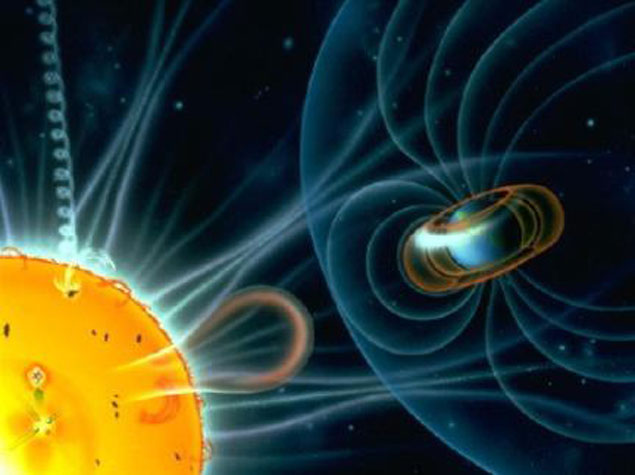
On February 16th 2014, solar flares from the sun are believed to have been strong enough to cause magnetic storms on out planet, Earth. This was due to the size of the solar flares, the flares were so long that they actually reached the Earths magnetic field around it. Namig Jalilov told APA that the storm lasted 6-7 hours and it was undetectable to the average human, “However, people with heart failure, high blood pressure diseases felt it.” He also claimed that the frequency of these events was much higher than we expected. He also makes a connection to the solar flares and earthquakes, claiming that the tides are affected by the change in magnetic behavior and thus effect the earthquakes we feel. See here for more on this idea.

Source


Posted in Class, Sun | Tagged , , | Comments Off on Solar Flares cause magnetic storm on Earth

Telescopes and Technology

Pictured above is an artists rendition of the James Webb telescope, a feat of modern technology that is to become the successor to the famous Hubble Telescope currently in orbit. While the Hubble was designed to observe relatively close astronomical phenomena, the JWST will be able to see much further. While at first this fact may seem irrelevant, one must consider that, because space is constantly expanding,  we are in a constant race against the clock in order to continue our observations. To put more simply, we on earth need to continue to advance technologically in order to continue to observe phenomena that in the past was more easily observable. Scientists predict that the new telescope will be able to see light that was emitted roughly 12 billion years ago. I find it incredibly interesting to think that our advancements forward in technology can give us such a great look backwards into the universe’s past.

Additional Information


Posted in Instruments | Tagged , , | Comments Off on Telescopes and Technology

Making waves

For many years, the understanding is that the shift in tectonic plates, creating an earthquake, was the first step to the earthquake, tidal wave, volcano pattern. As seen in this video: tidal waves. However, recent studies from Science Magazine, suggest that the tidal waves themselves may be more of the cause than they are the effects. As Kasahara suggests, “Several recent studies provide evidence that tidal forces influence earthquakes associated with volcanic activity”. This discovery has shaken the geophysics world and will lead to more interesting discoveries in the future.


Posted in Class | Tagged , , , | Comments Off on Making waves

Our Bodies on Mars

I discovered an interesting article from the magazine Wired about the importance of gravity when it comes to our bodies’ ability to function. It specifically discussed the challenges of colonizing Mars in regards to gravity. Of course before we can think about the challenges of living on Mars we would have to overcome the challenges of actually getting there and setting up a colony. Many interesting issue arise when we skip this issue and go straight to the living on Mars. Our bodies have evolved over astronomical amounts of time to be perfectly fitted to the gravitational force on Earth. Our muscles would deteriorate on Mars because we would have to fight against a weaker force of gravity. Our heart, a muscle, has been fighting against the same force of gravity when pumping blood through our bodies forever, but on Mars it would be fighting a weaker force. As a result, our body would start to be out of shape and we would become “coach potatoes.” Another interesting thing to consider is that our sense of balance relies heavily on our Earth’s gravitational force. On Mar’s we would constantly feel disoriented and dizzy. There are many more issues that arise like deterioration of the immune system, red blood cell count reduction, and insomnia. It is incredibly difficult to leave our planet, but even if we could leave our bodies might not be too happy to be away from home.


Posted in Class, Space Travel | Tagged , , , | Comments Off on Our Bodies on Mars

Unenergized Bunny

Image

After only a few months on the lunar surface, the Chinese Jade Rabbit rover has malfunctioned. This represents a major setback for China’s young space agency and demonstrates how difficult extraterrestrial missions are. It really is amazing that the Cold War of the ’50s, ’60s, and ’70s was able to produce such amazing progress on the part of the US and USSR, though both of these nations suffered setbacks themselves.We should hope that the failure of the Jade Rabbit does not discourage the PRC, but instead pushes them to continue to strive to advance our knowledge of the solar system.

http://www.theverge.com/2014/2/12/5404378/jade-rabbit-yutu-china-moon-rover-fails-after-malfunction


Posted in Class | Tagged , , | Comments Off on Unenergized Bunny

Telescope Stuff

We’ve all had the urge. The urge to buy a camper, drive and drive till civilization disappears, and finally, under the starlit sky, to use the six foot telescope located in the back of the camper. Check it out.

I'm gonna zoom in on Jupiter. Here, hold my beer.
I’m gonna zoom in on Jupiter. Here, hold my beer.

Picture

That is how Man was meant to gaze at the stars. With a telescope lens in one hand and a beer in the other, in the back of a camper just off I-40 somewhere between Little Rock and Memphis.
Now, if you really want to know a thing or two about telescopes, here’s the some info – Telescopes can be homemade or cost you thousands of dollars. The Hubble Telescope costs about two and a half billion dollars (and you can’t even tow it behind your F-150!).  As cool as Hubble is, scientists are planning to launch a new telescope in 2018 called the James Webb Space Telescope. JWST’s primary mirror is going to be about four times as big as Hubble’s (21 feet). Telescope enthusiasts are excited about that, but I wonder, what’s next in camper-telescoping?


Posted in Instruments | Tagged , | Comments Off on Telescope Stuff