The Largest Telescope in the World

The Arecibo Radio Telescope

The Arecibo Radio Telescope

Larger telescopes allow for better angular resolution, which allows for us to discern between two light producing objects that are close together.  Therefore, telescopes are ever increasing in size to get better and better images.  Beating out telescopes called “Very Large Telescope” and “South African Large Telescope”, the Arecibo Radio Telescope in Puerto Rico is the largest single telescope in the world with a 304 meter diameter.  Due to the long wavelengths of radio waves, all radio telescopes must be large.  Radio waves are also one of the only forms of light that can be easily observed from the ground, so radio telescopes are useful in observing the universe even on Earth’s surface.  However, humans use radio signals to transmit information, so radio pollution drowns out cosmic radio waves.  Eventually, a radio telescope could be built on the far side of the moon to block out the radio pollution from Earth.


Posted in Class, Instruments, Light | Tagged , , , | Comments Off on The Largest Telescope in the World

The Beauty of Science and the Firewall Paradox

Image


Image from this site. For more information on the conventional view of black holes, read the hyperlinked article.

“Einstein was wrong.”

Of course he wasn’t wrong about everything, and to many it may seem like he was only wrong over a minor point. And to most, like myself, it may seem obvious to conclude that since humans are not perfect, and since Einstein was a human too, Einstein made mistakes. Oftentimes we find it very hard to contradict the people we look up to, especially if we regard them as heroes, and it still hurts to admit that someone you regard as a perfect hero in your mind was wrong.

However, if science has shown us anything, it is that humility is of the utmost importance in the pursuit of truth. It has long been believed that anything that goes into a black hole vanishes with no chance of coming back, but recently, Stephen Hawking showed that things that are sucked into a black hole aren’t necessarily transported to a point of no return (the phenomenon is termed “Hawking radiation“). Black holes can sometimes spew out particles, which brings us to the paradox that many claim proves that Einstein’s theory of general relativity, when applied to the realm of black holes, doesn’t add up. According to general relativity, when an object enters the event horizon of a black hole, it simply vanishes from existence without much drama. As shown by the recent findings however, if particles can be spewed back out of a black hole, there must be quite a bit of commotion going on inside that singularity. These raging inferno in these black holes are termed a “firewalls”, and thus creates the “firewall” paradox of black holes.

This finding also demonstrates the beauty of science – it is by nature a humiliating field, and not at all in a bad way. This is why science is stressed so much in free countries, since through science we can find universal truths. Science is not dictated by the whims of the rulers of any land, or by any gender, or class, or ethnicity. Science is informing the public about misconceptions so that we can be freed from ignorance that can become shackles when used by manipulators. Science is a machine, powered by the millions of people working on guiding the machine towards the truth – a machine that doesn’t care about who discovered what, or which person’s discoveries it proved wrong. True scientific work humbles all those who devote their lives to it. Einstein would be proud to know that he was proved wrong, as long as it meant we were one step closer to the truth.


Posted in Science | Tagged , , , , , | Comments Off on The Beauty of Science and the Firewall Paradox

Mass, Space-Time, and Light

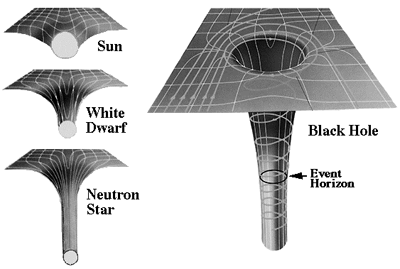
Mass, as we know, bends space-time. Examples of such bending (in 2 dimensions for ease of comprehension) can be seen here for our sun, a white dwarf, a neutron star, and a black hole. A good question was asked recently, and I would like to clear up some misconceptions. The question, which was very insightful, was “does the light speed up as it goes down into the gravity well?” So here’s why that is a reasonable question. If, when a satellite approaches the parent planet in an orbit, the satellite speeds up, shouldn’t light do the same? Well, the difference is the fact that light does NOT have mass. Because of the nature of light (the self-propagating fluctuation in electric and magnetic field), it is constrained to follow the bending of space-time. But that does NOT mean the light “speeds up” on its approach towards a massive body and “slows down” on its way out of the gravity well. THE SPEED OF LIGHT IS A CONSTANT IN ANY REFERENCE FRAME ALWAYS AND FOREVER (as far as our current understanding of physics dictates). So, if you ever find yourself in a situation where you’re about to ask a question about light speed changing, remember: it’s 3*10^8 m/s and it will not ever be a number other than that.


Posted in Class | Tagged , , | Comments Off on Mass, Space-Time, and Light

Light in the Universe

The light spectrum

The Light Spectrum

Light is a very meaningful aspect of the universe that allowed us to make the observations about space that we have made so far.  The light that stars produce allows us to determine many things about them.  Their absorption line spectra allow us to determine their composition and the Doppler effect allows us to determine their movement toward or away from us and their relative speed.  The light spectrum is far more than the visible colors that we see.  Radio waves and X-rays are also just forms of light that travel just as fast as the light that we see.  Humans have found out ways to encode information into light waves in order to transmit that information. Radios in our cars utilize light in the form of radio waves to transmit music across long distances.  TVs with antennas also use similar technology.   The first radio broadcast strong enough to leave the planet was in 1936 when Hitler was introducing the Summer Olympics in Berlin.  Because light travels one light-year every year, that broadcast will have traveled 78 light-years away and any planet within that vicinity will have been able to hear his speech.


Posted in Class, Light | Tagged , , | Comments Off on Light in the Universe

Travel Inside a Black Hole

Although we usually think of black holes as extremely massive objects, anything in the universe with mass can theoretically become a black hole. As this video discusses, it is mathematically possible for a black hole to form with the mass of the earth, or even Mount Everest. However, the object’s Schwarzschild radius, the size it would need to be compressed to in order to become a black hole, would be incredibly small. For instance, the earth would need to be compressed to the size of a peanut in order to become a black hole.

The video covers many other fascinating physical anomalies such as photon spheres. A photon sphere is the distance from a black hole where photons can achieve a stable orbit. They aren’t sucked in to the black hole, yet they also can’t escape it. The video mentions that theoretically, if you could stand in the photon sphere, you could actually see the back of your own head in front of you, as the photons that reflected off of it would travel around the black hole and into your eyes. Overall, this video gives insight into some of the lesser-known effects of black holes and does so in a digestible way. I definitely recommend that anyone interested in black holes, or astronomy as a whole, take a look at it.


Posted in Light, Physics | Tagged , , | Comments Off on Travel Inside a Black Hole

Hip-stars Wobble Too!

So one of the things I think is cute about the universe we live in is that even in the most vastness you rarely find things alone.

f224_plush_planets_inhandsaturntaylor-swift-boyfriends

And these kindred stellar bodies don’t just ignore each other. Oh no, they get caught up in each other’s gravity. And it is this fun and nifty relation that allows us to better tell what kind of shenanigans they’re getting up to up there in space. Namely, using a phenomenon called the Doppler Shift. In case you are unclear on how that works, here is a neat video I found that I think does a really good job of explaining!

Basically what happens is that when a star moves towards us, the light waves emitted catch up to each other, and the frequency appears to have increased, but when it’s moved away, the crests between waves get farther apart and the frequency appears to have decreased. And we can use this Doppler Shift to tell when stars are moving towards and away from us.

There are also more applications than just to knowing apparently nothing wants to be near us, though! And by way of introduction I have yet another neat video!

http://www.youtube.com/watch?v=iIxMzjaaZmQ

This one gives a demonstration of how stars that orbit a common center of mass (from being pulled by gravity!) appear to be wobbling! A star that was all by its lonesome would not have this unique appearance of motion, and so this allows us to detect when a star has a buddy!


Posted in Class, Stars | Tagged , , , , | Comments Off on Hip-stars Wobble Too!

Why is gravity so weak?

Gravity
This picture shows how gravity affects the fabric of space-time.

Gravity is a fundamental force that holds together our solar system, our galaxy, and every person to Earth. It must be pretty strong to hold something as massive as Jupiter in orbit right? Actually, compared to the three other fundamental forces, gravity is unimaginably weak. To demonstrate this, use a common refrigerator magnet to pick up a paperclip. That 3 inch magnet just overcame the gravitational force of the entire Earth. Remarkable!

How strong is gravity compared to the other fundamental forces? To make a real comparison, we can evaluate the gravitational and the electrical force among, say, 2 electrons separated by a distance of 1 meter:
Gravitational force:         ≈    7*10-71 N
Electric force:                      ≈ 2.5*10-28 N

The gravitation force here is 42 orders of magnitude weaker than the electric force between the two electrons. In general, the table below shows the relative strength of each of the forces:

Forces
This table shows the relative strengths of the four fundamental forces.

One of the largest mysteries is science is how to unify the gravitational force with the other forces. Scientists “know” that all four forces must be related, but have thus far been unable to show it through equations. This theory is Unified Field Theory, and will combine the four forces into a single equation.  Crafting this theory will go a long way in finding what is called the Theory of Everything.


Posted in Physics | Tagged , , | Comments Off on Why is gravity so weak?

The Celestial Compass

For millennia, humans have known that the movements of certain celestial objects repeat in a predictable pattern, and for millennia humans have mapped the movements of stars and other objects in the heavens and tried to make predictions about the cycles for these objects.  Most humans probably didn’t care about what might be up in the heavens, what really made the planets move, or whether or not the solar system rotated around the Sun or the Earth.  What most people did care about while observing the heavens in  were the effects that these cycles had on their lives, namely the seasons and for navigational use.  Celestial observations were extremely helpful for navigation, whether on land or on sea, since the patterns of many celestial objects were very predictable and by observing these, a traveller could calculate where he or she was currently headed and where they should go.

One of the most famous celestial navigation tricks, and perhaps one of the most useful, is looking for the North Star.  The North Star, or Polaris, is a star in the night sky that points North, so if you follow that star, you can easily get your bearings straight if lost or momentarily disoriented.  By observing where the North Star is, one could easily figure out which way is North, South, East, and West, making it far easier to follow a map without a compass.  The North Star points North because it is situated close to the Earth’s tilt axis.  The Earth is slightly tilted, and the Earth’s North Pole points towards this star.  Since the Earth rotates on this axis, Polaris is relatively stationary throughout the whole night, all year long, making it a dependable celestial compass.

However, Polaris will not always be the North Star!  The Earth slowly wobbles in its orbit around the Sun, causing the axis of the Earth to point to a different location over time.  At around the year 3,000 a.d., Polaris will no longer be the North Star due to this phenomenon, known as precession.  Earth’s precession cycle is approximately 26,000 years, meaning the Earth’s axis will point to exactly the same direction again every 26,000 years.  Another mistake that many people make while trying to locate and follow the North Star is to look for the brightest star in the sky, but Polaris is nowhere near as bright as some of the other stars in the night sky.

This image from another interesting and very informative astronomy blog illustrates the precession of Earth quite well:

Image


Posted in Stars | Tagged , , , , | Comments Off on The Celestial Compass

Gravitation and the theory of everything

Over the last several class periods, we have talked a lot about the force of gravitation. Incidentally, gravitation is considered one of the four fundamental forces of nature, along with weak force, strong force, and electromagnetic force. Interestingly, though, gravitation is the only one of these that is explained by a separate theory—the general theory of relativity—than the other three, which are covered in the theory of quantum mechanics.

Spacetime curvature

A diagram simulating the curvature of spacetime around a massive object, from Wikipedia.

Because this apparent inconsistency is frustrating and probably an indication that the theories are incomplete, scientists have put some effort into developing a “theory of everything“, i.e. a singular theoretical framework of physics that would explain all of these forces together. Since about the 1960s, string theory has been developed, and it naturally explains all four fundamental fources within one framework. It has become the most likely contender for an accepted theory of everything.


Posted in Class, Physics, Science, Universe | Tagged , , , | Comments Off on Gravitation and the theory of everything

The Invention of the Telescope

The telescope was most likely invented in 1608 by a German eyeglass maker named Hans Lippershey, although there is some uncertainty. Another eyeglass maker from the Netherlands, named Jacob Metius, filed for a patent soon after Lippershey and a third man, named Sacharias Janssen, later claimed to be the creator.  Despite these claims, Lippershey is usually credited with its invention because his patent application is dated the earliest.

The first telescopes were able to magnify objects 3 times and made from a combination of curved lenses at the end of a tube. Soon after it’s invention, Galileo heard about the telescope and constructed his own. He made many improvements, including increasing its magnification to up to 30 times. He was the first person to use it to look at the sky and discovered craters on the Moon, the light that is the Milky Way, sunspots, and Jupiter’s Moons. These observations eventually helped him figure out that the Earth orbits the Sun.


Posted in Class, Instruments | Tagged , , | Comments Off on The Invention of the Telescope