Tides

Many people know that tides rise and fall as a result of the Moon, but often times people are unaware that the Sun also exerts a tidal force on the Earth. Tides are caused by gravitational force, which depends on the mass of the objects pulling on each other and the distance between them. The moon’s tidal force on Earth is a result of the difference between the gravitational force from the Moon to the near side of Earth and the gravitational force from the Moon to the far side of Earth.  This difference creates the tidal force, which caused the whole Earth to behave like a rubber band and stretch to form two bulges (towards and away from the Moon). This means that the part of Earth facing the Moon and the part of Earth facing away from the Moon, experience high tide at the same time. I always assumed that high tide came only when the Moon was out, but this explains why there are two high tides and two low tides per day.

Although these bulges explain daily tides, they do not explain why there is a larger tidal range around New Moons and Full Moons. This is because during those Moon phases the Sun, Earth, and Moon are in a line. The Sun does exert a tidal force on Earth, but it is not as strong as the Moon’s tidal force. The difference between the gravitation force that the Sun exerts on the far side and near side of Earth is very small. This means that the Sun’s tidal force on the Earth is less noticeable on a daily basis, but it is still significant when the Sun and Moon’s tidal forces work together or work against each other. The result of this is spring tides and neap tides.

Spring tides are very high tides or very low tides that happen around Full Moons and New Moons. During these tides the tidal force of the Moon and Sun work together and pull on the Earth in the same direction. During spring tides, there has been a recorded tidal range of up to 16 meters! Neap tides occur around the quarter Moons when the Sun and Moon are at a 90° angle from each other, and therefore pull on different sides of the Earth creating less range between high and low tides.


Posted in Class, Moons, Sun | Tagged , , | Comments Off on Tides

Hubble Space Telescope

The Hubble Space Telescope was launched in 1990 and is still in service today. Just as Galileo’s first telescope opened the door to a new world beyond what the naked eyes can see, the Hubble Space Telescope broke through heaven’s gates and showed us a world beyond the boundaries of space-time, capturing even images of the early universe, famously known as the Hubble Extreme Deep Field.

Placing a telescope in space was completely necessary to avoid the atmospheric effects unavoidable by ground based telescopes. The main problems are light pollution and atmospheric turbulence. The Earth’s atmosphere also blocks out most UV rays, limiting observations to visible light and low energy rays.

Hubble is capable of observing visible, infrared and UV light, and reproducing the images in extremely high resolutions. It has made close to a million observations since its launch and the data it collected had contributed to more than 8700 scientific papers. This makes Hubble one of the most productive scientific instruments ever built.


Posted in Instruments | Tagged , , , | Comments Off on Hubble Space Telescope

Constantly Falling

Contrary to popular belief, there is gravity in space, in fact gravity is everywhere. On the International Space Station, there is as much gravitational force as it is on Earth’s surface.

But then… why are those astronauts (in the video) merrily floating around?

Not to ruin the party or anything, but they are not floating around, they are just constantly falling towards Earth, but they keep missing the ground. The diagram below should clarify things a bit:

With enough starting horizontal velocity, you could fall and miss the Earth every time, and this is actually how things get into orbit.

This constant state of free falling (weightlessness) is often mistaken for zero gravity, when gravity is actually never zero. Even across distances of a hundred thousand light years, gravity is still effective, which is why all the stars in the Milky Way orbit the center of the galaxy.


Posted in General, Physics | Tagged , , | Comments Off on Constantly Falling

Where Can You See Stars in the 4th Largest City?

The  Houston Museum of Natural Science  is home to the Burke Baker Planetarium.

The Houston Museum of Natural Science is home to the Burke Baker Planetarium.

In the heart of the museum district in Houston, Texas, there is the Houston Museum of Natural Science.  Besides a football field size paleontology hall, IMAX screen and butterfly center, HMNS hosts the Burke Baker Planetarium.  The planetarium also is used to train astronauts to help them be able to identify stars. In addition to regular star shows, the planetarium shows movies such as “Stars of the Pharaohs” and “Black Holes.”  The movies focus on various aspects of the cosmos and their relevance to science and museum exhibits.  This summer, a new Egypt hall opened in the museum, so the “Stars of the Pharaohs” movie was interesting and relevant to the new exhibit.  The movie focused on the Egyptian religion and how the ancient Egyptians used and depicted the heavens in their art.  The planetarium works hard to be relevant and interesting beyond the normal star shows.  The star shows are about 30-45 minutes long and the current night sky is projected onto the dome and all the constellations are explained.  Overall, the planetarium at the Houston Museum of Natural Science is a great place to visit to learn about the stars in a big city where most stars cannot be seen due to all the light pollution.

Outside the city there is the George Observatory in Brazos Bend State Park.  The observatory is connected to the museum and you can visit 3 domed telescopes.  The Gueymard Telescope, the largest telescope in the USA that you can look into that is dedicated to public education.  It is currently going under renovations for the 25th anniversary of the George Observatory.


Posted in Observables, Science, Stars | Tagged , , , , , , | Comments Off on Where Can You See Stars in the 4th Largest City?

The Earth and Rubber Bands

So I found this neat video, curtesy of YouTube that helped me understand tides a little better. What confused me most – and I’m sure I’m not the only one for whom this is true – is that the Moon’s gravitational pull on the Earth causes tides on both sides of the Earth. One thing that helped me to visualize what was happening was to think about the earth before I thought about the water on it.

Now, the Moon is close to the Earth, which means that according to Newton’s Law of Gravitation, it pulls really hard on the Earth. And the Earth isn’t just this completely unmoving rigid object that remains unaffected! No, no. The Earth is totally affected and gets pulled by the Moon. Keep in mind, though, that the Moon is not the only thing interacting with Earth in this situation, so it’s not going to suddenly zoom towards the Moon. Instead, it gets stretched. VERY important to remember is that there is a difference in gravitational pull on the side closest to the Moon and the farthest. It’s like if you can imagine a rubber band, when you pull on one side and keep the other still, you don’t just stretch one side – you actually stretch the entire thing! – same as what’s happening to the Earth. Both sides end up stretched, and a bulge shows up in both directions in the plane of the Moon. (Here are some good pictures of what that looks like, along with some more detailed explanations!)

Stretching a Rubber Band on "one side".

Stretching a Rubber Band on “one side”.

So then the tides are a consequence of this stretching of the Earth. Now we can’t really see the earth itself stretching – I know I’ve never seen the mountains heighten themselves to reach for the moon – but as you’ll remember, there are entire oceans sitting on top of Earth, and they can certainly move around. As the Earth bulges, the water is raised, and so we get the tides on both sides.


Posted in Class | Tagged , , , , | Comments Off on The Earth and Rubber Bands

The Highest Tides in the Bay of Fundy

This picture, taken in 1972 shows the  Bay of Fundy  at low and at high tide.

This picture, taken in 1972 shows the Bay of Fundy at low and at high tide.

Tides are created by the Moon’s gravitational pull on the Earth.  While the Sun also pulls on the Earth, it is so far away that the tides are not as affected by the Sun as they are by the Moon.  The tidal force is created by the difference in gravitational pull on each side of the Earth.  In Nova Scotia, the world’s highest tides take place every day.  The Bay of Fundy has 14 million tons of seawater enter it during high tides!  Because of this immense amount of water entering the bay, the land actually tilts under all the weight.  The seawater is pushed into the bay at high tide, and because the bay is so skinny, the volume of water is concentrated and causes very high tides.  There is also a tidal bore at the Bay of Fundy.  A tidal bore is a wave that marks the coming of the high tide.  While there is not always a tidal bore, when there is one, it is easily seen from a viewing station at the Fundy Tidal Interpretive Centre.  Besides the high tides that bring the Bay of Fundy to fame, there is also impressive whale watching in the bay.  There are many minke whales to see.  There are seven species of whale that can be found in the Bay of Fundy.  The Bay of Fundy has many natural wonders for visitors to see and experience, all because of the high tides!


Posted in Science | Tagged , , , , , | Comments Off on The Highest Tides in the Bay of Fundy

Supermassive Black Hole at the Center of Our Galaxy

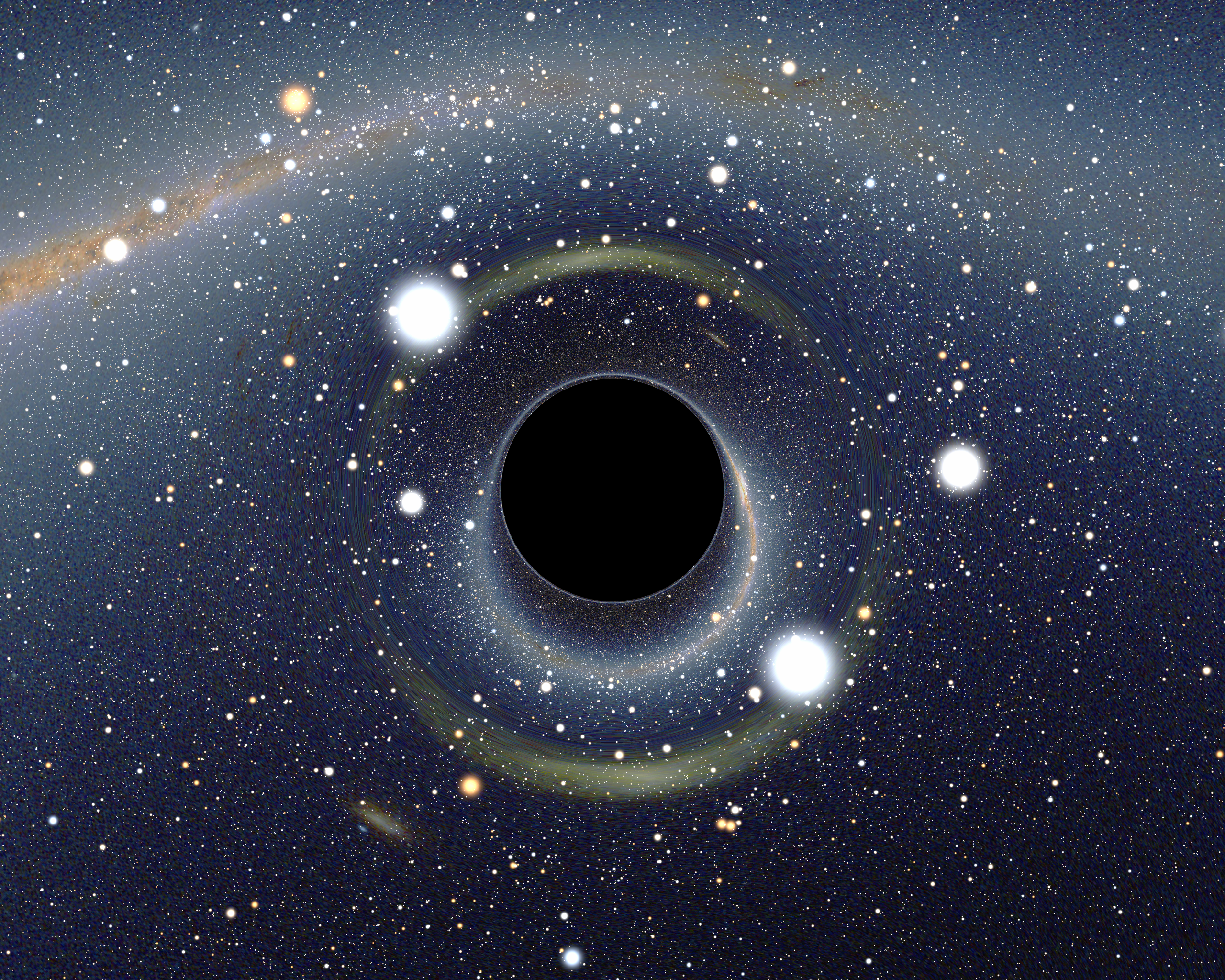
Sitting at the center of our galaxy, a supermassive black hole weighing four million times the weight of our sun waits. After the class discussion on black holes, I began investigating local black holes, and discovered that there is a gigantic black hole in our very own milky galaxy. Scientists first located this black hole by noticing strange things at the center of our galaxy. What they noticed was that approximately a dozen stars are orbiting some invisible object and moving at incredibly fast speeds. A specific star at the center of our galaxy was clocked in at moving 3,000 miles a second, in comparison, our sun is moving 137 miles per second. Such incredible speeds suggest a supremely powerful gravitational force of a massive object-i.e. a supermassive black hole. Additionally the black hole is moving at .62 miles per second, which is impressively slow and indicates that it is especially huge because if it wasn’t, it would be affected by other gravitational pulls and move faster.

And this black hole, known as Sagittarius A, is about to gobble a large gas cloud. In the next couple of months, the gas cloud will begin to interact with the black hole and NASA’s Swift satellite is ready to document the event. Such an event is rare to see so close, so scientists are eagerly waiting for Sagittarius to interact with the cloud. They anticipate that the black hole will let of a very bright x-ray flare, which Swift will pick up.


Posted in Class | Tagged , , | Comments Off on Supermassive Black Hole at the Center of Our Galaxy

Alcubierre Warp Drive

Alcubierre Warp Drive

Image Source

Physicists and astronomers today are confident that the age of our universe is about 13.8 billion years. However, they are also confident that our universe is much bigger than 13.8 billion light years. But how can this be if nothing in our universe can travel faster than the speed of light? The fact of the matter is that during the early moments of the creation of our universe there was a period known as ‘inflation’. It is during this time that the fabric of space itself expanded faster than the speed of light, accounting for a universe currently larger than 13.8 billion light years.

This shows the unpredictable and unlawful nature of spacetime, opening doors to several mind-bending possibilities. Of these is a theory put forth by a Mexican physicist, Miguel Alcubierre. Alcubierre formed a theory stemming from inflation, allowing objects themselves to travel beyond the speed of light by means of spacetime. His theory is known as the Alcubierre Warp Drive, and states that an object can travel vast distances in a short period of time by means of spacetime warping. In particular, the spacetime behind the object expands while the spactime ahead of the object contracts. The object is essentially riding a wave of spacetime, accelerating to great speeds.


Posted in Physics | Tagged , , | Comments Off on Alcubierre Warp Drive

World’s Largest Telescope To Expand Our Horizons

World's Largest Telescope To Expand Our Horizons

Image and Information Source

Currently, the largest telescope in the world is the Gran Telescopio Canarias, which has an aperture size of about 10.4 meters. However, plans to build an even larger telescope were recently approved. This new telescope will be built at the summit of Hawaii’s Mauna Kea volcano, and will cost an alarming $1 billion to create. Accompanying such a large cost, however, is an aperture size of almost 30 meters, allowing astronomers to see 13 billion light years away. This is less than a billion light year short of the entire observable universe. Because of these vast distances at which the telescope will cover, much of the light from those distances has yet to reach us. It is for this reason that astronomers will be able to see into some of the relatively earlier years of our universe. Peering into the past of our universe can provide astronomers with some of the information they need to answer many of the big questions in the field today. For instance, astronomers may further their understanding of the formation of our universe with the use of such a telescope. We may even discover entirely new things as a result of this development; the possibilities are boundless.


Posted in Instruments | Tagged , , | Comments Off on World’s Largest Telescope To Expand Our Horizons

My New Favorite Insult

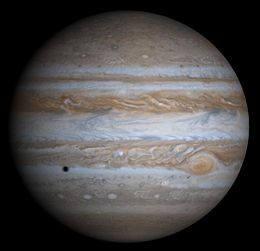
Your mother has a greater tidal force than Jupiter! HA!

Yes, I just said that your mother has more of an effect on Earth’s tides than does the largest planet in the solar system. On the surface, this might seem like a statement implying that you have a very massive mother. While this may or may not actually be the case, I decided to check the numbers on it to determine if there could possibly be any validity to the statement.

First, there are several measurements we will need: the mass of the Earth, the mass of Jupiter, the mass of a typical human (since on an astronomical scale we all basically have the same mass), the distance from Earth to Jupiter (I’ll use the shortest distance, in hopes of fully removing doubt), and the radius of Earth.

Now, the way to calculate tidal force is to find the difference in gravitational force at opposite sides of Earth. So, we will use the equation for Gravitational force G * [(m1 * m2)/(d^2)] to find the force between Jupiter and the near side of Earth (or the distance between them minus Earth’s radius) and the far side of Earth (distance plus Earth’s radius). The same calculation will be made for your mother, with her height being distance from near side and the diameter of Earth being distance to the far side. Below are the measurements that I used for my calculations (done in Excel):

Mass of Earth 5.972E+24
Mass of Jupiter 1.898E+27
Mass of your mother 60
Distance from Earth to Jupiter 5.88E+11
Distance from Earth to mother 6.37E+06
Gravitational Constant 6.67E-11

Numbers for mass are in kg, Distance in meters

By completing the calculations for the Gravitational force at the near side and far side and taking the difference, we can find the tidal force for each of these bodies. I did these calculations in Excel, so feel free to check my work if you wish.

And now, for the result (the units for this will be [(kg * m)/(s^2)], in case it’s bothering anyone):

Jupiter-Earth Tidal Force: 9.47714E+13
Earth-Mother Tidal Force: 5.97499E+15

As we can see, your mother actually does have a larger tidal force on Earth than Jupiter does. However, it is not because she is particularly massive. Jupiter is simply so far away from Earth, even at its closest point, that it does not have a tremendous effect on Earth’s tides. The effect that the Moon and Sun have far outweigh the effects of everything else, including your mother. However, I think I’ll keep using this as an insult until someone realizes that it is merely a statement of astronomical fact.


Posted in Class | Tagged , , | Comments Off on My New Favorite Insult