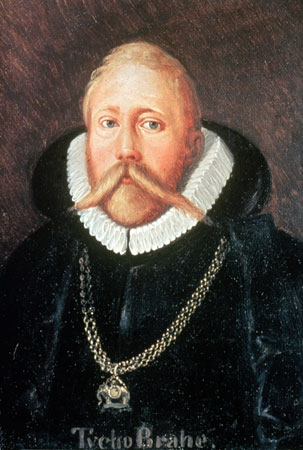
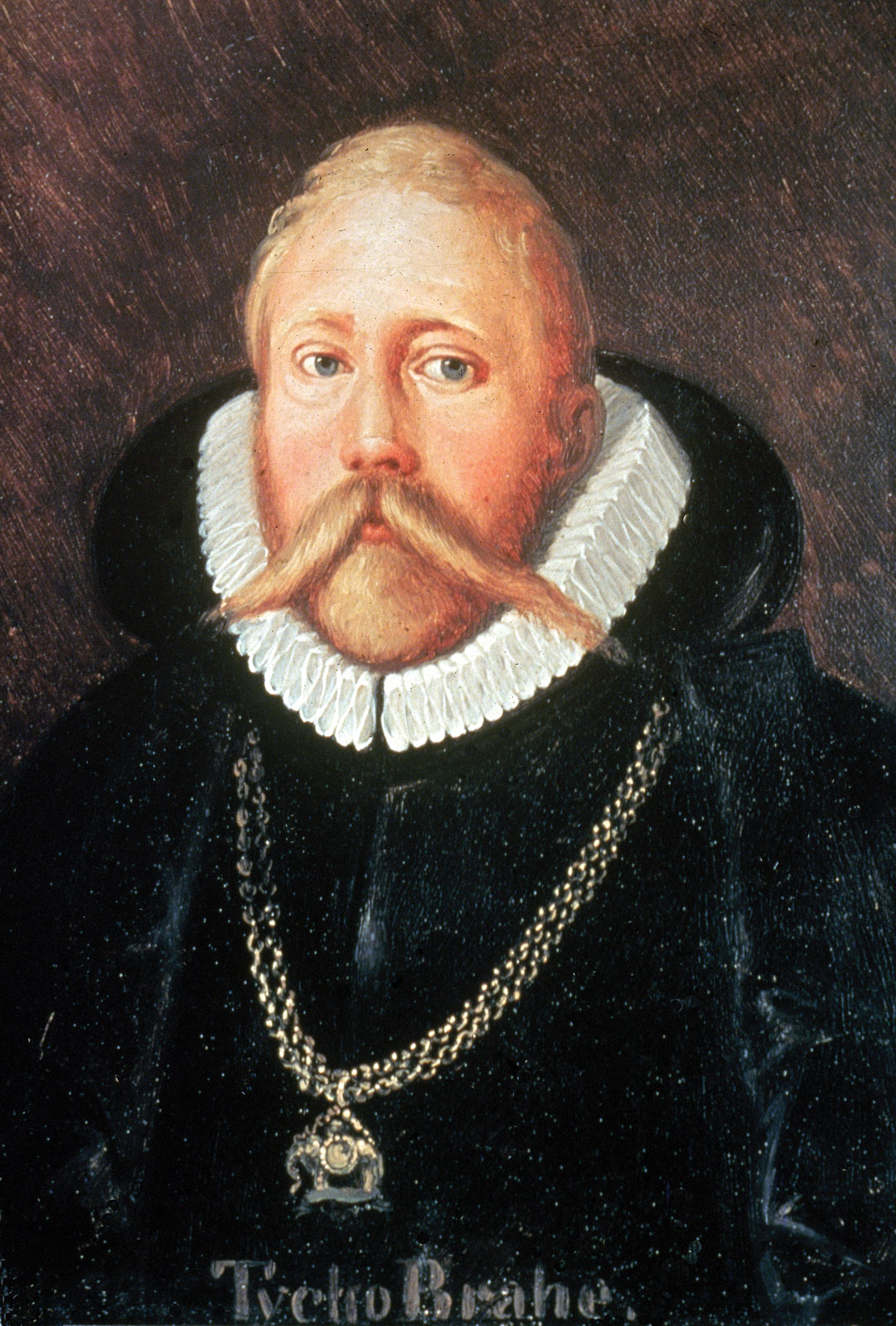
Tycho Brahe (12/14/1546 – 10/24/1601) was a Swedish noble whose interest in astronomy was aroused during his years of higher education. With his money he was able to build a state-of-the-art observatory as well as many different instruments that enabled him to revolutionize instrumentation and observational habits, as well as record some of the most accurate observations of astronomical oddities that Johannes Kepler and other astronomers would be able to use to reform the field of astronomy.
During his lifetime, two major events that happened were that the Gregorian Calendar was implemented in 1582, and Sir Walter Raleigh sponsored the first (although failed) English Colony in the New World.
- The change of the calendar, named after Pope Gregory XIII, came about due to the drift of the Christian holidays, specifically Easter, from the seasons they were biblically tied to, and so the Italian scientist and philosopher Luigi Lilio made adjustments from the Julian calendar that created a new set of rules for calculating Leap Years and dropped a few days that in all decreased the inaccuracy of the Julian calendar with astronomical cycles.
- Sir Walter Raleigh was a well-connected and well-educated explorer who came into the favor of Queen Elizabeth I. His expeditions to America intrigued him and so he sponsored the first colony of Roanoke there in what is now North Carolina.
As mentioned above, another historical figure who lived during the same time as Tycho was Queen Elizabeth I (9/7/1533 – 3/24/1603). The daughter of King Henry VIII who separated from the Catholic church in order to obtain a divorce, Queen Elizabeth I established the Protestant church as the primary church, making it the official Church of England. As an unmarried woman, her successor was a great source of tension between those who would wish to see a Catholic take the throne, and those who liked her.
Putting the historical figures in order along with context helps to see how quickly the world changed in such a relatively short time, it also shows what kind of conditions the astronomers had to work under, with tensions already high between the state and the Church. And so for them to be making all these discoveries, while the Church is already struggling for a foothold and not looking to lose any ground could be considered brave.