Secondary use of radiological imaging data: Vanderbilt’s ImageVU approach
David S. Smith, Karthik Ramadass, Laura Jones, Jennifer Morse, Daniel Fabbri, Joseph R. Coco, Shunxing Bao, Melissa Basford, Peter J. Embi, Reed A. Omary, John C. Gore, Jill M. Pulley, Bennett A. Landman. Secondary use of radiological imaging data: Vanderbilt’s ImageVU approach. J Biomed Inform. 2025 Oct;170:104905. doi: 10.1016/j.jbi.2025.104905. Epub 2025 Sep 10. PMID: 40939950.
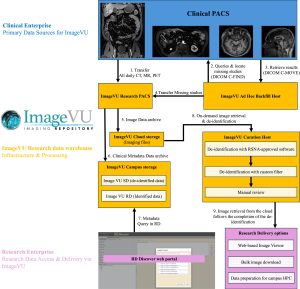
Objective: To develop ImageVU, a scalable research imaging infrastructure that integrates clinical imaging data with metadata-driven cohort discovery, enabling secure, efficient, and regulatory-compliant access to imaging for secondary and opportunistic research use. This manuscript presents a detailed description of ImageVU’s key components and lessons learned to assist other institutions in developing similar research imaging services and infrastructure.
Methods: ImageVU was designed to support the secondary use of radiological imaging data through a dedicated research imaging store. The system comprises four interconnected components: a Research PACS, an Ad Hoc Backfill Host, Cloud Storage System, and a De-Identification System. Imaging metadata are extracted and stored in the Research Derivative (RD), an identified clinical data repository, and the Synthetic Derivative (SD), a de-identified research data repository, with access facilitated through the RD Discover web portal. Researchers interact with the system via structured metadata queries and multiple data delivery options, including web-based viewing, bulk downloads, and dataset preparation for high-performance computing environments.
Results: The integration of metadata-driven search capabilities has streamlined cohort discovery and improved imaging data accessibility. As of December 2024, ImageVU has processed 12.9 million MRI and CT series from 1.36 million studies across 453,403 patients. The system has supported 75 project requests, delivering over 50 TB of imaging data to 55 investigators, leading to 66 published research papers.
Conclusion: ImageVU demonstrates a scalable and efficient approach for integrating clinical imaging into research workflows. By combining institutional data infrastructure with cloud-based storage and metadata-driven cohort identification, the platform enables secure and compliant access to imaging for translational research.