Anatomy-Guided Multi-Path CycleGAN for Lung CT Kernel Harmonization
Aravind Krishnan, Thomas Li, Lucas Walker Remedios, Kaiwen Xu, Lianrui Zuo, Kim L Sandler, Fabien Maldonado, Bennett Allan Landman, MIDL 2025, Link to paper: https://openreview.net/pdf?id=w3p7GddsQ8
Abstract
Accurate quantitative measurement in lung computed tomography (CT) imaging often re-
lies on consistent kernel reconstruction across scanners and manufacturers. Harmonization
can reduce measurement variability caused by heterogeneous reconstruction kernels; how-
ever, harmonization across different manufacturers and scanners remains challenging due
to significant differences in reconstruction protocol and positional alignment of subjects,
often resulting in anatomical hallucinations. To address this, we propose a multi-path cy-
cleGAN framework that incorporates multi-region anatomical labels and a tissue statistic
loss as anatomical regularization to preserve structural integrity during harmonization. We
trained our model on 100 scans each of four representative reconstruction kernels from the
National Lung Screening Trial (NLST) dataset and evaluated it on 240 withheld scans.
Experimental results demonstrate superior performance of our method in both within-
manufacturer harmonization and cross-manufacture harmonization: Harmonizing hard-to
soft-kernel images within a single manufacturer significantly reduces emphysema measure-
ment discrepancies (p < 0.05). Across manufacturers, harmonizing all kernels to a reference
soft kernel yields consistent emphysema quantification (p > 0.05) and preserves anatomical
structures, as demonstrated by improved Dice similarity coefficient in skeletal muscle and
subcutaneous adipose tissue between harmonized and unharmonized images. These find-
ings demonstrate that segmentation-driven anatomical regularization effectively addresses
cross-manufacturer discrepancies, ensuring robust quantitative imaging. We release our
code and model at https://github.com/MASILab/AnatomyconstrainedMultipathGAN.
Keywords: cycleGAN, harmonization, CT, emphysema, synthesis
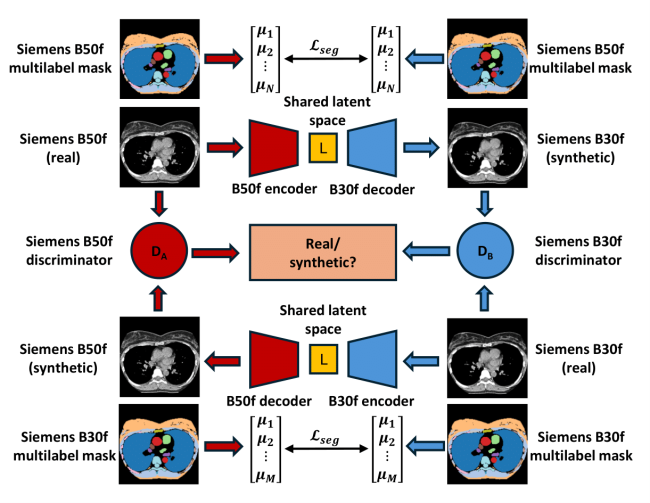
Figure: For any given pair of reconstruction kernels, the generator is a ResNet, formed
by a source encoder and target decoder in the forward path and a target encoder
and source decoder in the backward path. Each generator produces a synthetic
image with the style of either the source or target kernel. A PatchGAN is used
as a discriminator for the corresponding domain to distinguish between real and
synthetic images. The mean of all unique labels are computed using the multilabel
masks for the real and synthetic image and are penalized such that the anatomy
remains preserved in the harmonized image.